


 العربية
  English (UK)
  Русский
  日本語
日本語  한국어
한국어  Magyar
  Türkçe
  Español
  Čeština
  Svenska
  Português
  Ελληνικά
  Suomi
Suomi  Nederlands
  Română
  Italiano
  Français
  Polski
  Українська
  Deutsch
  简体中文
简体中文  Slovenčina
 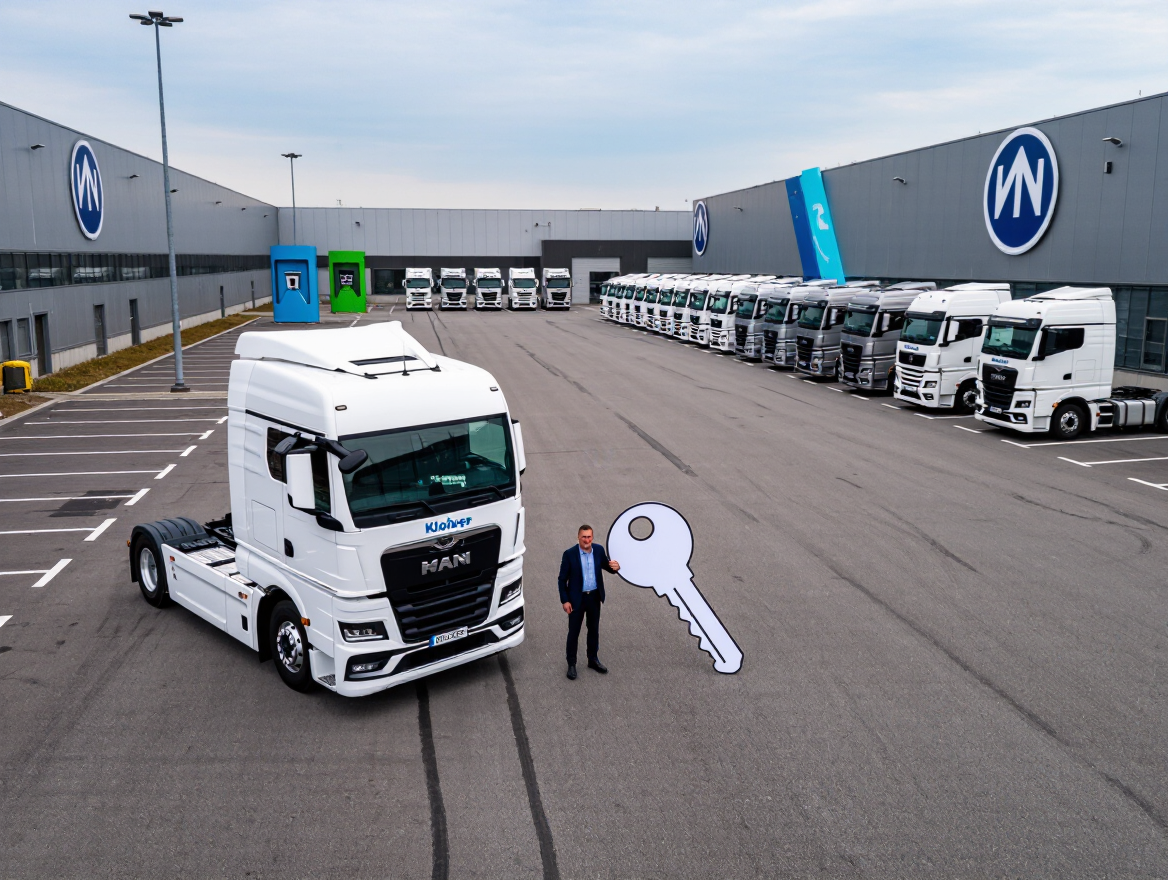 كلوبر تطلق أول شاحنة MAN الكهربائية كجزء من دفعة لتكهرب 15 شاحنة لـ MAN">

Electric inbound transport: what just started
The logistics firm Kloiber has introduced the first of 15 MAN eTrucks into regular service for MAN’s inbound transport between the Nuremberg and Munich plants, marking a clear step toward electrified supply chains.
How the new operation works
These fully electric MAN eTGX tractors will run scheduled shuttles between the factories, covering a round trip of about 328 km. Typical daily usage falls in the range of 1,300–1,900 km, with each truck completing four to six round trips a day.
| Item | Figure | الملاحظات |
|---|---|---|
| Round-trip distance | 328 km | Nuremberg ↔ Munich |
| Daily mileage (typical) | 1,300–1,900 km | 4–6 round trips |
| Estimated annual CO₂ saving | up to 566 tCO₂ | per truck, using 100% green electricity |
| High-power chargers (MAN Munich) | 4 × up to 400 kW | Munich-Karlsfeld service center |
| Kloiber private charging park | 10 × up to 500 kW | Petershausen near Dachau |
Charging infrastructure: close to the load and fast
MAN upgraded the charging infrastructure at its Nuremberg and Munich plants so the eTrucks can recharge rapidly and often right next to unloading. The Munich-Karlsfeld service center now hosts four high-power chargers up to 400 kW, designed with space for articulated trucks and trailers. The Dachau site also received appropriate charging upgrades.
Complementing the factory efforts, Kloiber built its own commercial vehicle charging park in Petershausen with 10 charging stations rated up to 500 kW each, ensuring quick turnaround for operations that can’t afford long waits.
Vehicle specs tailored to automotive logistics
The chosen MAN eTGX is supplied in an ultralow configuration ideal for automotive transport: a fifth-wheel height of just 950 mm and a short wheelbase of 3.75 m allow for maximum usable volume and internal height up to three meters — a real advantage when payload volume matters more than a few centimetres of ground clearance.
Planning, tendering and rollout
MAN launched a tender in early 2025 covering the first 40 routes of inbound logistics to be run with battery-electric vehicles (BEVs). Kloiber won responsibility for eight routes, while other logistics providers took further allocations. MAN expects additional tenders to roll out through to the end of 2026.
- حلول النقل من MAN provided route-by-route consultancy, offering autonomy and consumption data specific to each connection.
- Custom charging concepts were prepared for each route to ensure operational feasibility.
- Decisions were driven by total cost of ownership and route practicality, not just headline emissions numbers.
Why this matters to logistics operators
Electrifying high-frequency shuttle routes is not just a green badge; it reshuffles the logistics playbook. When vehicles recharge at points close to loading and unloading zones, scheduling, yard layout and turnaround windows all change. Freight planners need to balance energy availability, charging power and daily mileage—essentially swapping some diesel planning routines for an electrical operations mindset.
الآثار العملية
Key takeaways for transport managers:
- Route-specific energy modelling becomes as critical as route timing.
- Depot and plant layout must offer safe, manoeuvrable access to high-power chargers.
- Maintenance, driver training and charging contracts are new pillars of fleet reliability.
Environmental and economic outcomes
استخدام 100% renewable electricity for these eTrucks yields substantial local emission savings and contributes to broader decarbonization targets across MAN’s inbound network, which sees up to 165 million km per year. MAN frames electrification as essential to reaching zero-emission transport and sustainable profitability: operational tests with the MAN eTGX are already demonstrating both environmental and cost advantages in practice.
Challenges ahead
Electric haulage is not a silver bullet. The main pain points to watch:
- Grid capacity and local permitting for large chargers.
- Predicting battery consumption under real-world loading and weather.
- Integrating charging windows into tight inbound schedules without harming throughput.
Still, as they say, you learn to walk before you run — or in this case, plug in and then hit the road running.
Highlights and a realistic invitation
The rollout highlights the tangible benefits of electrified freight: large CO₂ savings, quieter yards, and predictable energy costs when paired with renewables. But remember: no matter how glowing the reviews, nothing beats firsthand experience. On GetTransport.com, you can order your cargo transportation at the best prices globally at reasonable prices. This empowers you to test electric or conventional transport options without overspending and to compare real-world performance. The platform’s transparency, wide choice, and convenience make it easier to plan routes, arrange bulky or vehicle transport, and move office or home loads—so you don’t have to learn everything the hard way. Start planning your next delivery and secure your cargo with GetTransport.com. Book now GetTransport.com.com.com
Summary: Kloiber’s introduction of the first MAN eTrucks for inbound shuttles between Nuremberg and Munich marks a practical step toward decarbonised logistics. Upgraded charging at plants, a dedicated high-power park, and route-specific planning led by MAN Transport Solutions make this rollout feasible. For supply chain managers, the shift means adding energy planning to the usual mix of timing, load and maintenance; for operators, it promises reduced emissions and operational cost benefits. Whether you’re assessing freight, shipment options, container or pallet haulage, moving bulky items, vehicle transport or full-scale relocation, the move to electric freight demands new thinking but delivers clear rewards. In short: electric trucks are already reshaping transport, forwarding and distribution—offering reliable, global, and cost-effective solutions for cargo, courier and moving needs.