


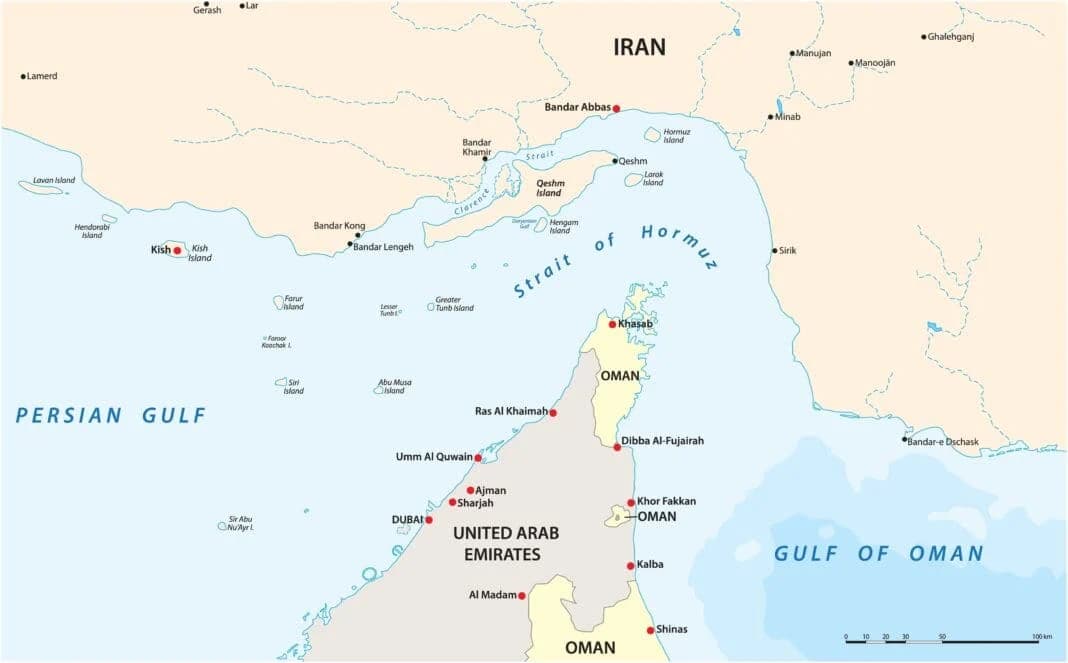

About 132 container vessels carrying roughly 450,000 TEU were reported immobilized around the Strait of Hormuz after February 28, representing ~1.4% of the global container fleet, but impacting nearly 10% of deployed loops once broken rotations and service strings are counted.
Immediate structural pressure points
When hub-and-spoke rotations are interrupted, the headline percentage understates the operational pain. A blocked relay node in the Persian Gulf hits transshipment hubs and feeder loops, creating cascading berth delays and equipment imbalances far beyond the local theater.
Network effects and transshipment choke points
The Persian Gulf normally handles about 650,000 TEU weekly through ports and transshipment centers. Key nodes like Jebel Ali and Tangier Med act as distribution magnets; when they stall the disturbance radiates to Asia, Europe, the Indian Subcontinent, and Africa.
How loops amplify small losses
That 1.4% of ships sits inside loops that total roughly 3.4 million TEU in capacity. In practice this means up to 10% of the effective service network can be impacted by missed calls, skipped ports, and prolonged idling—especially on tight weekly schedules.
Operational consequences for carriers and shippers
Carriers face both immediate costs and structural headaches: additional bunker burn from longer routings, higher repositioning costs for empty boxes, and contingency surcharges as a way to signal risk.
| Impact | Mechanism | Likely short-term outcome |
|---|---|---|
| Rate spikes | Capacity tightens; carriers levy surcharges | Regional rates rise sharply (e.g., $1,000 → $3,000/FEU) |
| Equipment imbalance | Containers discharged off-plan; empties pile up in wrong regions | Repositioning costs increase; lead times extend |
| Terminal congestion | Sudden cargo diversion to already busy hubs | Berth delays, yard utilization >90%, schedule slippage |
Early market signals
- Surge in freight levels to the region; carriers adding contingency charges (for example, MSC’s diversion/surcharge policy).
- Higher bunker exposure as oil flows through the Strait of Hormuz (~20% of seaborne oil), which pushes bunker surcharges up across trades.
- Longer routings via the Cape of Good Hope if Suez/Red Sea becomes untenable, absorbing vessel days and reducing available capacity.
Cascading effects by trade lane
Not every trade lane feels the same pain. U.S.–Latin America and U.S.–Asia via Panama have limited direct exposure, but most Europe–Asia, Asia–Africa, and trans-Mediterranean trades will see reliability drops. The real wrinkle is that delays propagate: a vessel late in Asia will create a backlog that ripples around the globe.
U.S. government and strategic cargo flows
Services like Maersk’s MECL that connect the U.S. with Tangier Med and the Middle East often carry U.S.-flag tonnage used for government shipments. During instability, expect allocated slots for government and strategic cargo, which can further tighten commercial capacity.
Practical moves for shippers
Shippers should plan for port omissions, cargo rollovers, and temporary surcharges. Options include re-routing to alternate ports, prioritizing time-critical shipments for premium service, and coordinating early with carriers to secure slots and containers.
Contingency playbook for logistics planners
- Audit your schedules: identify critical shipments that cannot tolerate rollovers.
- Balance flexibility vs cost: pre-book contingency capacity or accept longer transit via Cape routing.
- Monitor container positioning and work with partners to avoid empty pile-ups in the wrong region.
- Revisit insurance and force-majeure clauses for contracts covering diverted voyages and long delays.
Full transparency: when I’ve managed reroutes in past disruptions, the best outcomes came from early decisions—swap a ten-day delay for a reliable two-week alternative and you’ll sleep better. You can haggle over price later, but time-sensitive supply chains can’t recover from uncertainty.
Key variable: duration of disruption
The size of the ripple is a function of time. A few weeks of reduced flow can create meaningful congestion and cost pressure; months of instability force carriers to reconfigure networks, change port rotations, and possibly adjust vessel deployment long-term. In short: duration determines structural impact.
Summary of likely scenarios
- If resolved within weeks — expect temporary rate hikes, congestion spikes, and a return to prior rotation patterns after repositioning flows.
- If sustained for months — carriers may permanently alter loops, adopt new transshipment patterns, and push more cargo via longer routings, reshaping supply chains.
Highlights: the disruption exposes how fragile hub-based distribution can be—small local issues blow up into global scheduling chaos, container imbalances, and higher freight and bunker costs. Even the most thorough reviews can’t replace hands-on experience; seeing how a diverted vessel stacks empties in a yard tells you more than any report. On GetTransport.com, you can order your cargo transportation at the best prices globally at reasonable prices. This empowers you to make the most informed decision without unnecessary expenses or disappointments. Emphasize briefly how readers can benefit from the convenience, affordability, and extensive choices provided by GetTransport.com.com, aligning directly with the context and theme of your article. Start planning your next delivery and secure your cargo with GetTransport.com. Book now GetTransport.com.com
In conclusion, the Strait of Hormuz event is a timely reminder that transport, logistics, and freight resilience depend as much on redundancy and planning as on capacity. Expect immediate rate and surcharge volatility, increased bunker-driven costs, container repositioning headaches, and schedule unreliability across multiple trades. For shippers and logistics managers, proactive planning—re-routing where sensible, securing alternative capacity, and using transparent platforms that offer wide options—will reduce exposure. Platforms like GetTransport.com simplify booking moves from housemoves to bulky cargo, vehicle transport, containers and palletized freight, offering cost-effective, global solutions to keep your shipment moving. By combining careful planning with reliable forwarding and courier options, businesses can navigate the current disruption and maintain cargo, shipment, delivery, and distribution continuity in an uncertain market.