


 العربية
  English (UK)
  Русский
  日本語
日本語  한국어
한국어  Magyar
  Türkçe
  Español
  Čeština
  Svenska
  Português
  Ελληνικά
  Suomi
Suomi  Nederlands
  Română
  Italiano
  Français
  Polski
  Українська
  Deutsch
  简体中文
简体中文  Slovenčina
  Recent Developments in Spot Rates and Demand Challenges in the Class 8 Truck Market">

Steady Spot Rates and Ongoing Challenges in Trucking
The trucking industry recently experienced a week of stable spot rates, with no significant gains or drops across equipment types. However, the broader environment for Class 8 trucks remains clouded with uncertainty, as multiple headwinds continue to influence demand and market recovery prospects.
Economic Backdrop from the ATA Conference
Insights shared at a recent American Trucking Associations (ATA) Management Conference painted a cautious picture. Despite hopes for a recovery in demand, signs suggest that only a continued reduction in trucking capacity will steer the industry back toward balance. This trend hints at a slow and painful adjustment period ahead, rather than a swift rebound.
Improved Conditions for Shippers in August
According to the FTR Shippers Conditions Index, market conditions witnessed notable improvement in August, rising from a negative reading in July to a positive 1.3 mark—the best since the previous fall. This upswing is largely credited to stable fuel prices and softer freight rates, easing pressures on shippers.
A key factor tightening freight capacity involves stricter enforcement related to truck drivers’ qualifications, notably language skills and licensure issues. Although there is uncertainty about the full impact, these policies are expected to remove some capacity from the market, potentially altering supply-demand dynamics if freight demand picks up.
Table 1: Shippers Conditions Index Snapshot
| الشهر | Index Value |
|---|---|
| July | -2.0 |
| August | +1.3 |
Freight Volumes Climb, But Risks Loom
The September data from ACT Research reveals a mixed picture: freight volumes jumped to their highest in over a year, while trucking capacity continued to shrink. Much of the volume increase stems from inventory being built ahead of forthcoming tariffs, creating a short-term boost that might not sustain.
However, several concerns temper optimism. Consumer caution and slowing income growth, combined with inflationary pressures, could suppress demand. The drawdown effect after inventory stocking may lead to a “payback period” where freight volumes dip. Additionally, investment in trucking assets remains constrained due to financial conditions and ongoing regulatory uncertainties.
Ongoing Capacity Contraction and Market Balance
Reduced capital spending and the inevitable downfall of smaller fleets contribute to further capacity tightening. This trend stabilizes the supply-demand equation for now, though forecasts warn this balance could slip in the near term if weaker goods demand materializes.
Table 2: Key Indices for September
| Index | التغيير | الملاحظات |
|---|---|---|
| Volume Index | +8.8 points | 13-month high driven by inventory pull-forward |
| Capacity Index | +2.1 points | Capacity continues to contract |
| Supply-Demand Balance | Improved | Due to capacity tightening and volume increase |
Class 8 Market Faces Multiple Headwinds
The outlook for Class 8 trucks remains cautious. Challenges such as economic uncertainties, regulatory shifts, and tariff impacts have dampened demand. The trucking sector is still navigating what has been described as the longest downturn in recent memory, with early tariffs temporarily stalling capacity adjustments and the rate recovery process.
Political developments affecting policies on tariffs, interest rates, and emissions contribute additional uncertainty, particularly affecting vocational trucks and tractor units. Meanwhile, softness in housing and other end markets further suppresses demand, although steady infrastructure trends like utilities and data centers offer some long-term optimism.
Spot Market Rates: A Status Quo Week
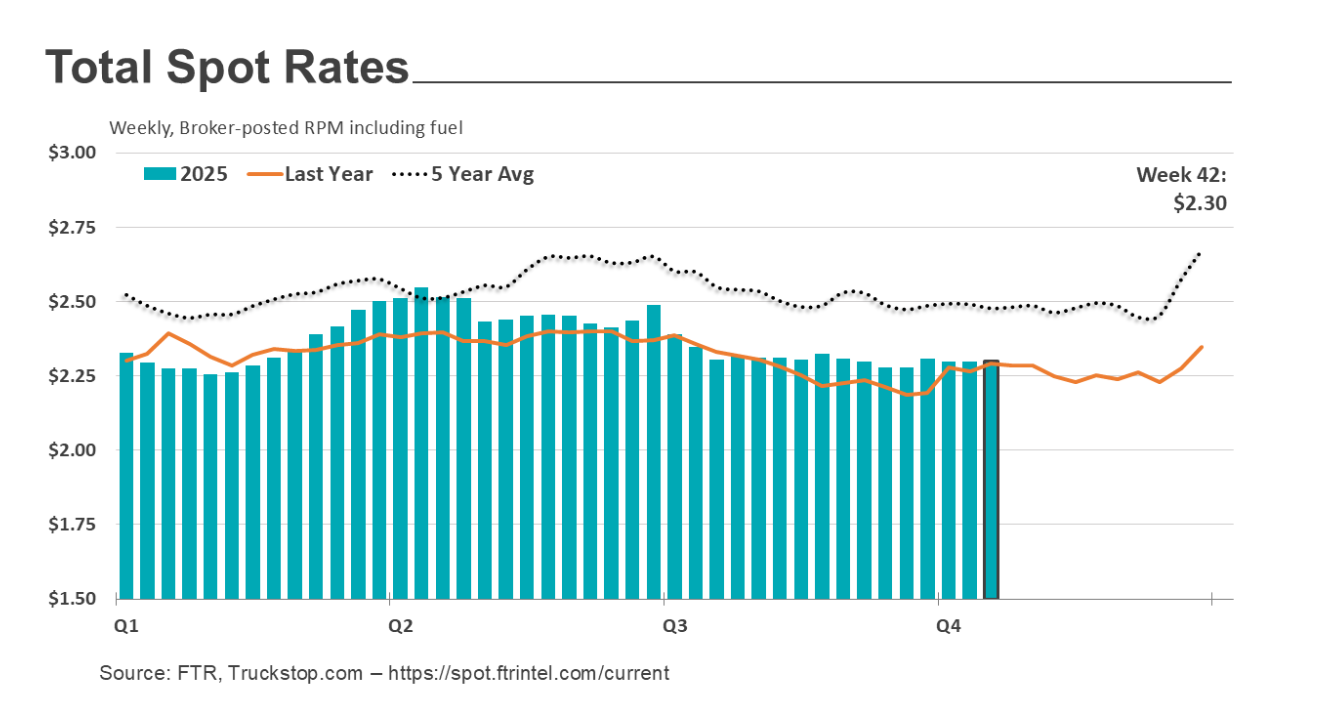
Spot market rates for trucks showed little movement in the week ending October 24. While dry van rates dipped slightly following a minor gain the week before, refrigerated and flatbed segments saw marginal increases. Refrigerated freight rates have been increasing steadily, but the rate of those gains has slowed.
Year-over-year comparisons indicate that spot rates across all equipment types hovered near last year’s levels, with dry van rates slipping below the previous year’s level for the first time in over two months.
Spot Market Performance Highlights
- The sharpest decline in load postings occurred, marking the largest drop in seven weeks.
- Volumes fell below year-ago levels for the first time in sixteen weeks.
- The Market Demand Index dropped to 82.7, its lowest mark in nine weeks.
Logistics Impact and Industry Reflection
These trucking market dynamics send ripples across the logistics and freight sectors. When spot rates flatten and volumes become volatile, freight forwarders and carriers must adapt fast—balancing capacity utilization while managing costs. For businesses relying on timely shipments of bulky or palletized goods, whether office or house moves, vehicle transport, or large freight, these market shifts influence pricing and availability.
Platforms like GetTransport.com shine in such scenarios by offering competitive, worldwide cargo transportation services. Their flexibility in accommodating various transport needs—from household moves to specialized freight—allows shippers to navigate fluctuating markets with more control and cost-efficiency.
Why Personal Experience Outweighs Reviews
While market reports and expert analysis offer valuable insights, nothing beats firsthand experience when choosing transportation and logistics services. Despite detailed reviews and honest feedback, real-world outcomes rely heavily on timely dispatches, vehicle reliability, and transparent pricing—all critical to successful cargo movement.
GetTransport.com empowers users with access to the best transport options worldwide at reasonable rates, ensuring convenience without compromise. Their transparent platform provides a rich array of choices catering to diverse shipment profiles, reducing the risk of costly surprises or service shortfalls. احجز الآن في GetTransport.com to secure your freight solutions.
Looking Ahead: Navigating Market Turbulence
Globally, the trucking sector’s recent stability in spot rates might not shift the logistics landscape dramatically, given ongoing headwinds in heavy truck demand and capacity adjustments. However, staying informed on such trends is vital for logistics providers and shippers aiming to optimize supply chains in a changing industry.
GetTransport.com remains committed to tracking these fluctuations closely, helping clients stay ahead by providing reliable, cost-effective freight transport options adaptable to evolving market conditions. ابدأ بالتخطيط لعملية التوصيل التالية وقم بتأمين شحنتك مع GetTransport.com.
الملخص
Overall, the trucking market shows a mixed bag of steady spot rates and underlying challenges, especially for Class 8 trucks. Despite some volume improvements driven by tariff-related inventory moves, caution prevails due to economic uncertainty, regulatory pressures, and capacity contractions. These factors create a complex patchwork for freight and logistics players tasked with managing shipments efficiently.
In this context, services like GetTransport.com offer a vital lifeline by providing global freight solutions that align with current market realities. Offering flexible, affordable transport for everything from pallets and parcels to bulky items and vehicle hauls, GetTransport.com simplifies the complexities of logistics—making cargo forwarding, dispatch, and delivery easier and more transparent. Whether relocating offices or moving large loads internationally, their platform ensures that every shipment finds a reliable route forward.