


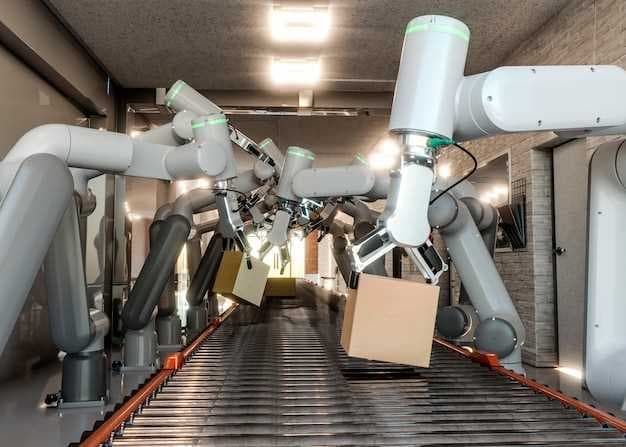

Recommendation: implement adaptive AMR robots with modular routing and interchangeable gripper modules to reconfigure the warehouse workflow in minutes, strengthening warehouse automation across changing layouts. This approach keeps material movement steady when demand or layout shifts occur, reducing downtime and the need for manual rerouting by technicians.
Testing protocols at a controlled site and then in a live warehouse setting illuminate where gains occur. Track metrics such as cycle time, pick rate, error rate, and resources allocation. In this phase, technicians observe a reduced manual handling load, and some tasks shift from human labor to robotic assistance. The data should show that changes are achievable across the sector and across different shifts.
In a climate where disruptions ripple through supply chains, resilience hinges on changing routes and continuously updating data. Adaptive AMR fleets pave the path for stable flow by dynamically reassigning tasks as orders arrive and stock moves shift. Operators in the industry and across the sector rely on real-time visibility to keep shipments within target windows.
Technicians and operators collaborate with automation to tune the workflow design. By documenting changes, teams can repeat success across warehouses and scaling sites. Some facilities report equally large gains in throughput when routines are standardized, with resources allocated to the highest-value moves while keeping risk low. This approach enables reduced setup time and some flexibility in gripper modules.
Implement this approach in a staged manner, monitor results, and iterate every two weeks. Align with technicians, facility managers, and the automation team to keep the workflow moving, while ensuring safety and compliance. With a disciplined mix of testing, data, and hands-on practice, resilience grows across the industry and sector alike, paving a path toward stable performance in the face of changing conditions.
Flexibility as Strategy for Resilient Material Handling in AMR-Driven Warehouses
Adopt a dynamic, data-driven routing policy that reallocates tasks in real time to align the autonomous fleet with demand, increasing throughput and reliability. This approach raises predictability across shifts and reduces strain on critical areas.
This configuration helps the AMR fleet perform consistently even under rapid demand shifts, offering a clear value proposition to operators and stakeholders.
Example deployment plan:
- Phase 1: In a two-warehouse e-commerce fulfillment center, implement real-time task reallocation with SLA targets of 98% order readiness within 60 minutes for standard SKUs and 95% for priority orders. This yields a 12–18% lift in on-time picks and a 6–10% reduction in travel distance per pick.
- Phase 2: Extend to replenishment and dock-to-stock paths, adding a security layer to prevent tampering and ensuring data integrity on movement logs.
- Phase 3: Scale to additional facilities, establishing scalable rules that adapt to seasonality and market trends while maintaining quality and safety standards.
Key components to implement:
- Align maintenance with usage: schedule preventive maintenance every 250 hours of operation; replace critical wear items preemptively to keep availability above 98%.
- Strategically couple AMR routing with inventory data to improve accuracy; integrate with WMS to update order status in near real-time.
- Initiatives for resilience: cross-train staff, create incident playbooks, and run quarterly drills to test response to AMR faults or network outages.
- Areas to optimize: picking zones, packing corridors, cross-docks; allocate dedicated AMR sub-fleets to high-velocity lines to reduce congestion.
- Dynamic scheduling: use AI-based forecasting to anticipate demand spikes; adjust fleet size and route density accordingly.
- Scalable architecture: modular AMR units with swappable batteries and sensors; easy reconfiguration for new layouts or product mixes.
- Pressure management: implement lane prioritization and queuing rules to prevent pileups during peak hours; monitor queue lengths and adjust thresholds.
- Security considerations: segment networks, enforce least-privilege access, and monitor anomaly detection signals to prevent tampering.
- Quality controls: continuously monitor picking accuracy with sensor checks and barcode verification; integrate quality gates into the AMR workflow.
- Layers of redundancy: duplicate critical paths and fallback modes for manual override if needed.
By weaving these initiatives into your strategies, warehouses achieve higher reliability, better performance, and a steadier service level for e-commerce orders, with a data-driven framework that scales as operations grow. Leading facilities report average order cycle times reduced by 15–22% and a 10–15% increase in picking accuracy after three months of rollout.
Key metrics to monitor include throughput per hour, on-time delivery rate, AMR fleet uptime, average travel distance per task, and overall maintenance downtime. Align these indicators with continuous feedback loops to refine routes, zones, and maintenance windows, ensuring scalability as the operation expands.
Adaptive Path Planning for Dynamic Warehouse Layouts

Start with a hybrid path planning approach: offline global routes for static zones, and real-time local adjustments driven by perception data. Build a concise training program for professionals and a manual that captures specific parameters, thresholds, and fallback modes your teams should apply in the field. Your collaboration across robotics, technology, and operations becomes a cornerstone of the rollout. Set goals to minimize travel time, balance workload, and sustain throughput as layouts shift. Develop a climate of rapid testing and continuous improvement. Movement patterns adapt as aisles widen or close; turning decisions happen at intersections. Design the systems to maximize available capacity and limit bottlenecks rooted in past layouts. Like turning points for material handling, the adaptive planner transforms how tasks flow.
Implementation steps include: map current layout and inventory zones; run offline simulations that model dynamic obstacles; deploy real-time re-planning; monitor key metrics such as average route length, replan frequency, collision rate, and robot utilization; and tune parameters through iterative testing. Initiatives should start in a single zone, with continuous data collection and feedback loops. When demand spikes or aisles are temporarily reconfigured, the planner should adjust routes within seconds and communicate conflicts to operators via a shared interface. Your technology stack should support sensor fusion, a world model, and a lightweight local planner that can operate alongside existing systems.
| Component | Function | Key Metrics |
|---|---|---|
| Global Path Layer | Computes long-range routes across stable zones; updates when layout changes detected by sensors | Average route length, plan stability, replan frequency |
| Local Replanner | Adjusts routes in real time to dynamic obstacles and congestion; feeds back to the global layer | Response time, success rate, congestion avoidance |
| World Model & Data Pipeline | Fuses LIDAR/camera data with map updates; maintains semantic labeling for zones and racks | Data freshness, drift, cue accuracy |
| Human-in-the-Loop & Overrides | Provides safety constraints and manual override when needed | Override rate, mean time to override, operator confidence |
| Governance & Testing Framework | Runs simulations, bench tests, and live trials; tracks coverage and risk indicators | Test pass rate, incident count, change adoption |
These components align with a training-and-initiatives program that expands from one zone to the entire facility. By building collaboration into the process, you turn adaptive planning into a repeatable capability rather than a one-off project.
Real-Time Task Reallocation Across Interdependent Robots
Implement a centralized real-time task allocator that continuously reallocates tasks across agvs and interdependent robots to maximize throughput while maintaining safety. Use optimized routing and load-balancing rules that consider current movement, task priorities, and deadlines. This approach reduces pain from idle times and queue buildup and yields measurable results in production lines.
In practice, connect software to live streams from sensors, agvs, and fixed manipulators. A pilot deployment on a single line shows how cross-robot reallocation reduces average task time by 12-15%, cuts travel distance by 22%, and increases overall production by 8-10%, all while keeping incidents safely at zero. These technologies enable the system to respond to disruption, align roles, and preserve goods flow.
Mechanics: The allocator builds an execution plan that respects task dependencies and movement constraints, then issues real-time reallocations to robots and agvs. The software uses feedback from sensors to update the plan every few hundred milliseconds, increasing predictability and reducing conflict between aisles. It supports retrieval tasks, prioritizing urgent pickups and balancing load across the network. The built-in safeguards pause tasks when a safety condition triggers, ensuring operations are safe and compliant. This aligns with the nature of interdependent processes, where small delays ripple through the line.
Deployment guidance: define roles and guardrails, and log decisions for annual review. Begin with a controlled pilot on a single line, then scale to additional lines as the software proves its reliability. Ensure the monitoring stack provides visibility into throughput, pain points, and ROI, so you can adjust rules to reflect demand and the nature of the line.
Beyond initial deployment, establish a cadence for improvements: annually refresh models, incorporate operator feedback, and invest in training to expand the ability of teams to configure and extend the software. The result is a powerful, adaptable capability that keeps goods moving, improves predictability, and supports resilient production networks.
Human–Robot Collaboration: Safe Handovers and Shared Work Zones
Recommendation: implement dedicated, clearly marked handover stations at shared work zones, requiring mutual acknowledgment between operator and AMR before any payload is passed. Having built-in safety interlocks and visual signals, these stations reduce ambiguity and cut handover time.
In facilities serving e-commerce fulfillment, scalable AMR fleets reduced injuries in handover zones by 30–40% after standardizing the protocol, and handover-related errors declined by more than 50%. These gains significantly boost competitiveness by shortening cycle times and improving overall throughput.
Design shared zones for efficiency: align robot routes with human paths, use physical and visual cues, perform a multifaceted risk assessment, and enforce a constant dwell time at handover points. Also create clearly separated lanes when possible to protect pedestrians and minimize cross-traffic that can lead to things colliding.
Algorithms drive coordination: a two-layer control stack plans task sequences and time windows, while edge algorithms handle immediate collision checks and safe speeds. This setup lets operations operate with less waiting and reduces error opportunities, and the controller can easily adapt to new tasks.
People and machines share responsibilities: operators gain clear handover duties, while AMRs handle payload transfer, detection, and safe-zone monitoring. Safety plays a critical role, and continuous training and simulation sessions reduce injuries and reinforce safe habits, especially in labor-intensive facilities where tasks are physically demanding.
Measurement and improvement: track constant metrics such as dwell time, handover error rate, and throughput, then adjust zone layouts, retrain algorithms, and scale the solution across facilities. Regular audits help ensure that safety margins remain robust as new lines come online.
Operational tips: map zones with high footfall, install reliable lighting and signage, and deploy pause signals in the shared zone. Involve front-line workers in redesign sessions and keep spare parts and PPE readily available to minimize downtime and keep operations continuously productive.
Power, Charging, and Runtime Management for 24/7 Availability
Just implement a centralized charging policy with smart scheduling and modular chargers to guarantee 24/7 availability for your AMR fleet. This enabling framework covers the essential aspects of power, charging, and runtime, and it thrives in modern facilities where human and robot teams operate together. It will require clear rules for task prioritization, pilot tests to validate settings, and active involvement from staff and managers to sustain improvements.
Adopting flexible charging layouts and swappable energy packs reduces idle time and keeps lines moving. Use high-rate charging where appropriate, pair it with regular battery health checks and robust thermal management, and maintain a dashboard that flags anomalies before a halt. The complexities of runtime rise with changing demand across shifts, so grasping these patterns enables lifting throughput while limiting battery wear.
Pilot a two-line rollout with defined success metrics: uptime target, dock utilization, and average charging time per robot. Track energy cost per cycle, state of charge at shift start, and outage rate. Increasingly, operators will rely on live dashboards and alerts to act quickly, and managers can adjust priorities on the fly. Also train staff to swap packs safely and to isolate faults efficiently.
Partner with facilities and service firms such as cbre and santagate to design charging zones that align with grid capacity. Ensure electrical resilience with backup power, automatic fault isolation, and scheduled maintenance to keep the fleet ready. Alongside this, build a continuous improvement loop: managers review pilot results, update policies, and scale proven tactics across the fleet. This approach keeps flexible operations reliable while sustaining lifting performance in demanding environments.
Payload Agility: Handling Mixed Containers, Odd Shapes, and Non-Standard Loads
Deploy a modular, payload-aware gripper platform that swaps tool sets in under 5 minutes, enabling rapid handling of mixed containers and non-standard loads. This approach aligns with consumer packaging changes and manufacturing workflows, delivering resilient, ongoing operational performance.
- Modular gripping architecture: three interchangeable arms and finger assemblies, plus suction heads and soft pads, with smart grip logic. This design covers payloads from 0.5 kg to 60 kg and reduces tool-change time, improving arms and parts availability and minimizing line stops.
- Payload taxonomy and adaptive control: define six load classes (totes, crates, bottles, irregular bundles, long shapes, bulk bags) with defined contact points, CG, and recommended grip geometry. The software uses real-time 3D vision to classify loads and trigger grip recipes, offering a clear path for sortation optimization. The system adds payload intelligence to inform grip decisions and guide continuous learning.
- Sensor fusion and data-driven policy: fuse 3D cameras, force-torque sensors, and tactile arrays to adjust grip pose and force in real time. Continuously learn from every cycle to improve policies; the software often leverages AI to adapt to packaging changes and dynamic lines.
- Handling non-standard loads and shapes: adaptive fingers with soft pads, flexible suction heads for flat surfaces, and multi-point contact to stabilize protrusions up to 180 mm. This approach is particularly successful for irregular items, reducing slippage and maintaining grip during CG shifts of up to 35 mm.
- Operational readiness and workforce engagement: invest in software updates and ongoing training for personnel; dashboards display grip success rate, cycle time, and error rate. Maintain spare parts inventory to keep changeover times to minutes rather than hours, and ensure cross-functional coordination between maintenance and operations.
- Performance metrics and continuous improvement: typical tote handling times 6–12 seconds per item, irregular shapes 12–18 seconds; grip success rates 98% for standard totes and 92% for irregular shapes. Surges in orders trigger automated reallocation via sortation and route optimization, reducing line congestion and increasing throughput.
To sustain gains, couple this with ongoing simulation-based testing and continuous data collection to refine load profiles and grip recipes for consumer-facing lines.