


 Čeština
  English (UK)
  Русский
  العربية
  日本語
日本語  한국어
한국어  Magyar
  Türkçe
  Español
  Svenska
  Português
  Ελληνικά
  Suomi
Suomi  Nederlands
  Română
  Italiano
  Français
  Polski
  Українська
  Deutsch
  简体中文
简体中文  Slovenčina
 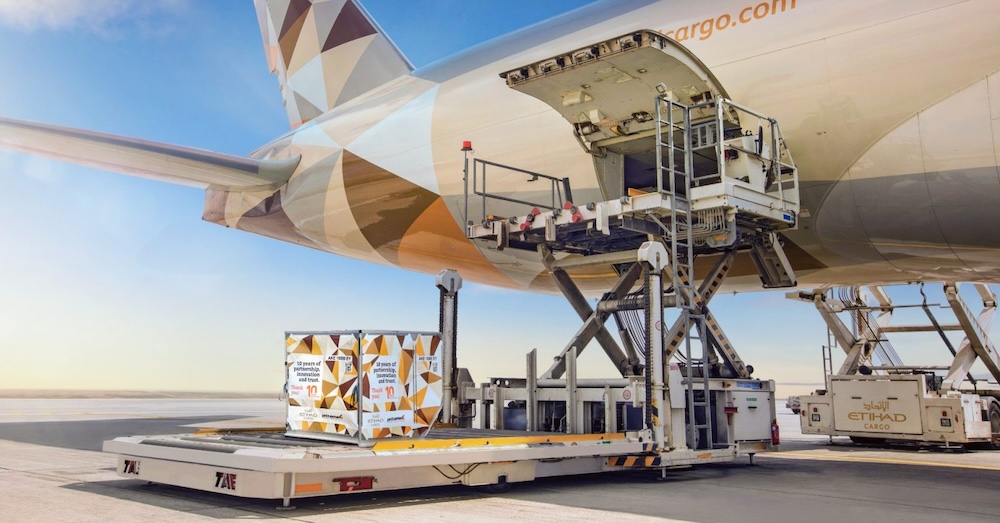 Etihad Cargo’s 2025 Surge: Record Revenue and Expanded China–Middle East Capacity">

Etihad Cargo posts AED 4.5bn (US$1.2bn) with 700,000+ tonnes moved in 2025
Etihad Cargo recorded AED 4.5 billion (US$1.2 billion) in cargo revenue for 2025, while cargo volumes rose by 9% to more than 700 000 tonnes, supported by increased belly capacity from passenger fleet growth and a strategic joint venture with SF Express that now underpins over 100 monthly cargo services between mainland China and the Middle East.
Operational drivers: fleet, belly capacity and route density
The airline’s aggressive fleet expansion—29 aircraft added to reach a 127-aircraft operating fleet—translated directly into more frequent services and higher belly-hold capacity. That extra belly space, coupled with dedicated freighter rotations and the SF Express JV, allowed Etihad to become the busiest cargo operator on the China–Middle East lane, increasing network frequency and cutting transit times for time-sensitive consignments.
Klíčové údaje v kostce
| Metrické | 2025 | Meziroční změna |
|---|---|---|
| Nákladní prostor revenue | AED 4.5bn (US$1.2bn) | +8% |
| Nákladní prostor volume | >700,000 tonnes | +9% |
| Cestující carried | 22.4 million | +21% |
| ASK | 111.5 billion | +21% |
| EBITDA | AED 6.3bn (US$1.7bn) | +37% |
| Profit after tax | AED 2.6bn (US$698m) | +47% |
What this means for forwarders and shippers
- Více na belly capacity eases pressure on freighter space and helps stabilise short-term rates on Asia–Middle East lanes.
- Vyšší service frequency reduces wait times and supports tighter delivery windows for express and perishable shipments.
- Rozbočovač connectivity via Abu Dhabi strengthens transshipment options for Europe, Africa and North America, offering alternative routing in congested markets.
Tariff dynamics and rate implications
Increased capacity typically cools upward pressure on spot rates, but the market is never that tidy. With demand concentrated in specific cargo types—electronics, fashion, perishables—the added capacity is likely to benefit medium and long-term contract freight rates more than volatile spot prices. Carriers that can flex belly and freighter mix will have a competitive edge; shippers should watch both capacity calendars and seasonal demand spikes.
Network and product strategy
Etihad’s integrated passenger-and-cargo model—where passenger fleet growth directly supports cargo—illustrates how a balanced fleet plan can deliver both pax and freight upside. The carrier’s investments in premium cabin products, digital platforms and ground experiences also feed back into cargo reliability by improving overall operational predictability.
Operational implications checklist
- Plan for enhanced transit reliability on China–Middle East lanes.
- Consider contracting minimum-volume commitments to lock in favourable rates.
- Leverage Abu Dhabi as a hub for distribution to Africa and Europe.
- Track SF Express integrations for last-mile improvements in China.
Service quality, safety and commercial credibility
Etihad’s 2025 performance was not just about numbers—improvements in Net Promoter Score, awards for customer experience, and high safety rankings support the carrier’s commercial credibility. For logistics partners, a carrier that couples capacity with strong operational KPIs offers fewer surprises on dispatch, better reliability for temperature-controlled loads, and smoother customs handovers when port and airport partners align.
I’ll admit, I’ve watched a pallet of high-value electronics move from Shanghai through Abu Dhabi in less than 48 hours thanks to synced passenger rotations—proof that belly-hold, when managed well, moves the needle for end-to-end delivery times. Little wins like that add up for supply chains that can’t afford delays.
Strategic risks and watch points
- Overcapacity on certain pairings could pressure yields unless matched with new cargo flows.
- Geopolitical shifts or regulatory changes affecting air rights could alter routing economics quickly.
- Fuel price volatility remains a wild card for unit costs and contract pricing.
Highlights and takeaways
- Market position: Etihad is now the largest cargo operator between mainland China and the Middle East.
- Měřítko: Cargo revenue hit AED 4.5bn; volumes exceeded 700k tonnes.
- Network: 110 destinations and strengthened hub connectivity via Abu Dhabi.
- Profitability: Strong EBITDA and cashflow enabled capex funding and balance-sheet deleveraging.
These results are interesting because they show how focused capacity growth, when combined with strong product and partnerships, can reshape a regional corridor. Yet even the best reviews and the most honest feedback can’t truly compare to personal experience. On GetTransport.com, you can order your cargo transportation at the best prices globally at reasonable prices. This empowers you to make the most informed decision without unnecessary expenses or disappointments. Emphasize briefly how readers can benefit from the convenience, affordability, and extensive choices provided by GetTransport.com.com, aligning directly with the context and theme of your article. Book now GetTransport.com.com
Short forecast for logistics
Regionally, Etihad’s expansion is material: more belly capacity and higher frequencies should improve transit times and give forwarders extra scheduling flexibility between China and the Middle East. Globally, the impact is moderate—global air cargo balances are influenced by many carriers and lanes—but the move is still relevant for logistics planners who rely on Middle Eastern hubs for redistribution. For your next cargo transportation, consider the convenience and reliability offered through streamlined platforms. Book now GetTransport.com.com
In summary, Etihad Cargo’s 2025 performance demonstrates how coordinated fleet expansion, strategic partnerships (like the SF Express JV), and disciplined unit-cost management can boost cargo revenue, improve service density, and strengthen hub connectivity. For shippers and logistics providers, the practical takeaway is clear: expect more reliable belly capacity on China–Middle East lanes, better scheduling options through Abu Dhabi, and competitive contract opportunities. Platforms such as GetTransport.com make it easier to convert those opportunities into action by offering affordable, global cargo transport solutions for office and home moves, pallet and container shipments, vehicle and bulky-item haulage, and last-mile distribution—helping to simplify freight, shipment, delivery, transport and relocation decisions across international and domestic routes.