


 Čeština
  English (UK)
  Русский
  العربية
  日本語
日本語  한국어
한국어  Magyar
  Türkçe
  Español
  Svenska
  Português
  Ελληνικά
  Suomi
Suomi  Nederlands
  Română
  Italiano
  Français
  Polski
  Українська
  Deutsch
  简体中文
简体中文  Slovenčina
 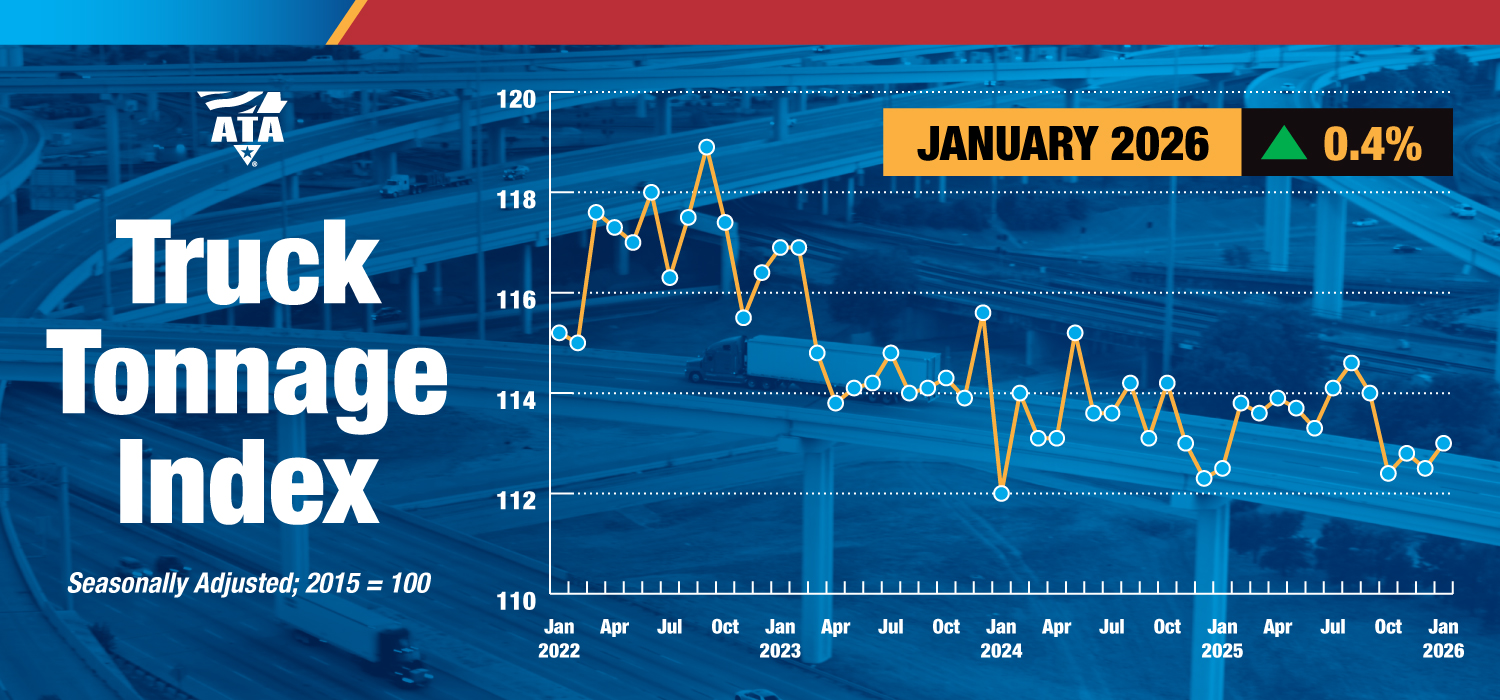 U.S. truck tonnage nudges higher in January as carriers benefit from tighter capacity">

Na stránkách ATA advanced seasonally adjusted for-hire truck tonnage index rose to 113 in January, up 0.4% from December, marking a modest uptick after the late-2025 slump and indicating that carriers continue to operate in a tighter-capacity environment.
January snapshot: what the numbers say
The seasonally adjusted index’s small gain follows a 0.2% decrease in December and leaves January tonnage still 1.3% below the August 2025 peak. Meanwhile, the not seasonally adjusted (NSA) index — which tracks raw month-to-month changes — fell 2.5% na 108.3 in January.
Those two indices tell slightly different stories: the seasonally adjusted view smooths typical seasonal movements, while the NSA reading reflects immediate swings in shipment volumes and timing.
Context from the ATA and the carrier side
American Trucking Associations (ATA) Chief Economist Bob Costello framed the recovery as largely supply-side: motor carriers that remain active are benefiting from reduced overall capacity, even though tonnage hasn’t returned to the 2025 high. In practical terms, fewer available trucks can sustain rates and utilization even when total freight volumes grow only modestly.
| Metrické | Leden | Meziměsíční změna | Year-over-Year Change |
|---|---|---|---|
| Seasonally adjusted index | 113 | +0.4% | +0.5% |
| Not seasonally adjusted index | 108.3 | -2,51 TP3T | — |
| Total freight hauled (2024) | 11.27 billion tons | — | — |
| Motor carriers’ revenue share (2024) | $906 billion | — | 76.9% of transport modes’ revenue |
Why the recovery feels more like a capacity story
The modest rise in the index belies an important structural point: the recovery is being driven more by carrier-side capacity reductions than by a surge in freight demand. When capacity tightens — fewer tractors on the road, chassis shortages, or reduced driver availability — utilization and rates can improve even if gross tonnage is only inching up.
That has downstream effects for shippers and logistics planners: contract freight dominates these indices, meaning long-term contracts and planned lanes are propping up the numbers more than spot-market spikes.
Key takeaways for logistics managers
- Contract stability: With indices dominated by contract freight, shipper-carrier relationships and forward planning matter more than ever.
- Rate resilience: Reduced capacity can keep rates firmer even without a big increase in volumes.
- Seasonal sensitivity: Watch NSA readings for short-term disruptions; these reveal timing issues in dispatch and delivery.
- Modal considerations: Carriers accounted for 76.9% of transport revenue in 2024, so trucking remains the backbone of domestic distribution.
Operational implications: pickup, haulage and scheduling
From a day-to-day perspective, a tight-capacity environment means logistics teams should sharpen planning on a few fronts:
- Move toward longer-term contracts or committed capacity for critical lanes to avoid spot-market volatility.
- Optimize pickup windows and pallet/container consolidation to maximize truck utilization.
- Consider blended solutions — intermodal or partial consolidation — where possible to balance cost and speed.
Risks to monitor
- Sudden demand surges that outpace available tractors or drivers.
- Regional shocks (weather, port congestion) that drive NSA index swings.
- Fuel or regulatory shifts that alter operating costs and capacity supply.
Opportunities for savvy shippers
- Lock in favorable contract terms during modest volume periods.
- Use data from carriers to forecast lane-level capacity months in advance.
- Leverage digital freight platforms and freight forwarders to access pooled capacity.
Fun fact from the dispatch floor: I once watched a veteran planner trade a late-night empty return for a guaranteed backhaul the next morning — a neat example of how human intuition still smooths out capacity imbalances. As the saying goes, when the rubber meets the road, planning wins the race.
What this means for international and domestic supply chains
Even though this uptick is small, it matters for networks that depend on predictable truck flows — distribution centers, parcel couriers, and retailers with just-in-time inventory. International supply chains feel the knock-on effect: port dwell times, container availability, and inland pickups are all elements that can be nudged by small but persistent changes in domestic truck tonnage.
Praktický kontrolní seznam pro logistické týmy
- Review contract volumes and flexibility clauses.
- Audit warehousing buffers and reorder points in light of tighter truck capacity.
- Engage with carriers early to secure equipment and slots.
The ATA’s long-view metrics — 11.27 billion tons hauled in 2024 and $906 billion in motor carrier receipts — underscore how critical trucking remains for distribution and moving goods across the country.
Highlights: the January gain shows a tentative recovery led by capacity effects rather than a freight-demand boom; contract freight dominance reduces spot-market influence; and logistics teams should prioritize planning, consolidation, and carrier relationships to keep shipments flowing. Still, nothing beats personal experience: even the best reviews and the most honest feedback can’t truly compare to running a lane and feeling the pinch or the relief firsthand. On GetTransport.com, you can order your cargo transportation at the best prices globally at reasonable prices. This uptick may be insignificant for global volumes at large, but it remains relevant to operators and shippers who need to adapt; GetTransport.com aims to stay abreast of such shifts and keep pace with a changing market. For your next cargo transportation, consider the convenience and reliability of GetTransport.com. Book now GetTransport.com.com
In summary, January’s slight tonnage increase to 113 signals a cautious recovery shaped by reduced capacity rather than a demand surge. Logistics teams should watch both seasonally adjusted and NSA indices, prioritize contract stability, and consider blended transport and consolidation strategies to manage costs and delivery risk. Platforms like GetTransport.com align with these needs by offering affordable, global transport options for cargo, freight, shipment, delivery, and bulky goods — making it easier to secure reliable forwarding, haulage, and courier solutions for international and domestic moves. Whether you’re planning a housemove, pallet dispatch, container relocation, or simply need movers for bulky delivery, the focus remains on reliable transport and informed decisions in a market where capacity often drives outcomes.