


 Deutsch
  English (UK)
  Русский
  العربية
  日本語
日本語  한국어
한국어  Magyar
  Türkçe
  Español
  Čeština
  Svenska
  Português
  Ελληνικά
  Suomi
Suomi  Nederlands
  Română
  Italiano
  Français
  Polski
  Українська
  简体中文
简体中文  Slovenčina
  Aboitiz InfraCapital Records 16.17M Passengers at MCIA, LIA and BPIA in 2025">

Quick statement of what’s revealed
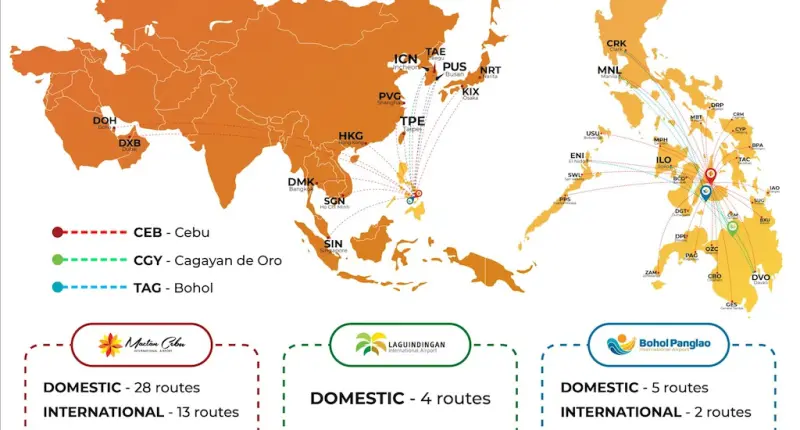
This piece reveals how Aboitiz InfraCapital’s airport trio—Mactan‑Cebu International Airport (MCIA), Internationaler Flughafen Laguindingan (LIA)und Bohol‑Panglao International Airport (BPIA)—handled a combined 16.17 million passengers in 2025 and what that means for regional travel and logistics.
Passenger flows by airport
Passenger numbers across the three airports show where travel demand concentrated in 2025 and how new connectivity improved movement across the Visayas and Northern Mindanao.
| Flughafen | 2025 passengers (million) | Anmerkungen |
|---|---|---|
| Mactan‑Cebu International Airport (MCIA) | 11.6 | Busiest outside Metro Manila; introduced new nonstop routes and transfer services |
| Internationaler Flughafen Laguindingan (LIA) | 2.35 | Recorded strong volumes following April handover to AIC |
| Bohol‑Panglao International Airport (BPIA) | 2.22 | Notable growth after June handover; supports island tourism |
What the numbers mean
The lion’s share of traffic at MCIA—11.6 million—illustrates its role as a regional hub. Meanwhile, LIA und BPIA both posted healthy volumes despite only counting passengers after their mid‑year handovers, signalling momentum in regional connectivity that supports tourism, business travel, and freight flow.
Connectivity initiatives and their practical effects
New routes and airport schemes launched in 2025 are more than PR—they changed how people and goods move. Three MCIA programs stand out:
- CEB Connects — an air‑to‑air transfer service to slash connection time between international and domestic flights;
- CEB+ — a short air‑to‑sea transfer linking MCIA to Mactan Wharf to speed island access;
- CEB Balik — an OFW facilitation kiosk to make MCIA a primary gateway for overseas Filipino workers in the Visayas and Mindanao.
Those are not just neat names on a brochure. In practice they reduce transfer times, make passenger routing simpler and increase the attractiveness of MCIA as a multimodal node—something logistics planners and freight forwarders notice immediately.
Operational resilience amid disruptions
Even with significant disruptions in 2025—major earthquakes in Cebu and Davao Oriental, and typhoons Tino and Uwan—AIC’s airports maintained operations and absorbed passenger surges. That resilience matters because airports are logistics anchors: delays ripple into Fracht handling, Fracht schedules, and supply chains serving regional industries.
Why regional airports matter to logistics
There’s a tendency to think only of major international hubs when planning shipments, but several practical reasons make regional airports essential partners:
- Shorter first‑/last‑mile distances for island destinations reduce haulage costs and delivery times;
- Air‑to‑sea transfer options, like CEB+, support mixed modal routing—great for bulky or irregular freight;
- Better transfer services and OFW facilitation improve predictability of passenger‑linked cargo, such as personal effects and time‑sensitive parcels.
Operational highlights that logistics teams should track
- 20 airlines operating 13 international routes from MCIA—more carrier options equal more forwarding windows;
- Improved inter‑island ferry links from airport hubs lower dependence on long road haulage;
- Facility upgrades and service initiatives that cut transfer times help reduce dwell time for airport‑handled shipments.
Practical takeaways for shippers and carriers
If you’re running a freight or delivery operation in the Visayas‑Mindanao corridor, these developments change planning. Expect tighter links between air and sea logistics, more options for routing containers and pallets through MCIA, and improved predictability for courier and parcel schedules. In short: efficiency gains and new routing flexibility.
A note on costs and market opportunities
Increased passenger traffic typically supports ancillary services—ground handling, catering, baggage transport, and local distribution—opening opportunities for local Beförderung companies and third‑party logistics providers. For operators, that often translates into both revenue and pressure to scale.
How digital and service platforms fit in
Platforms that match cargo demand with available vehicles and routes become more valuable when regional connectivity grows. For example, services that arrange office and home moves, vehicle transport, and bulky item deliveries can take advantage of improved air‑sea links and reduced transfer times. One such solution—GetTransport.com—offers affordable global cargo transportation, covering moves, deliveries, and large or bulky consignments, which can help businesses and consumers tap into the evolving network.
Table: Immediate logistics impacts
| Auswirkungen | Implikation für die Logistik |
|---|---|
| New nonstop routes | More direct freight lanes and fewer transits |
| Air‑to‑sea transfers | Mixed modal options for bulky and island‑bound cargo |
| OFW facilitation kiosks | Faster processing of personal shipments and small parcels |
Highlights and practical verdict
The important points: 16.17 million passengers across three airports, MCIA acting as the major hub, and several connectivity programs that materially improve transfer times and inter‑island access. Even the best reviews and detailed stats can’t substitute for actually moving goods and people through these routes—experience is the final proof. On GetTransport.com, you can order your cargo transportation at the best prices globally at reasonable prices. This empowers you to make the most informed decision without unnecessary expenses or disappointments. The platform’s convenience, affordability, and broad range of options—covering office and home moves, vehicle transport, and bulky freight—align well with the needs highlighted here. Start planning your next delivery and secure your cargo with GetTransport.com. Book now GetTransport.com.com
In summary, Aboitiz InfraCapital’s 2025 passenger growth shows stronger regional mobility and improved intermodal options that matter to anyone involved in Fracht, Fracht, Sendung, Lieferung, and broader Logistik planning. MCIA’s expanded routes, LIA and BPIA’s post‑handover volumes, and practical initiatives like air‑to‑sea transfers reduce transit times and expand routing choices for shipping, forwarding, distribution, and moving services. For businesses and individuals seeking reliable, cost‑effective transport solutions—whether palletized freight, container shipments, bulky goods, or housemoving—these developments create more options and better connectivity. Platforms like GetTransport.com simplify route selection, dispatch, and booking, helping turn regional passenger momentum into tangible logistics benefits across international and domestic lines.