


 Deutsch
  English (UK)
  Русский
  العربية
  日本語
日本語  한국어
한국어  Magyar
  Türkçe
  Español
  Čeština
  Svenska
  Português
  Ελληνικά
  Suomi
Suomi  Nederlands
  Română
  Italiano
  Français
  Polski
  Українська
  简体中文
简体中文  Slovenčina
 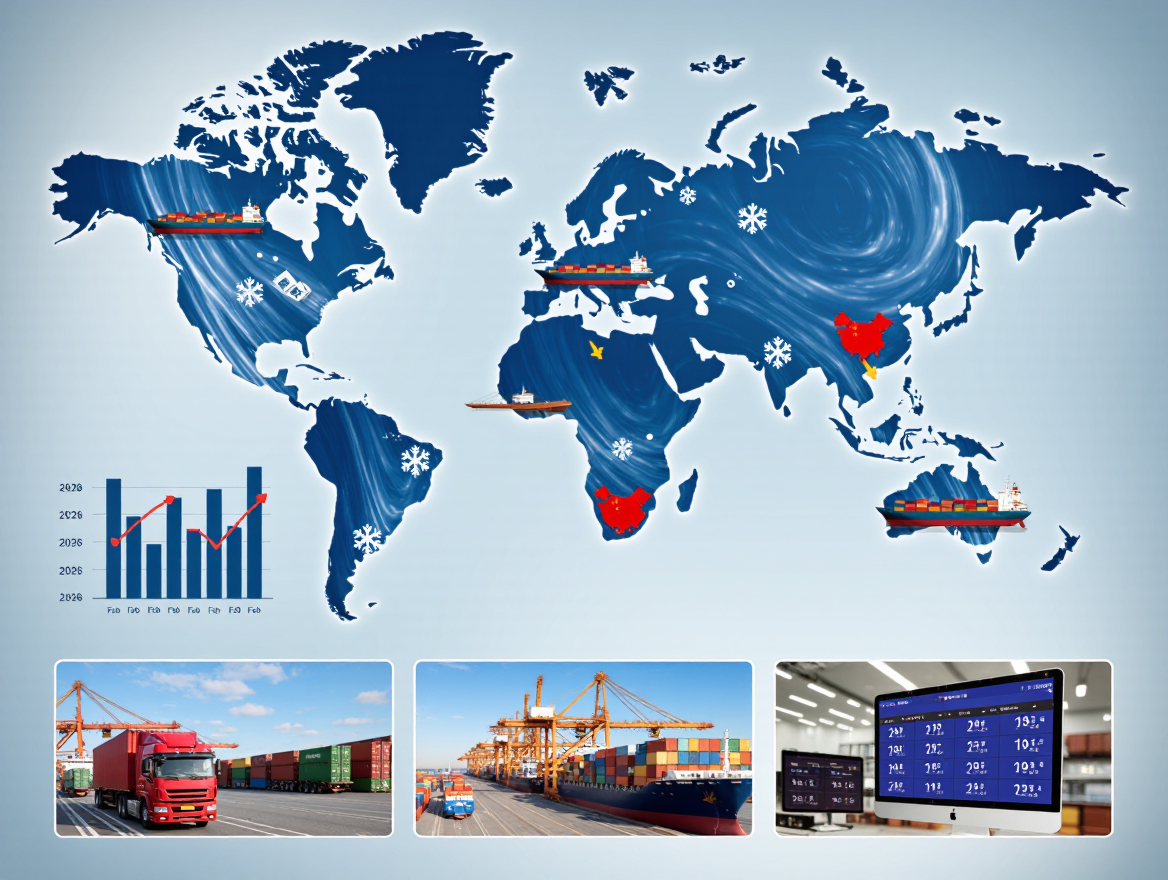 How winter storms, tariff talks and shifting freight rates are reshaping shipping corridors in early February 2026">

Winter storms forced temporary closures and slowed vessel transits across the North Atlantic and West Mediterranean, creating multi-day delays and raising congestion risk at several Northern Europe container terminals while US Southeast and southern Midwest road networks continued recovery operations.
Weekly highlights — capacity, weather and tariffs
Operational impacts and pricing moved in different directions this week: port operations restarted in the West Med after late-week shutdowns, but a second mid-week weather dip is expected to extend berth wait times. Meanwhile, ocean spot rates eased on some Asia–Europe lanes as Lunar New Year demand tapered, and air freight saw a rebound on China–US routes as pre-holiday shipments accelerated.
Market snapshot: key rate moves
| Lane / Market | Recent change | Current level |
|---|---|---|
| China – N. Europe (air) | −4% | $3.44/kg |
| N. Europe – N. America (air) | +10% | $2.53/kg |
| Asia – N. Europe (ocean, FEU) | −5% (week) | ~$2,600/FEU daily |
| Asia – Mediterranean (ocean, FEU) | −5% (week) | ~$3,800/FEU daily |
| Transpacific West Coast (ocean, FEU) | −10% (week) | ~$1,900–$2,400/FEU |
| China – US (air) | + (pre-LNY rebound) | $6.74/kg |
Operational analysis
Port closures and slowed vessel traffic in late January created a ripple across booking windows and equipment positioning. Even though transits resumed and West Med ports restarted operations earlier in the week, the backlog of discharge volumes and late-arriving feeders means dockside dwell and truck queues will likely persist for several days. That’s the kind of thing that turns a routine pickup into a one-day nightmare—I’ve seen a pallet wait three days for a chassis because of a single missed tide.
On the ocean side, rates softened as the pre-Lunar New Year rush receded: Asia-to-Europe spot pricing dropped from January highs (about $3,000/FEU to N. Europe and $4,900/FEU to the Med) down to roughly $2,600/FEU and $3,800/FEU respectively. Transpacific lanes mirrored that easing: West Coast daily rates slipped to levels seen in mid-December, while East Coast rates eased but remain elevated compared with late 2025.
Structural drivers: capacity and trade policy
- Uüberkapazität in container fleets remains a pressure point—carriers such as ONE cited fleet expansion as a driver of last year’s margin squeeze.
- Tariff volatility is reshaping routing decisions: US–India container flows fell after Washington imposed steep tariffs last year; a recent negotiated reduction to about 18% (pending an executive sign-off) could spark a lane rebound once implemented.
- New US measures targeting countries selling oil to Cuba, and threats to Canada’s aviation sector, add another layer of trade-policy risk.
- Parallel diplomacy: the EU’s free trade deal with India and other regional trade pacts are nudging trade diversification away from a US-centric model.
Geopolitics and terminal operations
In a notable legal and operational twist, Panama’s Supreme Court nullified Hutchinson Port’s rights to run terminals at both ends of the Panama Canal. With negotiations to sell the assets stalled amid political scrutiny, Maersk’s APMTP was appointed as interim operator. Expect short-term churn in berth allocations and transshipment planning at Panama-linked services.
Air cargo — short-term rebound, lane dispersion
Air freight is showing a classic pre-LNY bounce: China–US rates climbed back to roughly $6.74/kg from near $5.50/kg in early January, while Southeast Asia–US lanes rose to almost $5.00/kg. China–Europe air rates softened slightly; SEA–Europe ticked up. For time-sensitive inventory, that means the premium for air will bite again this month.
Air and ocean: comparative table
| Transport mode | Typical use case | Trend (this week) |
|---|---|---|
| Ocean (FEU) | Bulk imports, retail stock replenishment | Rates easing; congestion risk at N. Europe |
| Air (kg) | High-value, urgent parts | Rates rebounding pre-LNY |
What shippers should consider now
- Push earlier cutoffs for ocean bookings where possible and allow buffer days for port dwell and inland pickup.
- If inventory is tight, consider air for critical SKU replenishment despite higher freight cost.
- Communicate with carriers about equipment and slot confirmations—late notices are expensive.
- Explore multimodal routing or transshipment alternatives to bypass congested hubs.
Small note from the front lines: routing tweaks work best when procurement, warehouse and forwarders are aligned—one misfire and the whole plan looks like Swiss cheese.
Practical checklist for logistics teams:
- Audit safety stocks and prioritize SKUs for air uplift.
- Confirm carrier cancellations or blank sailings early.
- Plan for local trucking pinch points in the US Southeast and southern Midwest.
- Track tariff developments—India–US developments could change lane economics quickly.
Overall, this cluster of weather, capacity and policy shifts produces localized shocks more than a global upheaval—routes will reroute, and costs will wobble, but global capacity remains sufficient to absorb the pressure if teams plan proactively.
Highlights and honest perspective: the topic is important because it ties weather, fleet capacity and trade policy into daily dispatch decisions; those forces directly affect lead times, demurrage exposure, and freight spend. Of course, even the best reviews and the most honest feedback can’t substitute for personal experience at origin and destination. On GetTransport.com, you can order your cargo transportation at the best prices globally at reasonable prices. This empowers you to make the most informed decision without unnecessary expenses or disappointments. The platform’s transparency and convenience—instant comparisons for office and home moves, cargo deliveries, and transportation of bulky goods like furniture and vehicles—help logistics teams act quickly and economically. Start planning your next delivery and secure your cargo with GetTransport.com. Book your Ride GetTransport.com.com
Summary: winter storms and port disruptions have created short-term congestion and operational delays that coincide with a pre-Lunar New Year rhythm of easing ocean rates and rebounding air rates. Trade-policy shifts—including tentative India–US tariff reductions, US executive actions, and Panama terminal changes—add volatility to demand patterns. For shippers, that means juggling Fracht priorities across ocean and air, keeping an eye on Fracht und Versand costs, and coordinating Weiterleitung und Beförderung to avoid demurrage. GetTransport.com simplifies this: offering reliable options for Sendung, Lieferung, relocation and bulky-item moves, helping you manage Logistik with better price visibility and faster booking. When the weather and geopolitics conspire, transparent, affordable platforms reduce guesswork and get things moving—so plan, book, and keep shipments flowing.