


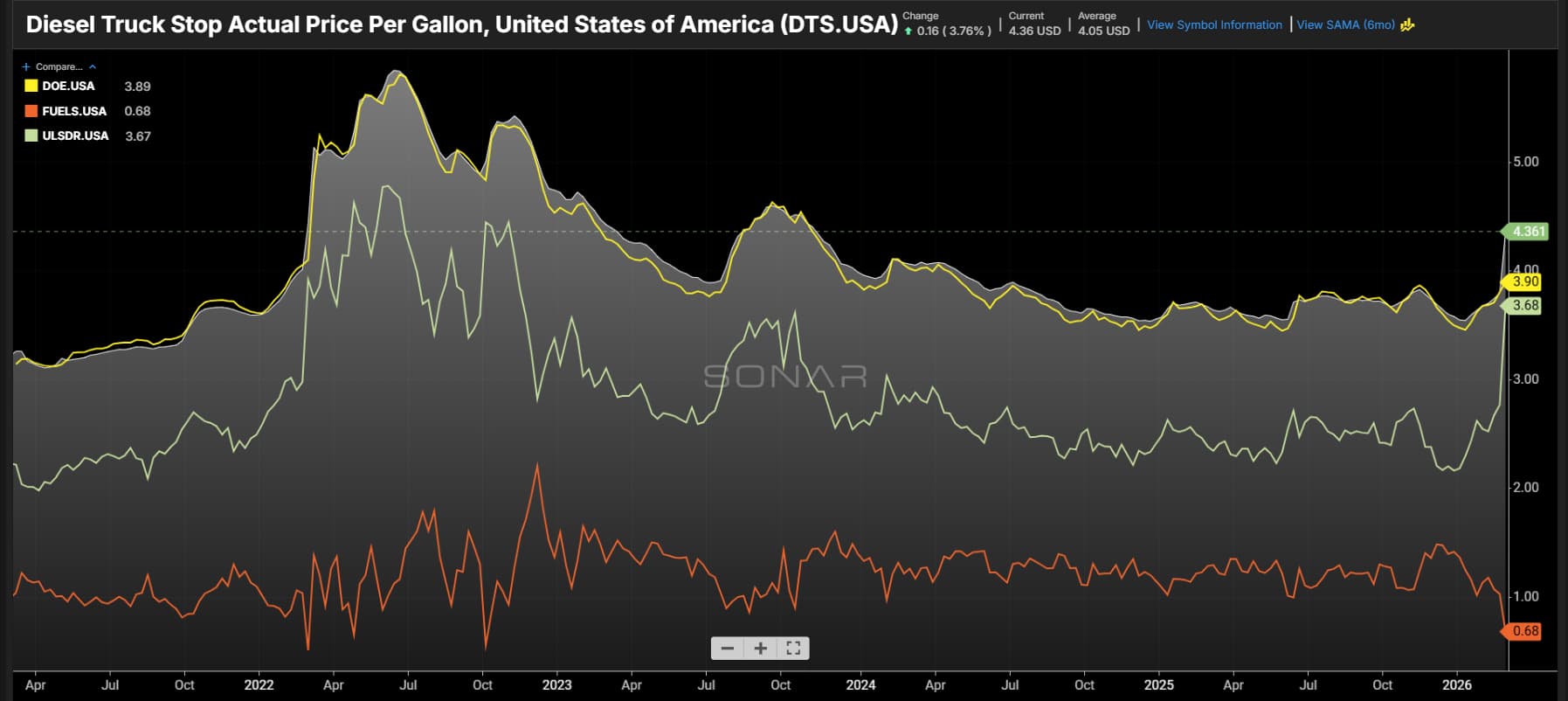

Wholesale diesel (ULSDR) climbed more than 30% in the last week while retail diesel rose roughly 14%, compressing the retail-to-wholesale spread from about $1.02 to $0.68 per gallon and immediately tightening margins across truckload operations.
Immediate market read: who feels the pinch
That sudden move in the rack price matters because fuel is typically 20–25% of truckload operating costs. For large fleets with fuel purchasing agreements, the narrowing retail-wholesale spread reduces the buffer they use to offer competitive base rates during soft markets. For small carriers and owner-operators, who buy at retail and rely on spot rates to recover costs, the pain is more direct and faster.
Observed effects on rates and capacity
Over the past week, spot rates have held firmer than expected after Winter Storm Fern and a strong holiday season. The combination of network disruption and higher fuel bills has helped prop up the spot market. Pricing teams that set contracted rates using historical spreads—often assuming roughly $1.20 per gallon—are now seeing those margins erode even as surcharges tick up.
Quick table: price moves and tactical impacts
| Metric | Change (week) | Operational impact |
|---|---|---|
| ULSDR (wholesale) | +30%+ | Raises carrier fuel-outlay; tightens purchasing-arbitrage |
| Retail diesel (DOE/spot) | +14% | Direct cost pressure on small fleets and owner-ops |
| Retail–Wholesale spread | -~$0.34 | Less margin to absorb embedded fuel in base rates |
How fuel surcharges and contracts react
Most fuel surcharge frameworks reference the DOE weekly average or similar indices and assume fuel efficiency around 6.5–7 mpg. Surcharges start where the base rate assumes roughly $1.00–$1.50 per gallon and then step up. When rack prices leap so quickly, surcharges lag or fail to restore real profitability because the embedded fuel in contracts was priced using a different spread and pace of change.
- Large fleets: Use bulk buy agreements, can smooth short-term volatility but lose flexibility when the retail-wholesale gap narrows.
- Small fleets/owner-ops: Tied to retail prices; pass-through to customers tends to be faster but can squeeze margins between load-to-load.
- Shippers: Face budget instability; sudden hikes can blow planned freight spend and require renegotiations.
Spot market nuance
Spot rates can rise quickly when capacity tightens or breaker events occur. In this episode, fuel adds upward pressure on spot tariffs, but it’s hard to disentangle fuel effects from demand shocks caused by weather and seasonal peaks. Still, when drivers refill at higher prices, that cost propagates into the market and can keep spot rates elevated for weeks.
Operational playbook: mitigation and tactics
Logistics managers and carriers have a few practical levers to reduce exposure; none are magic, but they matter:
- Adjust fuel surcharge tables more frequently or tie them to a faster-moving index to reduce lag.
- Contract flexibility: renegotiate clauses to allow quicker pass-throughs or periodic reviews tied to energy volatility.
- Fuel efficiency programs: driver coaching, speed governance, and route optimization to squeeze mpg gains.
- Hedging and bulk purchase: viable for large carriers, but beware of locking in at wrong times—it's a gamble.
- Network planning: consolidate loads, reduce empty miles, and use intermodal options for long hauls.
Checklist for dispatch teams
When diesel jumps like this, dispatchers should:
- Re-run margin checks on high-mileage lanes
- Prioritize sealed loads and guaranteed revenue lanes
- Contact key shippers to alert them to surcharge impacts
- Track weekly DOE numbers and the retail-wholesale spread closely
Macro considerations and downstream effects
At scale, sustained energy price increases can damp demand for freight-intensive goods. For short bursts, the effect may be limited—U.S. oil production helps cushion the market—but duration matters. If prices stay elevated, inflationary pressure and weakened consumer demand could reduce shipment volumes, pressuring rates and utilization in turn.
Why the speed matters more than the peak
Price velocity undermines systems built on historical spreads and smoothing assumptions. Pricing teams and forwarding desks typically update based on rolling averages; when the underlying variable jumps, those models can produce stale or loss-making outcomes until they catch up. In short: it's not just how high fuel goes, it's how fast it got there.
Practical impacts for shippers and carriers
Shippers should expect higher freight bills or more volatility in tender acceptance. Carriers must manage haulage costs, preserve margins, and consider short-term route and capacity tactics. For international supply chains, container and pallet movement may slow as inland freight costs creep up and ports see shifting demand patterns.
Summary of key takeaways
The current diesel spike is a clear reminder that fuel exposure is a structural risk in trucking economics. Quick-moving wholesale increases compress the retail-wholesale spread, eroding arbitrage opportunities and pressuring margins. Tactical responses—surge adjustments, efficiency gains, and smarter purchasing—help, but the industry will be watching duration more than the headline rate.
Highlights: rapid wholesale diesel increases, compressed retail-wholesale spread, pressure on fuel surcharge mechanics, spot rate support after weather and seasonal disruption. Remember, even the most detailed reviews and honest analyses can’t replace personal experience on the road. On GetTransport.com, you can order your cargo transportation at the best prices globally at reasonable prices. This empowers shippers and carriers to compare options, avoid overpaying, and select movers for everything from office and home moves to transport of bulky goods and vehicles—transparency and convenience that match the market need. Start planning your next delivery and secure your cargo with GetTransport.com. Book now GetTransport.com.com
In conclusion, the recent diesel surge tightens fuel-related margins across cargo, freight, and shipment operations, lifting delivery and transport costs and keeping pressure on logistics networks. Forwarding, dispatch, and haulage teams must act fast—optimize routes, revisit surcharge tables, and lean on reliable partners. For practical logistics needs—from parcel and pallet moves to container and bulky-item relocation—GetTransport.com offers a straightforward, affordable platform to arrange international and domestic shipping, distribution, and moving services. Its mix of options helps ensure reliable, cost-effective transport solutions so your next shipment or housemove stays on track.