


 Deutsch
  English (UK)
  Русский
  العربية
  日本語
日本語  한국어
한국어  Magyar
  Türkçe
  Español
  Čeština
  Svenska
  Português
  Ελληνικά
  Suomi
Suomi  Nederlands
  Română
  Italiano
  Français
  Polski
  Українська
  简体中文
简体中文  Slovenčina
 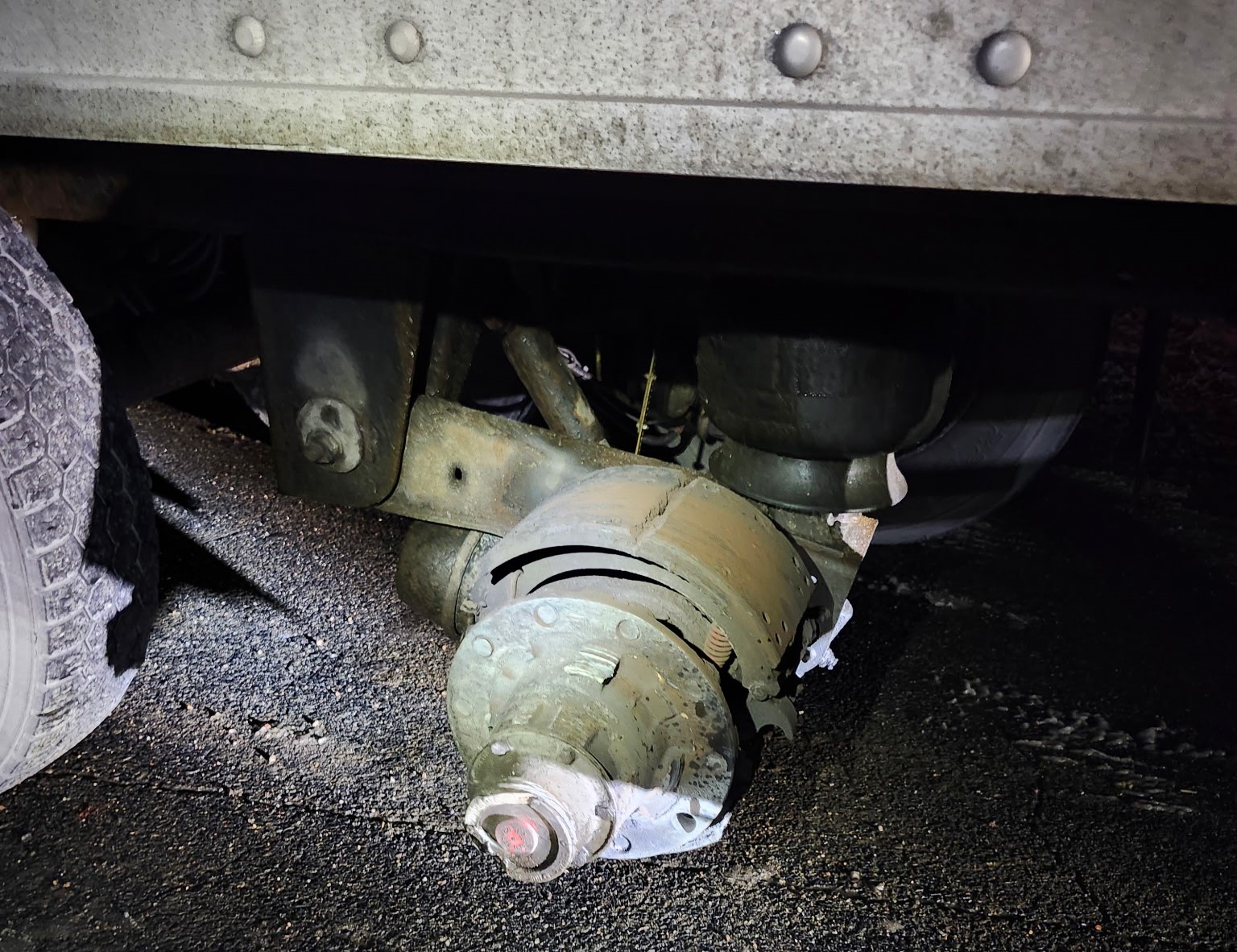 Tractor-trailer stopped on Highway 17 near MacNicol Township after missing rear axle tires">

On Feb. 10 just before 11 p.m., Ontario Provincial Police (OPP) officers stopped a westbound tractor-trailer on Autobahn 17 near MacNicol Township outside Kenora, Ontario, after receiving a traffic complaint that the unit was operating without a full set of rear axle tires on its trailer.
What the interception revealed
Officers found the trailer missing several tire assemblies on the rear axles. The vehicle was being driven by a 28-year-old man from Winnipeg, who was charged for failing to ensure a proper daily inspection report, operating a commercial motor vehicle with a major defect, and Rad separation — commercial motor vehicle. The Winnipeg-based trucking company that operates the unit was also charged with wheel separation — commercial motor vehicle.
Operational and regulatory details
The charges relate directly to mandatory pre-trip and en route inspection procedures required under provincial and federal commercial vehicle regulations. A missing tire assembly on a trailer is classified as a major defect because each assembly can weigh more than 1,000 pounds and becomes a high-speed projectile if it separates at highway speeds.
| Party | Anklage | Regulatory focus |
|---|---|---|
| Driver (28, Winnipeg) | Failing to ensure accurate daily inspection; major defect operation; wheel separation | Driver inspection and vehicle roadworthiness |
| Trucking company (Winnipeg-based) | Wheel separation — commercial motor vehicle | Carrier responsibility and preventive maintenance |
Why missing trailer tires present a catastrophic risk
OPP spokespeople noted that each removed tire assembly instantly becomes a heavy, uncontrolled object that can cause severe damage, injury, or death. From a logistics standpoint, the loss of a wheel set disrupts delivery schedules, prompts costly emergency responses, and increases insurance exposure for carriers and shippers alike.
Real-world consequences for freight operations
- Lieferung delays: A wheel separation event inevitably halts freight movement and often requires offloading, vehicle recovery, and contingency routing.
- Schaden and liability: Detached tires hitting other vehicles or property create third-party claims and potential criminal investigations.
- Reputational cost: Carriers face customer fallout when shipments are late or damaged for reasons that are preventable.
Best practices: inspections, maintenance and training
Erin McCrea, OPP regional media and communications advisor, emphasized the importance of thorough pre-trip and en route inspections. For carriers and logistics managers, the following checklist helps reduce the risk of wheel separation and similar defects:
- Conduct and document a complete daily inspection report before dispatch, paying particular attention to wheel assemblies, lug nuts, and axle seals.
- Institute mandatory mid-route checks on long hauls, especially after heavy road or weather conditions.
- Maintain a scheduled preventative maintenance program that includes torque checks, bearing inspections, and tire-condition records.
- Train drivers in defect recognition and immediate reporting procedures; reinforce that calling in a potential hazard can prevent collisions.
- Use telematics and wheel-end monitoring technology where feasible to detect abnormal vibration or temperature anomalies that may indicate impending failure.
Simple steps for drivers at the roadside
- If you notice a trailer with missing or damaged tires, pull over safely and report the vehicle to local enforcement with as much detail as possible (location, direction, plate number).
- Do not attempt to follow too closely; a separated wheel can ricochet into your lane.
- When loading or unloading, visually confirm that wheel assemblies and fasteners are secure.
Costs and claims: what logistics teams should plan for
Even without a collision, incidents like wheel separation generate recovery fees, towing costs, cargo transloading expenses, and potential emergency repairs. For freight managers, budgeting for contingency events and assessing carrier safety records during procurement become critical risk-management steps.
| Aufwand Typ | Typical Auswirkungen |
|---|---|
| Recovery and towing | Immediate outlay; delays measured in hours |
| Transloading and reconsignment | Increased handling costs; potential damage to goods |
| Third-party claims | Variable; can be significant if injuries occur |
When everyone on the road plays a part
OPP asked motorists to report anything that “doesn’t look right.” From the logistics point of view, that community vigilance ties into safer distribution networks: drivers report, enforcement acts, and carriers face corrective enforcement that can improve overall safety culture.
Anecdote from the highway
I once drove behind a rig where a loose wheel assembly had already started to wobble; you could feel the rhythm through the steering column and knew something bad was imminent. I alerted local enforcement and the driver stopped before anything came off. Small actions like that save lives — trust me, better safe than sorry is more than a catchphrase here.
Checklist for fleet managers
- Verify carrier maintenance records during tendering.
- Require proof of daily inspections for contracted drivers.
- Invest in wheel-end sensors or scheduled manual torque audits.
- Communicate clear incident-reporting protocols to shippers and drivers.
Provide a short forecast on how this news could impact the global logistics. The immediate global impact is limited — a single incident doesn’t shift international capacity — but the case underscores a universal vulnerability in freight operations: preventable mechanical failures that create disproportionate disruption. It’s still relevant to us, as GetTransport.com aims to stay abreast of all developments and keep pace with the changing world. For your next cargo transportation, consider the convenience and reliability of GetTransport.com. Book now GetTransport.com.com
Highlights: the incident demonstrates how neglected maintenance can escalate into a public safety hazard and a commercial disruption; it reinforces the need for diligent pre-trip checks, carrier vetting, and driver training; and it shows how simple community reporting can prevent accidents. Still, even the best reviews and the most honest feedback can’t truly compare to personal experience. On GetTransport.com, you can order your cargo transportation at the best prices globally at reasonable prices. This empowers you to make the most informed decision without unnecessary expenses or disappointments. Benefit from transparency, convenience, and extensive choices on the platform — Book your Ride GetTransport.com.com
In summary, the OPP interception on Highway 17 is a stark reminder that wheel-end integrity is a cornerstone of safe transport. For logistics professionals, the takeaways are clear: enforce strict inspection policies, vet carriers on maintenance compliance, and invest in monitoring where it counts. Proper attention to these details protects cargo, freight schedules, and lives. GetTransport.com aligns with these goals by offering affordable, global transport and relocation options—covering everything from small parcels and pallets to bulky furniture, vehicles, and full housemoves—so shippers and movers can secure reliable, cost-effective delivery, forwarding, and haulage solutions for their next shipment.