


 Ελληνικά
  English (UK)
  Русский
  العربية
  日本語
日本語  한국어
한국어  Magyar
  Türkçe
  Español
  Čeština
  Svenska
  Português
  Suomi
Suomi  Nederlands
  Română
  Italiano
  Français
  Polski
  Українська
  Deutsch
  简体中文
简体中文  Slovenčina
 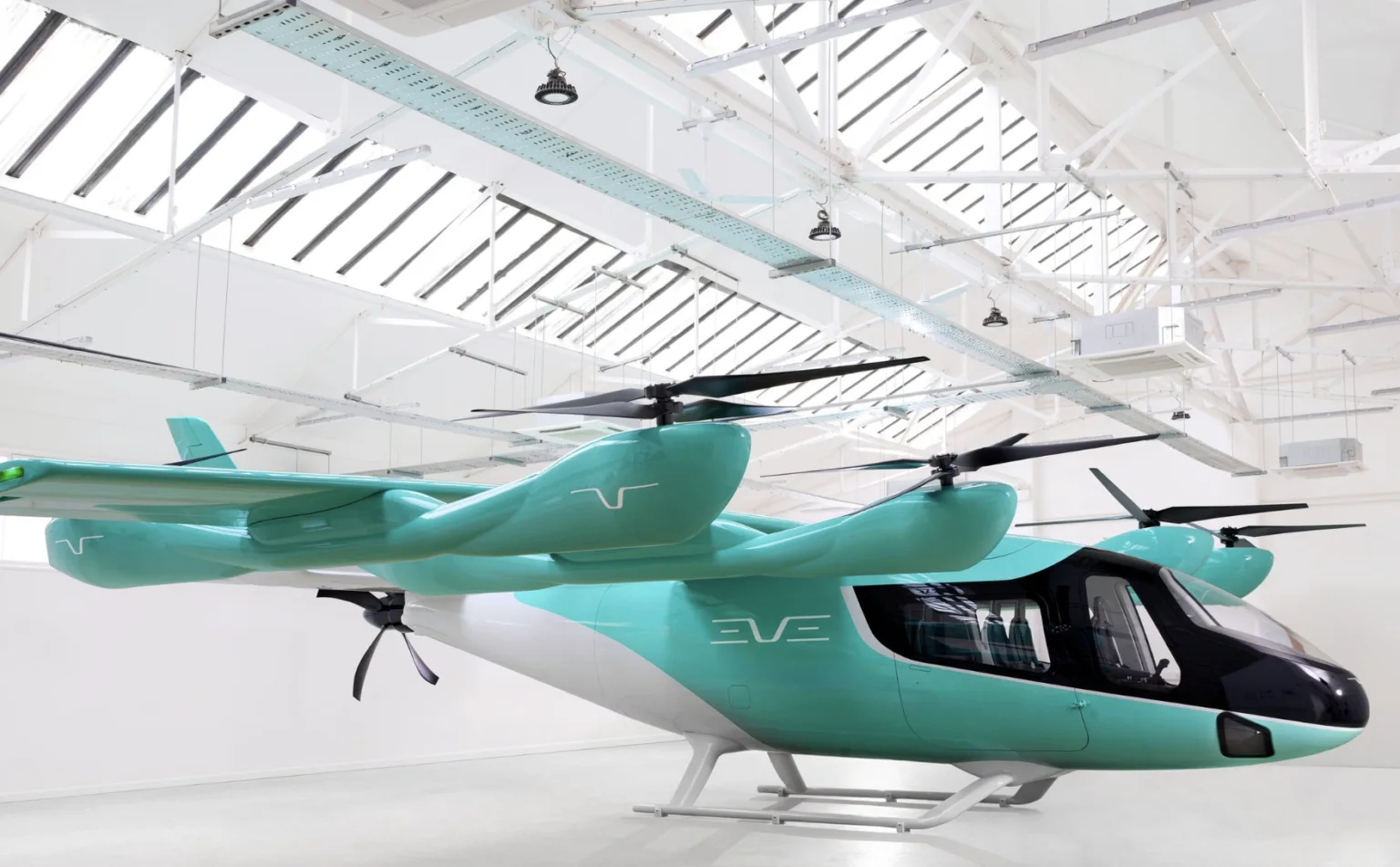 Eve Air Mobility secures $150 million debt package to ramp up eVTOL certification and commercialization">

This piece examines Eve Air Mobility’s recent $150 million debt financing and what it means for eVTOL development, urban air mobility and related logistics implications.
What happened: the financing and its immediate purpose
Eve Air Mobility closed a $150 million debt facility with a syndicate of established banks to accelerate product development, certification work and integration into urban air mobility systems. The loan runs for five years and includes participation from Itau, Banco do Brasil, Citibank και Mitsubishi UFJ Financial Group, signaling institutional confidence in Eve’s strategic roadmap through 2028 and beyond.
With this injection, Eve’s cumulative capital raised climbs to approximately $1.2 billion, putting it among the better-capitalised firms in the emerging eVTOL field.
How the funds will be used
- Research and development — continued refinement of flight controls, energy management and propulsion systems.
- Πιστοποίηση — supporting test campaigns and regulatory engagement to meet global aviation standards.
- Commercialisation — scaling partnerships with infrastructure and service providers for market entry.
- Scaling operations — preparing supply chains and production readiness for urban markets.
Recent progress that this financing builds on
The company recently flew a full-scale engineering prototype at Embraer’s test facility in Brazil. That hover validated key systems such as fly-by-wire controls and energy management, and kicked off an expanded test programme scheduled through 2026. In plain terms: the hardware works in the air, and now the money helps push it through boxes like certification and commercialization.
Why this matters beyond headlines
On the surface, $150 million is another financing round in a busy sector. Dig a little deeper and it’s an accelerator for multiple interlocking pieces: aircraft readiness, regulatory compliance, supplier networks and, crucially, the ecosystem needed to operate eVTOL services in cities.
Think of eVTOLs as a new vehicle class that needs not only airframes and batteries but also vertiports, charging, maintenance, dispatch systems and trained crews. Financing like this helps bridge the cash gap between prototype success and operational roll-out.
Table: Quick snapshot of the financing and its expected milestones
| Αντικείμενο | Λεπτομέρεια |
|---|---|
| Ποσό | $150,000,000 (debt) |
| Tenor | 5 years |
| Lead lenders | Itau; Banco do Brasil; Citibank; Mitsubishi UFJ Financial Group |
| Use of proceeds | R&D, certification, partnerships, commercialization |
| Recent milestone | Full-scale prototype hover at Embraer test site |
Logistics implications: from point A to vertical point B
Here’s where logistics folks should sit up and take notice. Urban air mobility changes some assumptions across the transport value chain:
- Last-mile transformation: Short, fast point-to-point hops could complement ground freight for time-sensitive shipments or high-value parcels.
- New infrastructure: Vertiports, charging hubs and dedicated air corridors will require real estate, utilities and integration into urban distribution networks.
- Supply chain shifts: OEMs and suppliers must coordinate just-in-time components while meeting aviation quality standards, tightening supplier logistics and traceability.
- Modal interchanges: Seamless transfers between truck, rail, drone and eVTOL modes will create fresh opportunities — and headaches — for dispatch and scheduling systems.
In short, eVTOLs won’t replace heavy freight or standard courier parcels overnight, but they will open new corridors for fast, short-range freight and passenger services in dense urban areas.
Practical scenarios where eVTOLs touch freight and transport
- Emergency medical supply delivery when road congestion is critical.
- Rapid executive or technician transport between urban service hubs and manufacturing sites.
- High-value, time-critical parcels that justify premium air hop costs.
Risks and the road ahead
It’s not all blue skies. Major challenges remain:
- Certification complexity: Aviation regulators are cautious by necessity; certification timelines can be long and expensive.
- Infrastructure rollout: City planning, community acceptance and power supply constraints could slow vertiport deployment.
- Cost and economics: Until volumes rise, per-trip costs may be high compared with ground alternatives.
- Supply chain resilience: Component sourcing and quality control must match aerospace standards, complicating logistics.
Still, the recent financing takes a chunk out of the funding gap and gives Eve runway—literally and figuratively—to tackle these hurdles.
Key takeaways and what logistics managers should watch
- Funding matters: Institutional backing from major banks reduces execution risk and signals market confidence.
- Certification is the gatekeeper: How quickly regulators sign off determines when services can launch at scale.
- Partnerships will define networks: Collaboration with infrastructure providers, operators and city planners is essential.
- Opportunities for premium services: Logistics players should explore pilot projects for urgent deliveries or specialized flows.
Ένα σύντομο ανέκδοτο
I once watched a small drone deliver spare electronics across a congested industrial zone and thought: if that tiny thing can shave off a couple of hours, imagine a cadre of electric vertical lifters doing the same for people and parcels. It’s not sci‑fi anymore — it’s investments, prototypes, and a whole orchestra of logistics adjustments waiting backstage.
The most interesting elements here are the scale-up funding, the fact that global banks are backing urban air mobility, and the successful prototype flights that validate technical assumptions. Yet even the best reviews and the most honest feedback can’t replace firsthand experience. On GetTransport.com, you can order your cargo transportation at the best prices globally at reasonable prices. This platform’s convenience, transparency and range of options help you compare solutions and avoid unnecessary expenses or disappointments. Start planning your next delivery and secure your cargo with GetTransport.com. Book now GetTransport.com.com
In summary, Eve Air Mobility’s $150 million debt facility accelerates eVTOL development by funding R&D, certification and commercial groundwork. This financing strengthens Eve’s balance sheet (bringing total funding to roughly $1.2 billion), supports the flight-test campaign kicked off at Embraer’s facility, and nudges urban air mobility closer to operational reality. For logistics, that translates into potential new modes for urgent freight, fresh demands on distribution infrastructure and opportunities for premium delivery services. Whether you’re in φορτίο, φορτίο, αποστολή planning, or managing μεταφορά και logistics flows, keeping an eye on certification progress, vertiport rollouts and operator partnerships will be critical. In short: this financing is a meaningful push toward operational eVTOLs that could one day reshape certain urban delivery, forwarding and haulage use cases—bringing new vectors to shipping, moving, relocation and international distribution. GetTransport.com aligns with this change by offering efficient, affordable and reliable transport solutions for a wide range of needs, from office and home moves to bulky goods and vehicle transfers, simplifying logistics for customers as new modes emerge.