


 Suomi
Suomi  English (UK)
  Русский
  العربية
  日本語
日本語  한국어
한국어  Magyar
  Türkçe
  Español
  Čeština
  Svenska
  Português
  Ελληνικά
  Nederlands
  Română
  Italiano
  Français
  Polski
  Українська
  Deutsch
  简体中文
简体中文  Slovenčina
 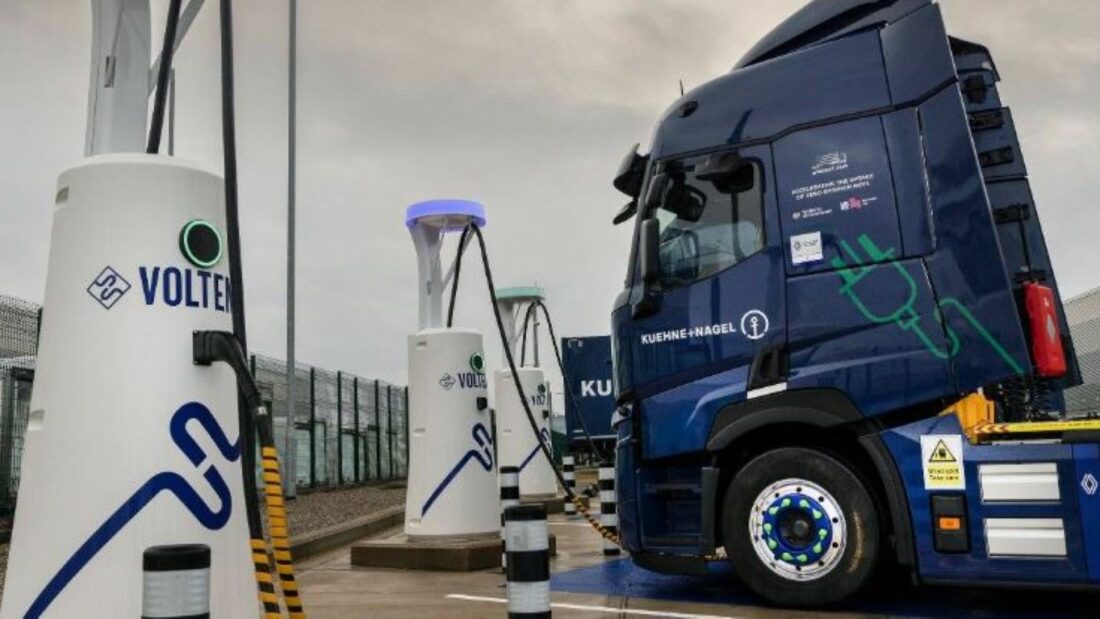 Voltempo installs first megawatt-scale HyperCharger at Kuehne+Nagel East Midlands Gateway">

What has been launched and why it matters
The United Kingdom now hosts its first megawatt-scale charging centre for heavy goods vehicles (eHGVs), installed by Voltempo at the Kuehne+Nagel East Midlands Gateway terminal as part of the eFREIGHT 2030 programme. This deployment is a practical step towards decarbonising road freight and testing high-power charging in a real logistics environment.
Key features of the new charging centre
The Voltempo HyperCharger installed at East Midlands Gateway is built to deliver charging speeds of up to 1 megawatt, with an intelligent power distribution module that serves six DC charging bays. Designed and manufactured in Britain, the system supports OCPP 2.0+ and allows “connect and charge” authentication, simplifying the driver experience by removing manual payment steps and managing fleet authorisation in the background.
| Tekniset tiedot | Yksityiskohta |
|---|---|
| Sijainti | Kuehne+Nagel, East Midlands Gateway |
| Charger type | Voltempo HyperCharger (1 MW module) |
| Number of bays | 6 DC bays |
| Initial fleet served | 12 electric HGVs including DAF XF Electric and Renault Trucks E-Tech T |
| Typical charge time | Future eHGVs: under 30 minutes at full 1 MW (depends on vehicle) |
| Programme affiliation | eFREIGHT 2030 / ZEHID demonstration |
How the system works in a depot setting
The HyperCharger is configured to distribute power dynamically across the six points of charge. That means when multiple trucks arrive, the system can prioritise based on state of charge and scheduled departures, reducing bottlenecks and shortening dwell time. In practice, depots gain the benefits of flexible high-power charging without needing separate 1 MW chargers for every bay — a smarter use of grid and onsite power capacity.
Operational benefits and practical impact
- Faster turnarounds: High-power charging targets realistic duty cycles to keep regional and national routes in motion.
- Fleet data: Each eHGV provides performance metrics — energy use, range, charge cycles, and cost — that feed into operational planning and total cost of ownership assessments.
- Simplicity for drivers: Automated authentication and background transaction handling reduce human error and dwell-times at the depot.
- Skaalautuvuus: Multiple HyperChargers can be deployed to scale for larger fleets and future high-power needs.
Haasteita, joita kannattaa tarkkailla
No innovation is free of friction. Key constraints include grid capacity requirements, upfront infrastructure investment, and aligning vehicle charging capability with the charger’s peak power. Real-world performance will also depend on vehicle charging architecture — not all HGVs will immediately accept full 1 MW rates — and on integrating renewable energy or storage to manage peak demand.
Strategic location and logistics context
The East Midlands Gateway site offers clear logistical advantages: 18,000 m² facility space, 67 docks, proximity to the M1 motorway and East Midlands Airport, and operations handling pharmaceuticals, high-tech goods and groupage. That backdrop makes the site a realistic proving ground for high-power depot charging because it mirrors the density and diversity of modern freight operations.
Vehicles and data: the test fleet
Initially the charger will serve a dozen electric HGVs under the ZEHID programme, notably including the DAF XF Electric ja Renault Trucks E-Tech T. These trucks will produce operational data on consumption, autonomy and charging cycles, enabling logistics teams to refine routing, scheduling and maintenance strategies — in short, practical insight rather than theoretical promise.
Industry collaboration and policy backing
The deployment is part of a larger UK government-backed initiative to accelerate zero-emission heavy vehicle infrastructure. It forms one hub in a planned national rollout that seeks to demonstrate depot-charging models that match real freight patterns. Collaboration among manufacturers, infrastructure providers and logistics operators is central to scaling this model.
Why this matters for logistics planners
Any logistics manager thinking about fleet transition should note two things: first, depot-centric high-power charging can reduce dependence on roadside chargers and better match daily schedules; second, access to reliable charging data helps refine route planning and predict operating costs. In other words, charging strategy is now a core element of transport planning, not an afterthought.
Benefits recap and next steps
Deployments like the Voltempo HyperCharger at Kuehne+Nagel turn abstract net-zero targets into operational choices. They demonstrate that with the right mix of charging technology, site planning and fleet selection, electric heavy transport can be integrated into real-world logistics without crippling turnaround times.
The project is interesting and important because it pairs high-power technology with an active logistics hub, but remember that reviews and press can only go so far — nothing beats riding shotgun on a real run to see how theory holds up in traffic, weather and tight delivery windows. On GetTransport.com, you can order cargo transportation at competitive global prices, choosing services for office and home moves, bulky deliveries, vehicles and heavy goods — a practical place to compare options before committing to fleet or route changes. This transparency and variety empower smarter decisions and reduce the risk of unnecessary expense or disappointment. Start planning your next delivery: small tests today can scale into major operational gains tomorrow. Book now GetTransport.com.com
In summary, the HyperCharger at Kuehne+Nagel’s East Midlands Gateway represents a practical leap toward electrified heavy freight: high-power depot charging, scalable architecture, and real-world data to inform route planning and TCO calculations. These elements will influence cargo dispatching, freight scheduling, haulage economics and international distribution planning as fleets evolve. For logistics teams, the takeaway is clear — adopt charging-aware planning, use data to optimise delivery windows, and consider partners that offer flexible, reliable transport solutions. Platforms like GetTransport.com simplify this transition by offering affordable, global cargo transportation services that cover moving, relocation, pallet and container shipments, bulky deliveries and vehicle transport — helping operations convert electric charging potential into dependable, everyday logistics performance.