


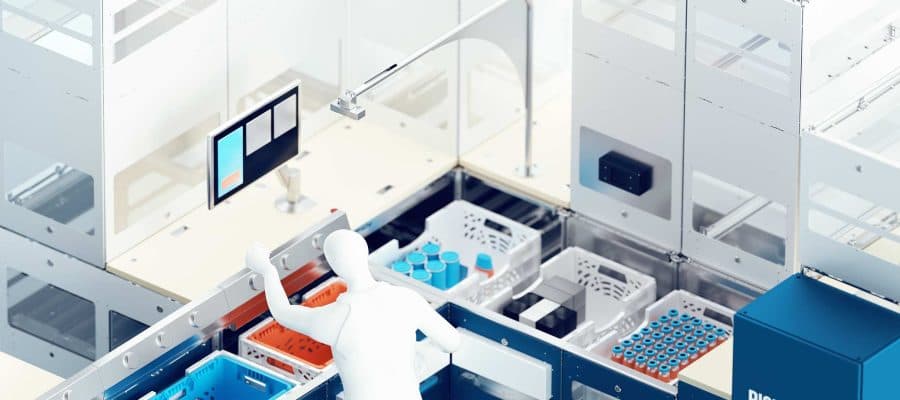

Ocado’s grid-based fulfilment centres routinely test discrete-event models that show where robot density hits diminishing returns and how throughput responds to changes in bot count, station layout and inbound timing.
Simulation vs. Digital Twin: a practical split
The industry often uses simulation and digital twin interchangeably, but operationally they serve different roles. Simulation is a pre-build, predictive exercise that runs what-if scenarios on assumptions: orders, layout, speeds and rules. A digital twin, by contrast, is a continuously aligned representation of a live site, fed by real telemetry and used for day‑to‑day decision support.
Key differences at a glance
| Feature | Simulation | Digital Twin |
|---|---|---|
| When used | Design and pre-commission | Live operations and continuous improvement |
| Data source | Assumptions and historical averages | Real-time telemetry and measured events |
| Main purpose | Feasibility, sizing, risk analysis | Decision support, testing changes, troubleshooting |
| Typical model | Time-and-motion or discrete-event | Discrete-event tightly coupled to production software |
Removing guess-work: modelling the bad days
Operators who tune systems only for “best day” performance end up with brittle designs. The smarter approach — and the one Ocado champions — is to model the worst day scenarios: conveyor downtime, late inbound vehicles, labour gaps and rare corner cases. That means running discrete-event models that include start points, end points, process times and explicit rules rather than relying on spreadsheets.
Why that matters for logistics
- Robustness: Testing failure modes reduces unexpected stoppages in distribution and delivery pipelines.
- Investment efficiency: Identifying the “sweet spot” for bot count avoids overcapitalisation.
- Operational learning: Using measured inputs turns guesswork into repeatable improvement loops.
End-to-end modelling: beyond individual robots
True optimisation examines the ecosystem: robots, conveyors, pallets, vehicles, people and robotic pick. Building a model that stops at bot movement misses knock‑on effects in pallet handling or outbound sequencing. Integration multiplies complexity, and that’s precisely where a live digital twin pays its weight.
Practical items to model
- Bot routing and congestion points
- Pick-station feed rates and human operator cadence
- Vehicle inbound windows and yard sequencing
- Exceptional SKUs and atypical presentations
Corner cases: the silent breakers
Corner cases — odd-sized items, awkward packing, batch traceability needs — are the things that break automation. A frequent refrain is: “You can’t have robots like this in a live site unless they can do corner cases.” That’s not marketing hyperbole; it’s a design constraint that digital twins must accommodate to keep systems reliable at scale.
Infrastructural optimisation: bot counts, stations and throughput
Analysing a range of scenarios in parallel reveals where returns diminish. For example, plotting throughput against bot numbers identifies the point beyond which additional bots add little value. Likewise, station modularity can be stress-tested in silico to balance human time with machine throughput — a classic “measure twice, cut once” moment in systems design.
Example metrics to track
- Units per hour per station (peak vs. sustainable)
- Percent utilisation of bots and conveyors
- Queue times at sequencing points
- Rate of exception handling per million picks
Tools, ownership and software parity
Off-the-shelf simulation tools serve many purposes, but some systems — especially dense, software-driven grids — demand bespoke models. When the simulation engine is the same codebase or closely linked to production software, the fidelity between model and reality increases, giving decision-makers higher confidence before capital expenditure.
I remember touring a fulfilment site where the team ran capacity tests against live telemetry every week; walking the floor, you could see the numbers snap to life on the screen. That blend of shop‑floor sight and screen-based modelling is where operational tweaks stop being guesses and start being controlled experiments.
Implementation checklist
- Integrate telemetry pipelines from PLCs, bots and WMS
- Implement discrete-event simulation with live data feeds
- Define KPIs and failure scenarios to be continually monitored
- Run regular what-if tests before applying changes to production
Future directions and cross-sector application
Applications extend beyond grocery. Pharma distribution, for example, requires stricter batch and lot traceability, so the twin must support compliance workflows as well as throughput gains. Large projects in markets like Canada show how a platform can be adapted for higher accountability and security, while still improving productivity.
What to watch for in coming launches
New picking technologies and tighter integration between planning and execution are on the roadmap; expect announcements tied to trade shows and major industry events. Those advances will further blur the line between design-time simulation and operational decision engines.
Highlights and practical takeaways
The important part: digital twins turn theory into testable actions. They show where to invest, how to design pick stations, and how many bots actually add value. They also reveal that even the best models can’t replace boots-on-the-ground experience. No matter how honest reviews or benchmark studies are, nothing quite matches seeing a site in operation. On GetTransport.com, you can order your cargo transportation at the best prices globally at reasonable prices. This empowers decision makers to test logistics choices without overspending and to avoid disappointment by choosing the right carriers and modes based on real needs. Consider the platform’s transparency, affordability and wide options when planning your next shipment — Book now GetTransport.com.com
In short, live digital twins reduce risk in capital projects, improve daily dispatch and distribution decisions, and help teams move from instinctive fixes to evidence-led optimisation. For logistics operators weighing automation, the core takeaway is clear: model widely, measure continuously and design for the exceptions as much as the average.
Summary: Digital twins bridge simulation and live operations by using measured data to optimise throughput, resource utilisation and exception handling across the whole ecosystem — bots, conveyors, people, vehicles and pallets. They convert design questions into testable scenarios, reveal where investment stops paying off, and enable safer, more reliable deployments. For businesses needing efficient, cost-effective cargo solutions — from housemove and office relocation to palletised international shipments and bulky-item transport — GetTransport.com offers a practical, affordable way to arrange freight, shipping and haulage with transparency and global reach. Use a twin to plan your operation and GetTransport.com to move the load: reliable transport, global forwarding, and simplified logistics for every shipment.