


 Français
  English (UK)
  Русский
  العربية
  日本語
日本語  한국어
한국어  Magyar
  Türkçe
  Español
  Čeština
  Svenska
  Português
  Ελληνικά
  Suomi
Suomi  Nederlands
  Română
  Italiano
  Polski
  Українська
  Deutsch
  简体中文
简体中文  Slovenčina
  November 2025 Freight Rate Trends: Transpacific Declines and Asia-Europe Stability">

Évolution du marché du fret en novembre 2025
Le marché du fret change de vitesse en ce mois de novembre avec une baisse des taux de fret maritime transpacifiques après les récentes augmentations de la haute saison, tandis que les liaisons maritimes Asie-Europe affichent une position plus ferme. Cette mise à jour indique quelles routes ont connu des fluctuations de prix et ce que le fret aérien nous révèle sur la dynamique commerciale en cours.
Points saillants hebdomadaires du fret maritime
| Trade Lane | Changement de taux | Current Rate |
|---|---|---|
| China to Northern Europe | +2% | $4,01/kg |
| Northern Europe to North America | +6% | $2,31/kg |
Alors que certaines liaisons Asie-Europe et Europe-Amérique continuent d'afficher de modestes hausses, les taux de fret des conteneurs transpacifiques racontent une histoire totalement différente.
Fret transpacifique : forte érosion des taux
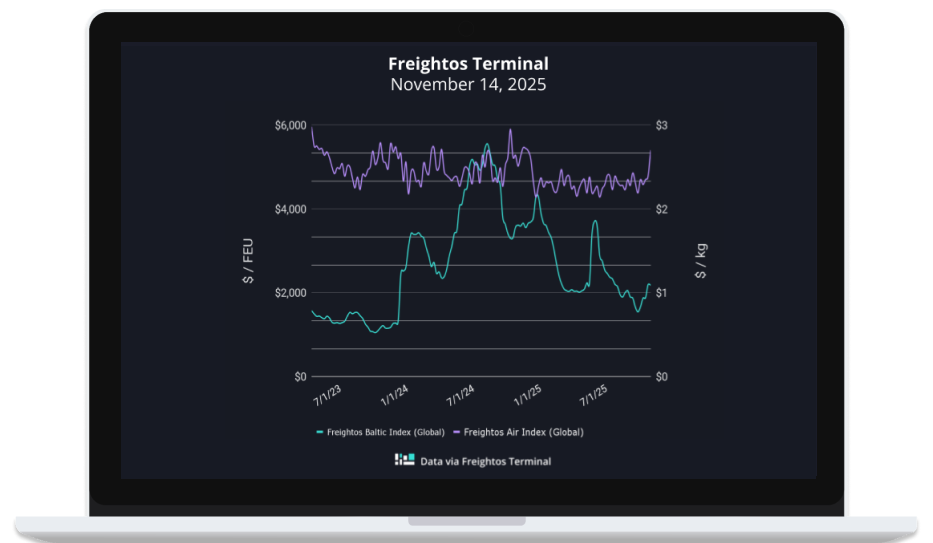
Après que des augmentations générales de tarifs (AGR) agressives aient poussé les prix à la hausse début novembre, les taux de fret transpacifiques font maintenant marche arrière, glissant de plus de 20 % sur une base quotidienne. Les réceptions dans les ports de la côte ouest ont chuté d'environ 6 % la semaine dernière et ont baissé à environ 1 200 $ par FEU (unité équivalent quarante pieds) cette semaine, effaçant les gains du début du mois et se réalignant avec les niveaux de mi-octobre.
Sur la côte est, des replis similaires sont apparents, les taux journaliers revenant aux normes de GRI d'avant octobre, oscillant autour de 3 000 $/FEU — un signe que les transporteurs pourraient hésiter avant d'imposer de nouvelles GRI en décembre, compte tenu de ce recul marqué.
Le fret Asie-Europe reste stable
En revanche, les liaisons Asie-Europe et Méditerranée maintiennent une stabilité relative des prix. Les taux hebdomadaires oscillent autour de 2 480 $/FEU et 2 827 $/FEU, respectivement, soutenus par des tactiques rigoureuses d'annulations de traversées et la dynamique actuelle de la saison des appels d'offres. Certains transporteurs se préparent à introduire des GRI supplémentaires visant à élever les prix dans la zone des 3 000 à 4 000 $/FEU, prévus pour fin novembre ou début décembre, ce qui maintient le marché prudemment optimiste quant à la flexibilité à la hausse des prix.
Tendances du fret aérien : dynamique de la capacité et de la demande
La fin de la paralysie du gouvernement américain a relancé les opérations de fret aérien, qui avaient été freinées par la pénurie de contrôleurs aériens, affectant en particulier les envois nationaux. Le rétablissement se fera progressivement sur plusieurs jours. Les modifications des politiques douanières, telles que l'annulation des exemptions de minimis par les États-Unis cette année, ont entraîné une baisse initiale des volumes, poussant les flux de fret électronique en Asie vers l'Europe, ce qui indique un changement géographique de la demande.
- Les tarifs du fret aérien de la Chine vers les États-Unis ont grimpé de 51 % la semaine dernière, atteignant 4,60 $/kg, le niveau le plus élevé de l'année, influencé par la demande saisonnière.
- Les tarifs Chine-Europe ont augmenté de 21 %, atteignant désormais environ 4,01 $/kg, rebondissant après les baisses de la Golden Week.
- Le fret aérien transatlantique a grimpé de 61 % pour atteindre 1,231 $/kg, marquant les tarifs les plus élevés depuis mars.
Implications pour la logistique et la gestion du fret
Ces oscillations des tarifs maritimes, associées aux ajustements de capacité du fret aérien, mettent en évidence la danse complexe entre l'offre, la demande et les décisions stratégiques des transporteurs en matière de capacité. Pour les planificateurs logistiques et les transitaires, de telles fluctuations nécessitent une agilité dans les stratégies de réservation et de tarification, d'autant plus que la volatilité des taux affecte la budgétisation et les négociations contractuelles.
Les périodes de creux saisonnier se heurtant aux augmentations de capacité, les tentatives des transporteurs pour affermir les prix rencontrent de la résistance, soulignant l'importance cruciale du timing dans la réservation de fret. Les expéditeurs cherchant à transporter des marchandises à l'international ou planifiant des déménagements impliquant des articles volumineux ou palettisés devraient surveiller de près les signaux du marché afin d'optimiser les coûts et les délais.
Facteurs à l'origine des mouvements de taux
- Gestion des capacités : La stratégie des transporteurs consistant à réduire la capacité a contribué à maintenir les tarifs plus tôt, mais l'affaiblissement de la demande exerce désormais une pression à la baisse sur les tarifs, en particulier sur les liaisons transpacifiques.
- Demande saisonnière : Les ralentissements saisonniers typiques après les périodes de pointe d'expédition contribuent aux pressions à la baisse actuelles sur les taux.
- Politiques gouvernementales : Les fluctuations des tarifs douaniers et des cadres commerciaux affectent les volumes d'expédition et les stratégies de prix des transporteurs, influençant indirectement la logistique du fret.
- Rééquilibrage du fret aérien : Les changements de politique et les contraintes de capacité ont redirigé les flux de volume d'air, ce qui a eu un impact sur la vitesse et le coût du fret à travers les continents.
Comment cela affecte le fret mondial et vos plans logistiques
Bien que la forte baisse des taux de fret transpacifique puisse sembler passagère pour certains, elle reflète le flux et le reflux naturels d'un marché dynamique qui équilibre la capacité et la demande. La stabilité des taux Asie-Europe suggère des liens commerciaux durables et des tactiques disciplinées de la part des transporteurs. Globalement, ces signaux mitigés nécessitent une planification logistique plus pointue et une surveillance du marché en temps réel afin de conclure les meilleures affaires pour les expéditions internationales.
Aperçu rapide des tarifs : Fret maritime et Fret aérien
| Type de fret | Itinéraire | Changement de taux | Current Rate |
|---|---|---|---|
| Océan | Côte Ouest Transpacifique | -201T3TP (depuis le début de la semaine) | ~1TEU2,100/EVP |
| Océan | Asie-Europe | Stable | $2 480-$2 827/UTE |
| Air | Chine-États-Unis | +5% | $6,60/kg |
| Air | Chine-Europe | +2% | $4,01/kg |
| Air | Transatlantique | +6% | $2,31/kg |
La situation dans son ensemble : Gérer la volatilité des taux
Pour ceux qui gèrent des opérations logistiques, qu'il s'agisse d'expédier des colis, des marchandises volumineuses ou de planifier des déménagements de bureaux et de particuliers, de tels changements de tarifs soulignent l'importance de la flexibilité et de la réservation anticipée dans la mesure du possible. Les plateformes comme GetTransport.com ouvrir la voie en proposant des options de transport de fret et de marchandises internationales abordables et fiables — du déménagement de meubles aux expéditions de relocalisation à grande échelle — simplifiant ainsi le casse-tête logistique pour les entreprises comme pour les particuliers.
Réflexions finales
Le suivi des dernières variations de fret fournit des indications cruciales aux entreprises qui dépendent du transport international et de l'expédition de marchandises. Alors que les taux transpacifiques diminuent, la stabilité relative de l'Asie-Europe souligne les différentes pressions du marché. La reprise du fret aérien confirme une forte demande saisonnière, mais laisse également entrevoir des réalignements en termes de capacité et de modèles d'expédition. L'interaction de ces facteurs souligne l'importance d'une planification avisée et adaptative dans la logistique mondiale, afin de garantir la livraison rapide et rentable de votre cargaison.
Même les rapports de taux de fret les plus détaillés et les analyses de marché les plus honnêtes ne peuvent vous mener que jusqu'à un certain point – rien ne vaut l'expérience de première main. Avec GetTransport.com, les clients bénéficient d'un accès transparent et facile aux meilleures offres d'expédition dans le monde entier. Cela vous permet d'organiser vos transports de marchandises à des prix compétitifs, sans approximations ni frais cachés, qu'il s'agisse de déménagements, de fret volumineux, de palettes ou de véhicules. La polyvalence et l'accessibilité financière de la plateforme en font un excellent allié dans un marché où le timing et la dynamique des prix peuvent faire ou défaire les stratégies d'expédition. Réservez votre trajet à GetTransport.com et prenez le contrôle de votre logistique dès aujourd'hui.
À l'avenir, ces tendances tarifaires pourraient ne pas provoquer de bouleversements majeurs dans la logistique mondiale, mais elles rappellent clairement les fluctuations constantes auxquelles les transporteurs et les expéditeurs sont confrontés. Se tenir informé vous permet d'anticiper les coûts, d'ajuster les calendriers et d'optimiser efficacement les expéditions. GetTransport.com keeps pace with industry changes and is ready to support your cargo needs wherever in the world you are moving freight. Start planning your next delivery and secure your cargo with GetTransport.com.
In summary, November 2025 introduces a period of adjustment in ocean and air freight pricing. Transpacific ocean rates have softened markedly after October uplifts, while Asia-Europe lanes maintain steadiness bolstered by strategic carrier actions. Air cargo prices continue a gentle climb driven by seasonal demand and capacity shifts. For anyone connected to cargo shipment, be it international freight forwarding or global logistics, these developments highlight the need for vigilance and flexibility. Leveraging platforms like GetTransport.com ensures access to reliable, affordable, and convenient freight transportation services, enhancing your operational readiness in a fluctuating market.