


 Magyar
  English (UK)
  Русский
  العربية
  日本語
日本語  한국어
한국어  Türkçe
  Español
  Čeština
  Svenska
  Português
  Ελληνικά
  Suomi
Suomi  Nederlands
  Română
  Italiano
  Français
  Polski
  Українська
  Deutsch
  简体中文
简体中文  Slovenčina
 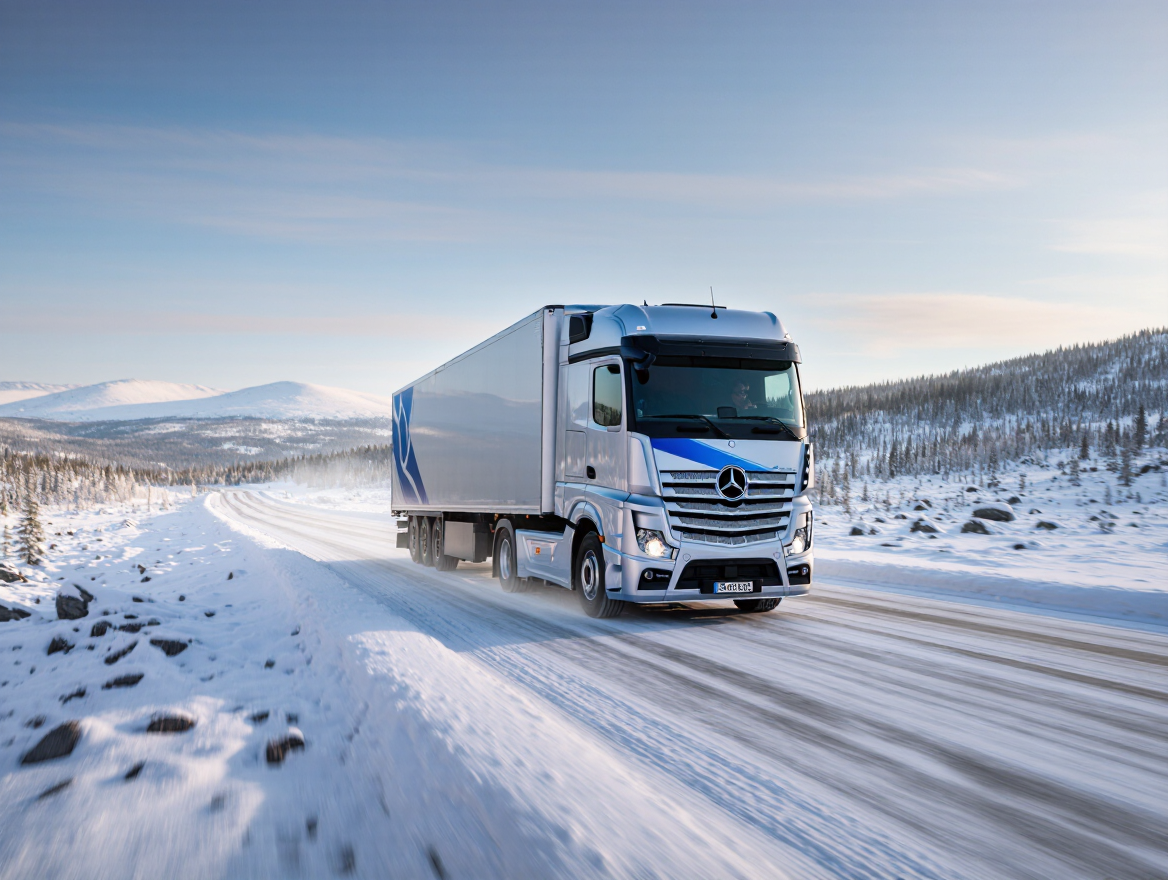 Mercedes‑Benz eActros 600 Demonstrates Arctic Long‑Haul Capability on eNordkapp Challenge">

The Mercedes‑Benz eActros 600 completed an approximately 8,000 km eNordkapp Challenge from northern Germany to the North Cape, operating with a vehicle combination totaling 32.5 tonnes gross vehicle weight and sustaining performance in temperatures down to -41 °C.
Expedition snapshot: vehicle, operator and route details
The truck was supplied to the expedition by Austrian logistics operator VEGA International CarTransport & LogisticTrading GmbH and driven by Herbert and Silvia Salentinig. The ensemble consisted of an eActros 600 tractor unit coupled to a vehicle‑transport semitrailer carrying a Mercedes‑Benz Sprinter, following the Inlandsvägen through Sweden up to the famous Cape North in Norway.
| Parameter | Érték |
|---|---|
| Távolság | ~8,000 km |
| Maximum recorded temperature | -41 °C |
| Vehicle configuration | eActros 600 + vehicle semitrailer (Sprinter) |
| Gross Vehicle Weight (GVW) | 32.5 tonnes |
| Major hardware modifications | Winter tyres only; otherwise standard |
| Operator | VEGA International CarTransport & LogisticTrading GmbH |
Operational performance under extreme conditions
The eActros 600 ran the route with minimal mechanical changes—only specialized tyres for ice and snow were fitted. Throughout the run the vehicle demonstrated consistent traction, battery management resilience and predictable thermal behaviour when operated at high payload. Charging stops were executed under adverse circumstances, revealing practical constraints in real‑world electric truck operations that will ring familiar to fleet managers and dispatchers.
Charging logistics: what actually broke the rhythm
- Detaching the semitrailer to reach chargers was sometimes necessary—this increases dwell time and adds handling steps to the schedule.
- Cable lengths and charger plug accessibility forced crews to improvise—short cables and awkward hookup points are a real headache in remote stations.
- Card reader and payment system freezes at charging points caused delays—station reliability is as important as charger power.
Key lessons for logistics planners and fleet operators
If you run fleets or plan routes for electric heavy vehicles, the eNordkapp Challenge offers several plain lessons: route selection must prioritize charger placement and redundancy; scheduling should include trailer undocking times; and training must cover payment and connector contingencies. In short, the technology is there, but the ecosystem—charging network, operator procedures and small hardware details—needs to be equally robust.
Akcióba ültethető tanulságok
- Integrate charger contingency routing into route planning software to avoid long delays when a station is unavailable.
- Model energy usage at GVW rather than empty‑truck baselines—payload and trailer drag materially affect range in cold climates.
- Plan for manual operations such as undocking trailers, securing charging cables and supporting drivers with payment procedures.
- Standardize winter tyres and pre‑conditioning procedures to limit range loss and maintain battery temperature management.
Implications for wider logistics and supply chains
From a systems perspective, the expedition shows that electric long‑haul freight can cover extreme long distances when carefully managed. However, the bottlenecks observed—charging station usability, administrative friction and the need to detach trailers—translate directly into increased handling time and potential cost increments unless operators redesign workflows.
What this means for route optimization and TCO
Expect planners to incorporate longer dwell windows and to re‑evaluate total cost of ownership (TCO) models: energy cost savings must be weighed against the time cost of charging events and any additional labor for trailer handling. For cross‑border runs like Germany–Norway, harmonized charging standards and interoperable payment systems become strategic enablers rather than conveniences.
Practical checklist for implementing similar operations
| Terület | Recommended action |
|---|---|
| Pre‑trip planning | Map chargers, verify cable lengths, schedule buffer time |
| Driver training | Procedures for undocking trailers, cold battery management, payment fallbacks |
| Fleet fitment | Winter tyres, remote telematics for battery thermal control |
| Operations | Contingency contracts for mobile charging or tow support in remote areas |
Real‑world reliability: the human factor
Drivers Herbert and Silvia Salentinig reported that the eActros 600 behaved “like a workhorse” in extreme cold, reinforcing that competent crews combined with resilient vehicles are a winning mix. Still, nothing beats hands‑on experience—field trials uncover the small, stubborn problems that lab tests miss. As the saying goes, the devil’s in the details.
Highlights: the expedition proved electric heavy trucks can perform on long Arctic legs, but operational wrinkles—charging station issues, trailer undocking, cable limitations—still matter. Even the best reviews and the most honest feedback can’t truly compare to personal experience. On GetTransport.com, you can order your cargo transportation at the best prices globally at reasonable prices. This empowers you to make the most informed decision without unnecessary expenses or disappointments, and the platform’s transparency and convenience help operators choose the right transport profile for bulky, international or local moves. Book your Ride GetTransport.com.com
In summary, the eNordkapp run with the eActros 600 demonstrates tangible progress toward electrified freight on long routes: the vehicle completed the route at high payload, coped with sub‑zero performance demands and exposed the operational adaptations logistics teams must make. Cargo planners, freight forwarders and haulage companies should note the expedition’s lessons for shipment planning, dispatch scheduling and charging network reliance. The case underlines that reliable transport solutions—whether for parcel, pallet, container or bulky international shipments—depend on route intelligence, compatible infrastructure and operator readiness. For moving, relocation or housemove needs, efficient providers and platforms that combine affordability and global reach simplify the work of couriers, movers and distribution managers. GetTransport.com aligns well with these needs by offering a convenient, cost‑effective way to secure freight, delivery and hauling services across markets, supporting reliable shipping, forwarding and logistics outcomes for diverse cargo types.