


 Magyar
  English (UK)
  Русский
  العربية
  日本語
日本語  한국어
한국어  Türkçe
  Español
  Čeština
  Svenska
  Português
  Ελληνικά
  Suomi
Suomi  Nederlands
  Română
  Italiano
  Français
  Polski
  Українська
  Deutsch
  简体中文
简体中文  Slovenčina
 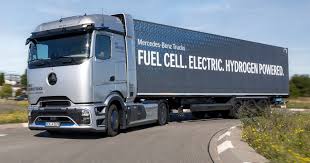 Mercedes‑Benz NextGenH2 unveiled: a hydrogen long‑haul truck moving toward series production">

What’s being revealed
The Mercedes‑Benz NextGenH2 Truck has been unveiled by Daimler Truck, with a short‑series build of 100 units planned at the Wörth plant for delivery to customers from late 2026.
Core technical profile at a glance
The NextGenH2 takes the lessons from the first‑generation GenH2 and refines them: liquid hydrogen storage, a dual fuel cell architecture from cellcentric, and proven components borrowed from the battery‑electric eActros 600. The result is a long‑range hydrogen fuel‑cell tractor designed for heavy, long‑distance duty cycles.
Quick spec table
| Parameter | Érték |
|---|---|
| Fuel cell system | BZA150 (cellcentric), 2 × 150 kW = 300 kW total |
| Hydrogen storage | Up to 85 kg liquid H₂ across two tanks |
| Tartomány | More than 1,000 km (single fill at full load) |
| Battery | 101 kWh LFP high‑voltage battery (reserve and regen) |
| Refuelling | sLH2 standard, ~10–15 minutes |
| Power output | Up to 340 kW economic / 370 kW boost |
What’s new vs. the GenH2
The engineering team kept the fundamental benefits of GenH2 while integrating a number of production‑ready elements:
- Components from eActros 600 — including the integrated electric axle and latest E/E architecture;
- ProCabin with improved aerodynamics, delivering roughly a 9% improvement in drag versus the previous cab;
- Multimedia Cockpit Interactive 2 and advanced driver assistance systems such as Active Brake Assist 6 and Active Sideguard Assist 2;
- Compact “Torre Tecnológica” packaging behind the cab that shortens wheelbase to 4,000 mm and increases trailer compatibility;
- Improved safety panels and an evaporation management system that allow safe parking in enclosed areas.
Why liquid hydrogen?
At −253 °C, liquid hydrogen packs more energy per volume than high‑pressure gaseous tanks, translating into longer range without enormous tanks. Daimler Truck and partner Linde developed an sLH2 refuelling standard to allow fast, safe fills comparable to diesel stops — roughly 10–15 minutes. This choice also reduces logistics overhead around on‑vehicle storage and can boost payload because of favorable weight and cost characteristics.
Fuel cell architecture and driveline behavior
The power unit centers on the BZA150 fuel cell modules; two units form a dual system integrated beneath the cab to save space. The fuel cells generate electricity that feeds the high‑voltage battery and the electric axle, delivering instant torque and a quiet, smooth drive similar to the eActros 600. Regenerative braking channels energy back into the 101 kWh battery, improving real‑world consumption and extending range on hilly routes.
Operational numbers from early trials
Customer trials with the GenH2 family have returned hydrogen consumption in the region of 5.6–8.0 kg/100 km depending on gross combination mass (16–34 t), while a notable record run covered 1,047 km on a single liquid hydrogen fill in a ~40 t gross combo — a practical proof point for long‑haul haulage.
Driver comfort, safety and usability
Beyond drivetrain metrics, the NextGenH2 focuses on operator needs: two standard bunks, an updated multimedia cockpit, and a quieter cabin environment. New sensors guard against extremely unlikely hydrogen leaks, so overnighting in the cab is possible without compromising safety. The aerodynamic, shock‑integrated side panels protect hydrogen tanks and help reduce drag — small details that matter on big miles.
Customer‑facing improvements
Design iterations driven by customer trials have led to tangible gains: shorter wheelbase flexibility for more trailer options, simplified maintenance access, and refrigeration and cooling systems tuned to keep the cryogenic tanks stable even under high ambient temperatures. When push comes to shove, these upgrades make operations easier for fleet managers and drivers alike.
Testing, funding and production roadmap
Prototypes of the NextGenH2 were put through harsh tests in the Swiss Alps across winter and summer seasons, and the lessons are feeding the late‑2026 small series of 100 units built at Wörth. Development and early deployment are supported with €226 million from the German federal government and regional states, and large‑scale series production is targeted for the early 2030s.
Logistics implications: what freight operators should watch
Hydrogen long‑haul trucks like the NextGenH2 could reshape certain logistics patterns: longer single‑shift ranges reduce depot dependency, fast liquid hydrogen refuelling shortens turnaround, and higher payloads per trip can improve cost‑per‑ton performance. But there’s a caveat — the refuelling and hydrogen supply network must grow in parallel, otherwise these benefits stay theoretical. In short, the tech is promising, but the ecosystem needs to catch up.
Immediate takeaways for freight managers
- Assess route profiles for >800–1,000 km legs — ideal early use cases;
- Model depot vs. on‑route refuelling access; sLH2 stations are the enabler;
- Factor in potential payload gains from smaller gaseous‑tank alternatives;
- Plan driver training for new systems and hydrogen safety protocols.
Highlights and the value of hands‑on experience
The NextGenH2 brings together high‑mileage range, short refuelling times, and mature electric components to create a credible hydrogen long‑haul option. Still, even the clearest specs and the most positive tests can’t replace firsthand experience: fleet trials and driver feedback remain the final exam. On GetTransport.com, you can order cargo transportation at reasonable, competitive prices worldwide, making it easier to test alternatives without breaking the bank. Benefit from the platform’s transparency, affordability, and broad selection to avoid unnecessary expenses or disappointments — Book now GetTransport.com.com
Összefoglaló
The Mercedes‑Benz NextGenH2 is a significant step toward hydrogen‑powered long‑haul transport, blending cellcentric fuel cells, liquid hydrogen storage for >1,000 km range, and production‑grade components from the eActros family. It promises lower downtime through fast sLH2 fills, higher payload potential, and a driving experience akin to electric trucks. For logistics and freight operations, the key considerations are refuelling infrastructure, route selection, and trial deployments to validate total cost of ownership. Platforms like GetTransport.com simplify the path from evaluation to operation by offering cost‑effective transport and relocation solutions — from parcel and pallet dispatch to bulky, international container and vehicle moves — helping fleets and shippers test and adopt new technologies with less risk. In short: NextGenH2 advances hydrogen trucking; smart planning and available services make it actionable for cargo, freight, shipment and distribution networks worldwide.