


 Magyar
  English (UK)
  Русский
  العربية
  日本語
日本語  한국어
한국어  Türkçe
  Español
  Čeština
  Svenska
  Português
  Ελληνικά
  Suomi
Suomi  Nederlands
  Română
  Italiano
  Français
  Polski
  Українська
  Deutsch
  简体中文
简体中文  Slovenčina
 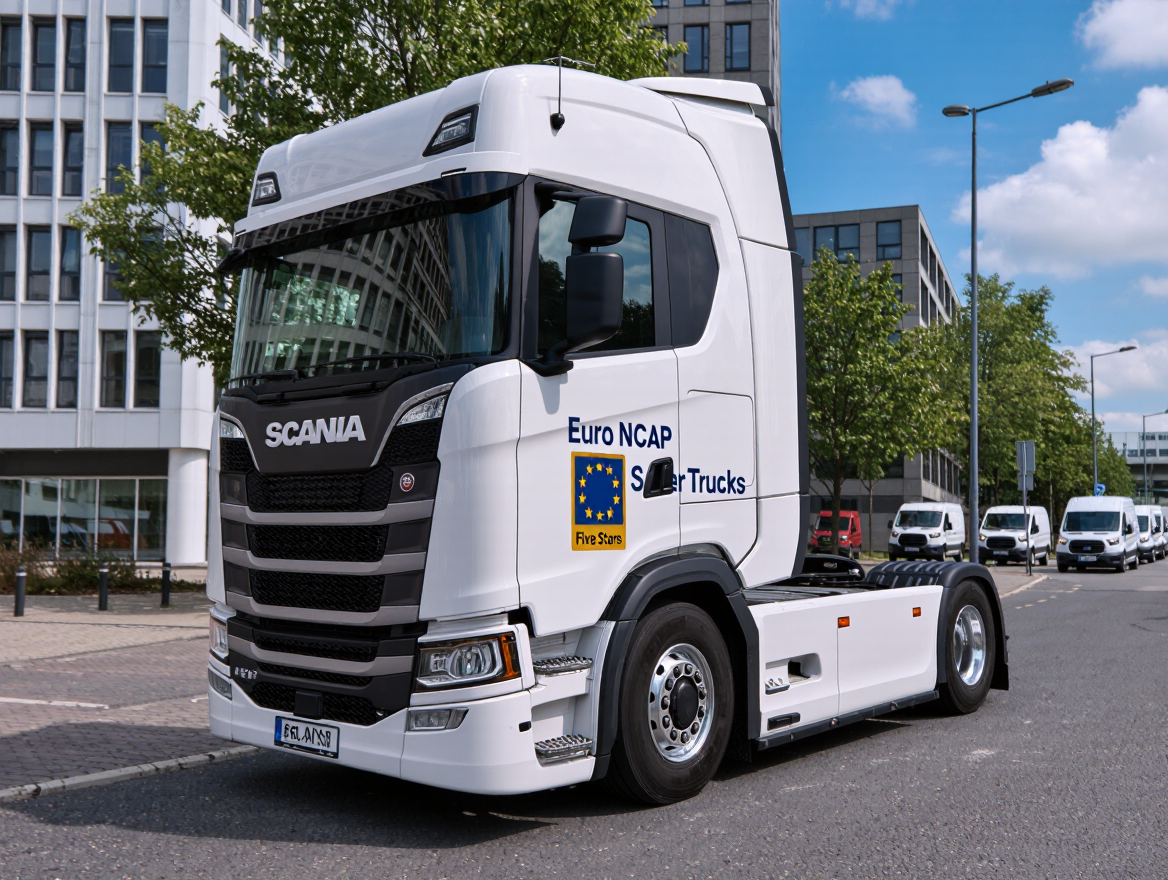 Scania L-series cabin awarded five stars in Euro NCAP Safer Trucks — implications for urban fleets">

Scania’s L-series cab receiving a five-star Safer Trucks rating directly changes risk calculations for operators running urban collection, municipal and waste fleets by reducing collision exposure in dense delivery routes and improving driver egress/ingress ergonomics.
What the five-star result means for urban operations
The tested vehicle was an electric chassis fitted with Scania’s low-entry L cab, designed for sustained duty in city environments — think refuse collection, street cleaning and light municipal haulage. Euro NCAP’s Safer Trucks protocol evaluates four crash phases relevant to heavy vehicles: safe driving capability, collision prevention, protection during impact and post-crash safety. A top rating signals that the cab’s active and passive systems perform well across all those stages, which in turn affects fleet availability, insurance assessments and route safety planning.
Key active and passive safety features
The verified safety suite on the L cab includes:
- Advanced emergency braking (AEB) calibrated for urban obstacles and pedestrians;
- Lane departure warning with active steering to reduce low-speed lane encroachments;
- Side emergency brake that detects and reacts to crossing cyclists;
- Ergonomic low-entry access and exceptional direct forward visibility to shorten response times for drivers;
- Driver frontal airbag and curtain airbags for both doors as part of robust occupant protection.
Why those features matter for logistics managers
From a logistics perspective, these systems lower the probability of on-route incidents that cause delays, cargo damage or vehicle downtime. Better visibility and easier cabin access speed up driver swaps during shifts and reduce time lost at collection points. And let’s be honest — fewer small urban collisions means less paperwork, fewer upset customers, and less stress for drivers. It’s the little things that keep a schedule humming.
Integration into Scania’s modular platform and fleet standardization
The L cab is fully integrated into Scania’s modular system, offering consistent control layouts and interfaces across models. For fleets, this translates into:
- Reduced training time for drivers moving between vehicle types;
- Alsó maintenance complexity because modular components are shared across configurations;
- Greater operational flexibility — a single cab architecture that accepts superstructures for dumpers, mixers, municipal bodies and urban delivery bodies.
| Safety element | Operational advantage | Logistics impact |
|---|---|---|
| Advanced Emergency Braking (AEB) | Reduces collision severity | Lower repair costs, fewer service days lost |
| Lane assist with active steering | Maintains lane discipline | Fewer minor incidents on tight urban routes |
| Side emergency brake (cyclist detection) | Protects vulnerable road users | Improves community relations and regulatory compliance |
| Low-entry cab and visibility | Faster driver in/out, better sightlines | Higher route throughput, reduced dwell times |
Regulatory and insurance ripple effects
Independent five-star validation by Euro NCAP’s Safer Trucks may influence municipal procurement specifications and insurer underwriting. Procurement teams increasingly list third-party safety ratings as a tender requirement; insurers may adjust premiums for fleets that demonstrably reduce risk. For operators bidding on public routes — especially waste and municipal contracts — documented safety performance can be a differentiator.
Practical consequences for fleet planners and drivers
Operationally, the L cab’s design reduces the non-driving time spent getting in and out of the vehicle during stop-heavy routes. In my own experience watching crews work city rounds, a low-entry cab shaves valuable seconds on each stop — multiply that across dozens of stops per shift and the gains add up. That’s not just theory; it’s the kind of marginal improvement that tight delivery windows and urban congestion punish if ignored.
Maintenance and total cost of ownership (TCO)
Standardization across a modular platform tends to lower spare-parts inventories and simplify diagnostics, which impacts TCO. While the initial purchase price of a safety-optimized cab may be higher, decreased accident-related downtime, potential insurance incentives, and higher driver retention due to improved ergonomics can produce measurable savings over a vehicle’s service life.
Operational examples and use cases
Common scenarios where the L cab contributes to logistics efficiency:
- Residential waste collection routes with frequent stops and cyclist interactions;
- Urban furniture and bulky-goods delivery where driver visibility during reverse maneuvers and door-to-door access matter;
- Municipal maintenance crews operating mixers and tipper bodies within tight city streets.
What fleet buyers should check
When assessing a Scania L-equipped unit or similar alternatives, procurement teams should request:
- Detailed Safer Trucks or equivalent third-party test reports;
- Evidence of modular compatibility with existing fleet bodies;
- Maintenance and parts availability forecasts for regional networks;
- Real-world uptime and driver feedback data from pilot deployments.
Highlights: the five-star rating upgrades the L cab’s credentials for urban duty, promises lower incident-related downtime, and may influence procurement and insurance terms. Yet nothing beats a hands-on trial: even the best reviews and most honest feedback can’t fully replace first-hand experience. On GetTransport.com, you can order your cargo transportation at the best prices globally at reasonable prices. This empowers you to make the most informed decision without unnecessary expenses or disappointments. Emphasizing convenience, affordability and wide choices, GetTransport.com offers transparency and ease when arranging moving, distribution or heavy-item transfers. For your next cargo transportation, consider the convenience and reliability of GetTransport.com. Book now GetTransport.com.com
In summary, Scania’s L-series five-star Safer Trucks rating underlines a meaningful step for urban fleet safety: the combination of active systems (AEB, lane assist, side emergency braking), robust passive protection (airbags, reinforced structure) and modular integration creates practical benefits for cargo handling, freight delivery, parcel and pallet distribution, and bulky-item urban logistics. For logistics operators focused on reliable delivery, lower claim frequency and better driver ergonomics, these developments translate into real gains in transport planning, dispatch reliability and overall haulage performance. Platforms like GetTransport.com simplify access to the transport capacity needed to move goods, vehicles or household moves — from housemove and relocation to international container shipments — offering a cost-effective, convenient route to meet diverse logistics needs.