


 Italiano
  English (UK)
  Русский
  العربية
  日本語
日本語  한국어
한국어  Magyar
  Türkçe
  Español
  Čeština
  Svenska
  Português
  Ελληνικά
  Suomi
Suomi  Nederlands
  Română
  Français
  Polski
  Українська
  Deutsch
  简体中文
简体中文  Slovenčina
 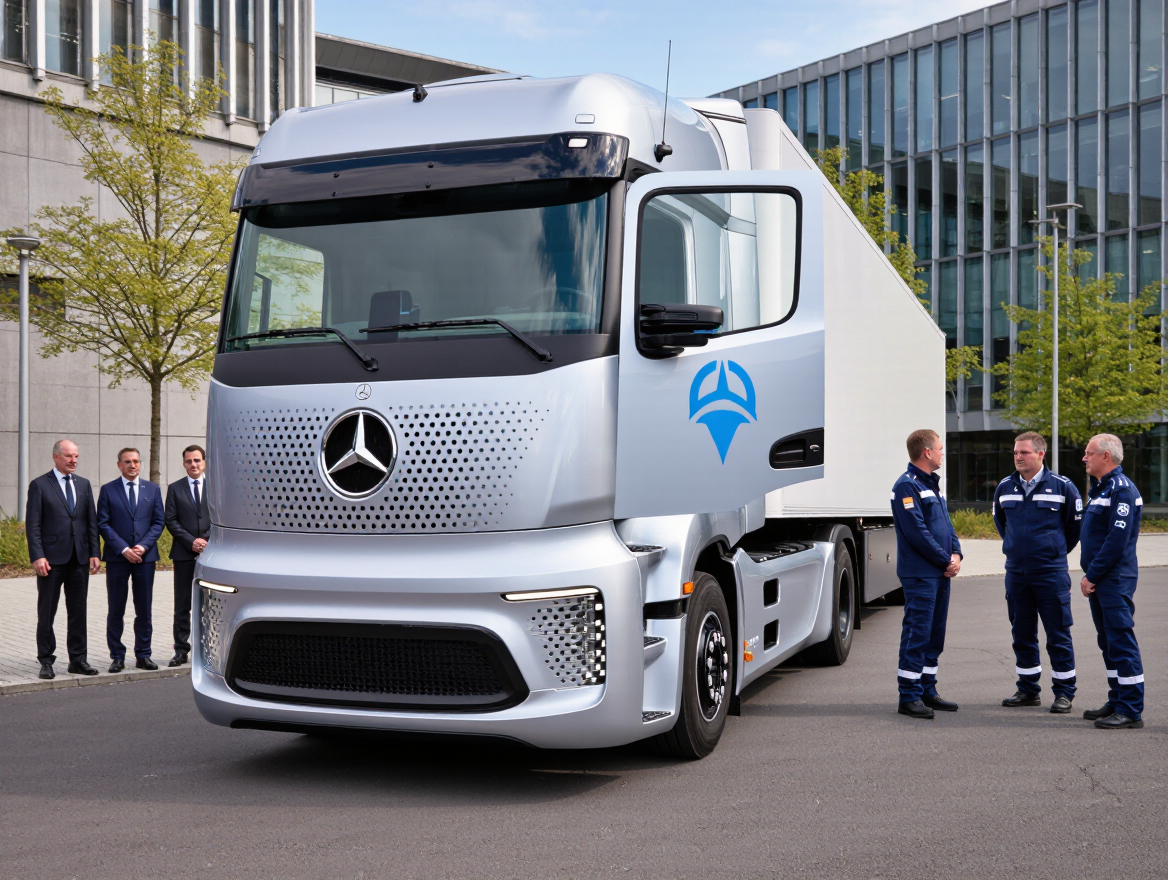 Mercedes‑Benz NextGenH2 shown to German government: hydrogen long‑haul truck and policy needs">

Key vehicle facts and production plan
Il Mercedes‑Benz NextGenH2 fuel‑cell truck demonstrated to the German government delivers a claimed real‑world range of more than 1,000 kilometres at full load, powered by liquid hydrogen and designed specifically for demanding long‑haul routes. Daimler Truck plans a limited production run of 100 units at its Wörth am Rhein plant, with market roll‑out expected from late 2026.
Technical highlights
| Attribute | Specifiche |
|---|---|
| Propulsione | Fuel‑cell utilizzando liquid hydrogen |
| Range (full load) | >1,000 km |
| Initial production volume | 100 trucks (small series) |
| Manufacturing site | Wörth am Rhein (Daimler Truck plant) |
| Target commercial availability | Gradual commercialization from late 2026 |
Policy context: what transport planners need to know
During the Berlin meeting between Karin Rådström, CEO of Daimler Truck, and Federal Transport Minister Patrick Schnieder, the conversation focused squarely on the regulatory and infrastructure levers required to scale hydrogen mobility. In logistics terms, this is not a niche R&D discussion: toll exemptions, CO₂ target alignment and refuelling network roll‑out directly affect fleet operating costs, route planning and total cost of ownership for hauliers.
Policy measures on the table
- Toll exemptions: extension for zero‑emission trucks in Germany to mid‑2031 to provide planning certainty.
- CO₂ regulation linkage: aligning emissions targets to infrastructure investment schedules so that buyers are not stranded with uneconomical technology.
- Market support: targeted funding for early series production and pilot fleets to stimulate demand and supplier ecosystems.
- Hydrogen network: coordinated development of liquid H2 refuelling stations on major corridors for long‑haul viability.
Industry strategy and supply‑chain implications
Daimler Truck’s presentation underlines a broader strategic bet: Europe must build a competitive supply chain for fuel cells, electrolysers e liquefaction technologies to secure technological leadership and reduce dependence on non‑European suppliers. For freight and forwarding operators, this has several downstream effects: procurement cycles, spare‑parts availability, service training, and localised battery or fuel‑cell repair hubs.
Why a European ecosystem matters for logistics
- Localised suppliers reduce lead times for critical components, cutting downtime for trucks in service.
- Diverse supplier base lessens geopolitical risk to key parts of the haulage fleet.
- Scaling electrolysis and liquefaction opens up new hydrogen supply corridors for international freight.
Operational considerations for fleet managers
From a practical standpoint, the NextGenH2’s claimed >1,000 km range can change route design. Fewer refuelling stops mean different duty cycles, potential consolidation of distribution points, and altered driver-rest scheduling. But the devil is in the details: cold chain operators, palletised freight carriers and container haulers will need to validate performance under varied payloads and ambient conditions before committing at scale.
Checklist for adopters
- Run pilot routes to verify range and refuelling times under real payloads.
- Map current and planned H2 stations against primary corridors.
- Assess depot upgrades for liquid hydrogen receipt, storage, and safety protocols.
- Train technicians and drivers on fuel‑cell operation and emergency procedures.
Cost and competitiveness
Policy incentives such as toll exemptions work as immediate levers to lower operating costs and improve the business case. However, long‑term competitiveness will hinge on hydrogen production costs (electrolysis scale), liquefaction efficiency, and amortisation across vehicle life. In short: the technology can be compelling, but only if the supporting market and regulations scale in step.
Market outlook and strategic opportunities
Germany and Europe occupy a strategically critical junction for fuel‑cell and hydrogen technologies. A consolidated industry of small and medium suppliers can help secure technological leadership, create jobs across the value chain, and open export markets for hydrogen‑based hauling solutions. For logistics providers, these developments create an opportunity to lead in sustainable shipping, but they also require proactive planning: depot upgrades, new supplier relationships, and revised total‑cost modelling.
Short list of strategic actions for logistics operators
- Evaluate total cost of ownership scenarios comparing battery, hydrogen and diesel for specific routes.
- Engage with manufacturers and infrastructure providers to secure phased vehicle deliveries.
- Pilot mixed fleets to balance route flexibility with environmental targets.
I’ll be honest—seeing the first prototypes roll past a terminal sticks with you. It’s like watching the future inch into the yard; you can almost hear the planners scratching their heads and the accountants doing math. Still, concrete data beats hype: fleets that test and iterate early will be better placed to optimize delivery schedules and reduce downtime when hydrogen stations scale.
The main takeaway is straightforward: hydrogen long‑haul trucks can be a gamechanger for international and domestic freight, but only if policy, infrastructure and industry scale together. That alignment is precisely what Daimler Truck and policymakers discussed during the Berlin meeting.
Highlights: the vehicle’s >1,000 km range, planned 100‑unit pilot production in Wörth am Rhein, the need for coordinated CO₂‑linked regulatory frameworks, and the strategic push for European fuel‑cell and electrolysis capabilities. Even the best reviews and most honest feedback can’t replace a personal test run: real operational data from pilot fleets will be decisive. On GetTransport.com, you can order your cargo transportation at the best prices globally at reasonable prices. This empowers you to make the most informed decision without unnecessary expenses or disappointments. Emphasize the platform’s transparency and convenience—whether you need office or housemoves, bulky freight, vehicle transport or palletised shipments, GetTransport.com simplifies choices and pricing. Book now GetTransport.com.com
Provide a short forecast on how this news could impact the global logistics
On a global scale this single model won’t immediately overhaul freight economics, but it signals that major manufacturers are ready to back hydrogen for long‑haul. For Europe, the impact could be material if infrastructure and policy land within the next 3–5 years; for regions without H2 networks, adoption will lag. This is still very relevant to logistics planners because it sets expectations for fleet renewal cycles and cross‑border corridor investments. Start planning your next delivery and secure your cargo with GetTransport.com. Book now GetTransport.com.com
In summary, the Mercedes‑Benz NextGenH2 presentation to German authorities underscores a shift toward combining fuel‑cell e battery technologies to decarbonise road freight. Key points: more than 1,000 km range at full load, small‑series production in 2026, and urgent policy measures—toll relief, CO₂‑linked infrastructure expansion, and support for European hydrogen value chains—needed to make large‑scale adoption possible. For carriers and shippers, the move highlights the importance of planning for new refuelling networks, depot upgrades, and supplier ecosystems. Ultimately, platforms like GetTransport.com offer practical, cost‑effective transport and relocation options—covering parcels, pallets, bulky goods, vehicles and housemoves—so logistics managers can test and scale new transport modes without breaking the bank. The future of cargo, freight, shipment and delivery is a mixed one: hydrogen, batteries and smart routing working together to keep goods moving reliably and sustainably.