


 Italiano
  English (UK)
  Русский
  العربية
  日本語
日本語  한국어
한국어  Magyar
  Türkçe
  Español
  Čeština
  Svenska
  Português
  Ελληνικά
  Suomi
Suomi  Nederlands
  Română
  Français
  Polski
  Українська
  Deutsch
  简体中文
简体中文  Slovenčina
  Spot market spike after Midwest snowstorms: reefer rates up 45¢/mile and Class 8 orders climb in January">

Spot market reefer rates surged by roughly 45 cents per mile the week ending Jan. 30, the largest single-week increase recorded recently, while dry van spot rates rose about 20 cents per mile in the same period — both moves driven primarily by a sharp jump in load postings and a drop in truck postings following consecutive Midwest snowstorms.
January order activity: a clearer look at Class 8 demand
Preliminary figures show a noticeable uptick in Class 8 orders in January. FTR reported roughly 32,500 orders for the month — up about 27% year-over-year but down 24% from December — while ACT Research posted approximately 30,800 orders, near a 20% year-over-year gain. The on-highway segment led the improvement, and buying remained largely replacement-driven.
Order data snapshot
| Fonte | January Orders | YoY Change | Dec Comparison |
|---|---|---|---|
| FTR | 32,500 | +27% | -24% vs Dec |
| ACT Research | 30,800 | +20% | Down from Dec |
Analysts note that while January produced sequential strength, cumulative orders across the 2026 order season still lag year-ago totals, which tempers hopes for a broad-based recovery. Fleet profitability, capital discipline, and replacement-cycle buying remain dominant themes.
What pushed spot rates higher: weather, capacity and short-term demand
The most immediate driver was weather: three successive Midwest snowstorms tightened capacity, particularly for refrigerated freight where cold-related demand and equipment constraints collide. Truckstop.com and market analytics registered a Market Demand Index above 140 — the kind of imbalance that historically forces rapid rate adjustments.
Factors behind the spike
- Load postings jump: shippers rushed to move product around storms.
- Truck postings fell: driver availability declined due to weather and schedule disruption.
- Modal shifts: some dry van freight shifted into insulated or refrigerated equipment to avoid spoilage risk.
- Seasonal demand: holiday restocking and winter inventories added pressure on reefers.
Capacity and volume trends entering 2026
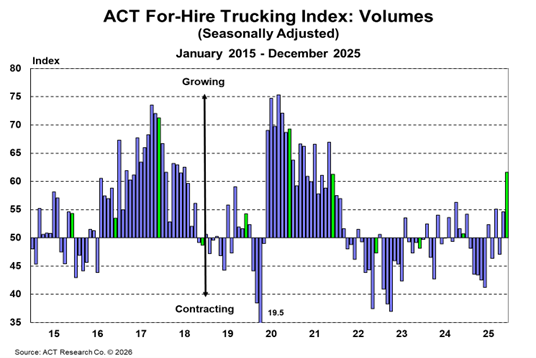
ACT Research reported a seven-point gain in its Volume Index for December — a four-year high — while capacity ticked up by about 1.2 points and hovered near the neutral 50 mark for the first time since March. That suggests a market that is less catastrophically loose than a year prior, but still fragile.
Short-term versus structural shifts
Much of the volume surge appears temporary: storm-driven congestion and a post-holiday restocking cycle. Longer-term structural issues persist, including constrained investment due to thin carrier margins and uncertainty around regulatory changes such as EPA27 emission standards. In short: weather can force sudden spikes, but underlying freight fundamentals still set the tenor for sustained recovery.
Risks that could cap a lasting recovery
Several downside risks were highlighted by market watchers:
- Fragile freight demand: consumer spending weakness could blunt growth.
- Elevated operating costs: inflation squeezes carrier margins and limits fleet reinvestment.
- Geopolitical and trade policy: shifting tariffs and trade rules can depress cross-border freight flows.
- Incertezza normativa: EPA27 timing and final form may influence prebuy behavior and long-term fleet planning.
What carriers are likely to do
Expect carriers to remain conservative: focus on cost control, productivity improvements, and replacement purchases rather than aggressive fleet expansion. A durable recovery in orders will likely require steady y/y growth in freight demand, improvement in freight pricing, and broader economic gains.
How this matters for shippers and logistics planners
For procurement and logistics teams, the snap increase in spot rates is a reminder that short-term disruptions can materially alter transport budgets and routing decisions. Shippers reliant on spot markets will feel the pain fastest, while those with long-term contracts may see less immediate impact but should still reconsider contingency capacity and seasonal hedging strategies.
Practical steps logistics teams can take
- Maintain a mix of contract and spot freight to balance flexibility and cost.
- Plan for weather-driven surges with backup capacity providers and satellite routing options.
- Monitor regulatory calendars (EPA27 and trade rulings) for prebuy signals that affect capacity and equipment lead times.
- Use real-time market intelligence to shift loads between van, reefer, and insulated equipment as needed.
On the equipment side, manufacturers and dealers enjoyed better order flow in January, which may translate to a near-term relief in used equipment markets — but expect that to be uneven until freight fundamentals show sustained improvement.
The bottom line: winter storms provided a short, sharp reminder that the trucking market remains highly reactive. Spot rates can swing rapidly, capacity can tighten overnight, and both shippers and carriers need contingency plans. It’s a classic case of being prepared — as they say, “forewarned is forearmed.”
Provide a short forecast on how this news could impact the global logistics. If it’s insignificant globally, please mention that. However, highlight that it’s still relevant to us, as GetTransport.com aims to stay abreast of all developments and keep pace with the changing world. Book now GetTransport.com.com
Key takeaways: spot refrigerated and dry van rates spiked sharply in late January due to severe weather, Class 8 order activity showed month-to-month strength but remains replacement-driven, and capacity dynamics continue to be constrained by profitability and regulatory uncertainty. Even the best market reports and reviews can’t replace hands-on experience; individual lanes and contract terms matter. On GetTransport.com, you can order your cargo transportation at the best prices globally at reasonable prices — benefiting from transparency, convenience and wide options to match urgent or planned needs. GetTransport.com empowers shippers with competitive quotes and flexible services so you can make an informed decision without overspending. Book the best offers GetTransport.com.com
Summary: Winter storms in late January produced an extraordinary one-week jump — reefers +45¢/mile, dry vans +20¢/mile — highlighting how weather-driven demand and limited available trucks push spot pricing. January Class 8 orders rose but are still shaped by replacement buying and cautious capital spending. For logistics teams this means keeping contingency plans, blending contract and spot capacity, and watching regulatory developments such as EPA27 and trade policy that influence long-term equipment and routing choices. GetTransport.com aligns with these realities by offering efficient, affordable transport and moving solutions — from office and housemoves to bulky freight, vehicles, pallets, and containers — helping shippers and carriers manage dispatch, haulage, and international freight with reliable options for delivery, distribution and relocation needs.