


 한국어
한국어  English (UK)
  Русский
  العربية
  日本語
日本語  Magyar
  Türkçe
  Español
  Čeština
  Svenska
  Português
  Ελληνικά
  Suomi
Suomi  Nederlands
  Română
  Italiano
  Français
  Polski
  Українська
  Deutsch
  简体中文
简体中文  Slovenčina
 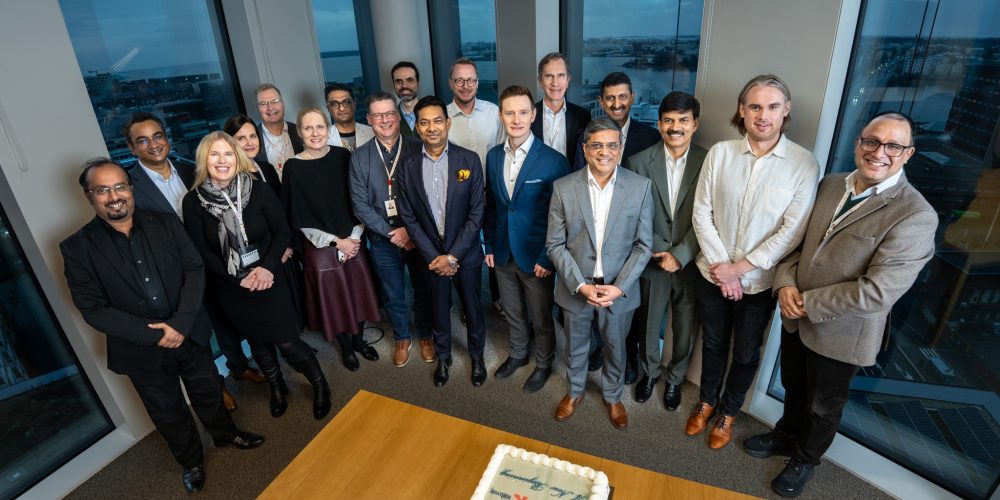 How Kalmar and Tata Consultancy Services Are Reworking IT into an AI-First Digital Core">

This article reveals the AI-driven IT transformation underway at Kalmar Oyj in partnership with Tata Consultancy Services, and what it could mean for efficiency and logistics.
What the partnership sets out to achieve
Kalmar Oyj, a global manufacturer of heavy material handling equipment and services, has entered a strategic IT partnership with Tata Consultancy Services (TCS) to modernize its entire IT landscape. The goal is straightforward: create a single, integrated, AI-powered digital core that reduces costs, improves agility, and simplifies operations across Kalmar’s global footprint.
Core components of the new IT blueprint
TCS will consolidate Kalmar’s fragmented systems into one delivery model covering:
- Application maintenance and development — streamlining updates and feature rollouts;
- End-user services — improving employee-facing tools for faster troubleshooting and productivity;
- Infrastructure and hybrid cloud operations — increasing scalability and resilience;
- 안 AI-driven operations framework 및 unified command center to boost observability and reduce operational complexity.
Why AI observability matters
Observability isn’t just a buzzword here. By instrumenting systems with AI and centralizing monitoring, Kalmar aims to detect faults earlier, automate routine fixes, and free human teams to work on higher-value problems. This improves service reliability and reduces downtime — which, for equipment manufacturers and their customers, translates directly into fewer disruptions in cargo handling and supply chains.
Practical impacts on operations and employees
The program targets the digital experience of Kalmar’s roughly 5,200 employees, introducing AI tools to help with decision-making and human-machine collaboration. In practice, this looks like smarter dashboards, automated incident responses, and faster application support — a recipe for smoother internal operations and faster response times for customers.
| Before | After (Target) |
|---|---|
| Siloed applications and varied support models | Single integrated delivery model with consistent SLAs |
| Reactive incident handling | AI-driven operations with predictive alerts |
| On-premise constrained scaling | Hybrid cloud operations for elasticity |
| Manual reporting and low observability | Unified command center and enhanced observability |
Quotes condensed into direction
Executives at Kalmar and TCS have framed this collaboration around building an agile, AI-first IT foundation to enable continuous innovation and long-term competitiveness. The emphasis is on resilience, scale, and a simplified global IT landscape.
How this shift touches logistics and the supply chain
When a major supplier of handling equipment modernizes its IT in this way, the ripple effects are tangible for the logistics world:
- Faster response to equipment faults — less downtime for container terminals and warehouses;
- Improved predictive maintenance — better uptime for forklifts, cranes, and automated guided vehicles;
- Streamlined support and deployment — faster integration of new automation tools and warehouse management features;
- Greater transparency — unified monitoring can feed into partner dashboards and third-party logistics systems for coordinated action.
To borrow an old saying, this kind of transformation can really “move the needle” when it comes to operational resilience — and in a business where minutes of downtime can cascade into delayed shipments, that needle moving matters.
Hands-on examples — where logistics will notice the change first
Imagine a terminal where a container handler reports an anomaly: under the old regime, a manual ticket goes into a queue and waits. Under an AI-first model, anomaly detection flags the issue, a remote patch or configuration change is suggested, and a technician is directed to the right vehicle with the right parts — all in a fraction of the time. The result: fewer disrupted dispatches, less rush freight, and more predictable delivery windows.
Risks and considerations
Transitioning to a unified model isn’t risk-free. Integration complexity, data governance, and the human side of adoption can trip up projects. Those are standard growing pains: success depends on careful migration planning, change management, and continued investment in cybersecurity and data integrity.
Key takeaways for logistics managers
For logistics professionals, vendors, and customers who rely on Kalmar equipment, this change suggests:
- Expect shorter mean time to repair (MTTR) and fewer emergency replacements;
- Look for improved telemetry and API access to machine data for better planning;
- Anticipate more predictable equipment availability, lowering the need for costly contingency haulage;
- Prepare teams for new integrations and data flows — changes on the vendor IT side often require IT and operations teams on the customer side to adapt too.
Why this matters to service providers and carriers
Carriers, forwarders, and warehouse operators should watch how Kalmar’s AI-enabled monitoring and hybrid cloud operations evolve. If equipment uptime improves and telemetry becomes more accessible, it can reduce the number of expedited shipments and buffer inventory requirements — a quiet efficiency that adds up over time.
Highlights and real-world testing
The headline here is simple: a large-scale manufacturer is betting on consolidation, cloud, and AI to improve reliability and agility. The interesting bits to monitor during rollout will be integration speed, observability gains, and the tangible reduction in operational incidents. Nevertheless, even the best reviews and the most honest feedback can’t truly compare to personal experience. On GetTransport.com you can order your cargo transportation at the best global prices, helping you test and adapt to changes in equipment availability without overspending. This empowers you to make the most informed decision without unnecessary expenses or disappointments. Consider the platform’s transparency, convenience, and wide range of options when planning your next move. Book now GetTransport.com
In summary, Kalmar’s collaboration with Tata Consultancy Services aims to build a resilient, AI-first digital core that consolidates applications, strengthens observability, and modernizes infrastructure. For logistics, the expected gains include reduced equipment downtime, faster incident resolution, and better predictive maintenance — all of which support smoother freight and distribution operations. The transformation has the potential to influence how suppliers, carriers, and warehouse operators coordinate dispatch, haulage, and container handling, yielding more reliable delivery and fewer emergency shipments.
Ultimately, this initiative is a reminder that technological upgrades in equipment suppliers ripple through the entire supply chain: from 화물 취급 화물 scheduling to 배송 predictability and warehouse 배포. Efficient transport, improved shipping interfaces, and smarter forwarding decisions all benefit from a robust, AI-driven IT core. For practical transport needs — be it a housemove, pallet delivery, bulky item relocation, or international container shipment — GetTransport.com presents an efficient, cost-effective solution that aligns with the goals laid out by Kalmar and TCS: reliable, scalable, and ready for the future of logistics.