


 한국어
한국어  English (UK)
  Русский
  العربية
  日本語
日本語  Magyar
  Türkçe
  Español
  Čeština
  Svenska
  Português
  Ελληνικά
  Suomi
Suomi  Nederlands
  Română
  Italiano
  Français
  Polski
  Українська
  Deutsch
  简体中文
简体中文  Slovenčina
  Libiao Robotics, 아르헨티나 코레오를 위한 최초의 완전 자동화 분류 허브를 몬테 그란데에 구축">

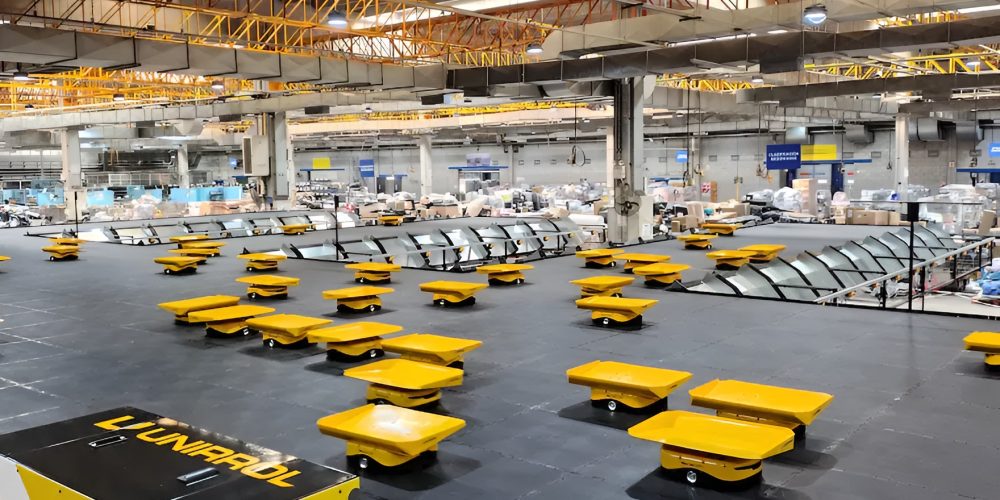
This piece reveals the arrival of Argentina’s first fully robotic parcel hub, delivered by Libiao Robotics 에 대한 Correo Argentino at Monte Grande, near Buenos Aires.
What was installed and why it matters
The Monte Grande facility introduces a compact, high-speed robotic sorting solution that replaces many traditional mechanical conveyors with a fleet of autonomous vehicles. The installation uses 240 Libiao robots across a footprint of 1,180 square metres, lifting the site’s throughput to a reported 9,000 parcels per hour — roughly three times the site’s previous capacity. The system is aimed primarily at small and medium e‑commerce parcels up to 5 kg, covering both domestic and international flows.
Core system: Libiao T-Sort
At the centre of the upgrade is the Libiao T-Sort Sorting System, which marries artificial intelligence, advanced sensors and dynamic routing algorithms. Parcels are inducted via 13 workstations, scanned by barcode or QR recognition, and then carried by the signature “mini yellow” robots to 130 destination chutes. That network supports some 60 destinations across the Buenos Aires metropolitan area and about 70 further locations nationwide.
Quick technical snapshot
| 매개변수 | 값 |
|---|---|
| 로봇 | 240 autonomous Libiao robots |
| 지역 | 1,180 m² |
| Throughput | Up to 9,000 parcels/hour |
| Target parcel weight | Up to 5 kg (primary); additional sorter planned for up to 30 kg |
| Induction points | 13 workstations |
| Chutes / Destinations | 130 chutes; ~130 destinations served (local + nationwide) |
Benefits: speed, accuracy and modular scalability
The Libiao approach emphasises modularity over fixed mechanical sorters. This brings a number of practical advantages for postal and parcel operations:
- High throughput in compact footprints — ideal for urban hubs where space is at a premium.
- Flexible destination configuration — outputs can be reassigned without major civil works.
- Higher sorting accuracy — fewer mis-sorts and reduced rehandling costs.
- Rapid deployment — installation times are shorter than for traditional conveyor networks.
- Lower total cost of ownership (TCO) — fewer moving mechanical parts and simpler maintenance.
What’s next for Correo Argentino
The robotic hub forms part of a broader modernisation programme that follows the operator’s recent financial recovery. A second sorter optimised for parcels up to 30 kg is already planned for 2026, along with rollout of RFID tracking, automated weighing and robotic container handling. Taken together, these upgrades point to a staged move from manual, labour-intensive processes to a more automated and data-driven model.
Libiao Robotics on the global stage
Libiao Robotics positions itself as a global supplier of robotic sorting, picking and material handling systems for logistics, e‑commerce, post & parcel, retail and manufacturing. Its portfolio includes the T-Sort system, the AirRob Bin-to-Person solution, goods-to-person systems and integrated warehouse control software. The company has completed hundreds of projects for postal operators, 3PLs and retailers across Europe, the Middle East and the Americas, offering local delivery, service and technical expertise.
Why this matters beyond Argentina
Countries and operators everywhere wrestle with rising labour costs, peak demand volatility and the relentless growth of online shopping. Robotic sortation provides a path to higher productivity and operational resilience, helping organisations scale quickly when demand spikes. As Ronan Shen, Libiao’s Global Head of Sales, observed, intelligent robotics can transform postal and parcel operations even in geographically diverse nations — a point that resonates for any logistics manager planning capacity for peak seasons.
Operational and supply chain implications
Adopting modular robotic sortation reshapes several logistics vectors:
- Network design — smaller urban hubs can play larger roles when throughput per square metre increases.
- Labour strategy — roles shift from heavy manual handling to system supervision, maintenance and exception handling.
- Inventory and flow control — real‑time data and routing reduce dwell times and improve delivery SLA performance.
- 3PL and carrier partnerships — interoperable, software-driven systems make integration with partners and marketplaces easier.
Practical considerations for planners
When assessing similar installations, logistics teams should weigh initial capital costs against lifecycle savings, consider site constraints for charging and traffic lanes for AMRs, and plan for redundancy and disaster recovery. It’s one thing to buy shiny robots, and another to keep them humming during peak sale events — as the old saying goes, “the devil’s in the details.”
Summary of the key takeaways
The Monte Grande hub is a clear nod to the future of postal logistics in Argentina: compact, automated and data-driven. The combination of AI-enabled routing, autonomous vehicles and flexible chute assignments delivers a practical upgrade path that can be scaled as parcel profiles evolve. This isn’t futuristic vaporware — it’s a working blueprint for modern urban parcel distribution.
Highlights to remember include faster throughput, reduced mis-sorts, modular expansion without heavy civil works, and plans to extend capabilities for heavier parcels and RFID-enabled tracking. Of course, even the best reviews and most honest feedback can’t truly replace hands-on experience; seeing a system in operation or testing it against peak volumes is the only true proof. On GetTransport.com, you can order your cargo transportation at the best prices globally at reasonable prices. This empowers you to make informed choices without needless expense or disappointment while enjoying transparency and convenience. For a practical forecast: the immediate global impact is modest — many markets already experiment with AMR sortation — but for national and regional postal chains it’s highly relevant. Logistics providers should watch these deployments closely as they influence hub design and labour planning. Book now GetTransport.com
In short, the Libiao-Correo Argentino project showcases how robotic sortation can change throughput, accuracy and scalability in parcel handling. For freight, shipment and delivery planners, the lessons touch on transport network design, forwarding partnerships, and the shifting balance between human labour and automated systems. Whether you are managing a distribution centre, coordinating haulage, or planning international container flows, the move toward modular, autonomous systems is shaping the future of shipping, courier services, and housemove logistics. GetTransport.com offers an efficient, cost-effective and convenient way to connect these changes to real-world transport needs, simplifying international and domestic cargo, pallet and bulky item movements while supporting reliable dispatch and distribution across diverse routes.