


 한국어
한국어  English (UK)
  Русский
  العربية
  日本語
日本語  Magyar
  Türkçe
  Español
  Čeština
  Svenska
  Português
  Ελληνικά
  Suomi
Suomi  Nederlands
  Română
  Italiano
  Français
  Polski
  Українська
  Deutsch
  简体中文
简体中文  Slovenčina
  트럼프 대통령의 그린란드 관세 위협에 머스크와 CMA CGM 노선 변경 및 시장 불안 초래">

이 글은 그린란드 분쟁의 여파, 즉 관세 위협, 운송 경로 변경, 그리고 이러한 변화가 화물 및 물류 네트워크에 미치는 파급 효과를 살펴봅니다.
Weekly highlights
Markets reacted fast to political headlines. Key takeaways include short-term tariff threats from the United States, a quickening of carrier route reversals through the Red Sea and Suez Canal, and mixed movements in both ocean and air rates that keep logistics teams on their toes.
Tariff escalation and political playbook
Over the weekend, President Trump announced plans to impose a 10% tariff starting February 1 on several European countries including Denmark, Norway, Sweden, France, Germany, the UK, the Netherlands and Finland, with a threatened increase to 25% in June if a deal is not reached. The move adds political fire to a trade environment that had begun to calm at the end of last year.
What the EU might do
- Implement previously approved retaliatory tariffs on up to $100B of US exports.
- Halt or delay parts of EU-US trade cooperation, including tariff reductions on select US goods.
- Leverage non-tariff measures — the EU’s so-called anti-coercion instrument could target services, intellectual property access, public procurement, and exports.
- Political gestures such as limiting military base access or diplomatic responses.
Legal and strategic caveats
Any tariffs implemented under the International Emergency Economic Powers Act (IEEPA) would arrive against a backdrop of legal uncertainty, with a Supreme Court review on the table. That legal fog makes this more of a tactical escalation than an immediate, irreversible shift—think chess not checkers.
Ocean and air rates snapshot
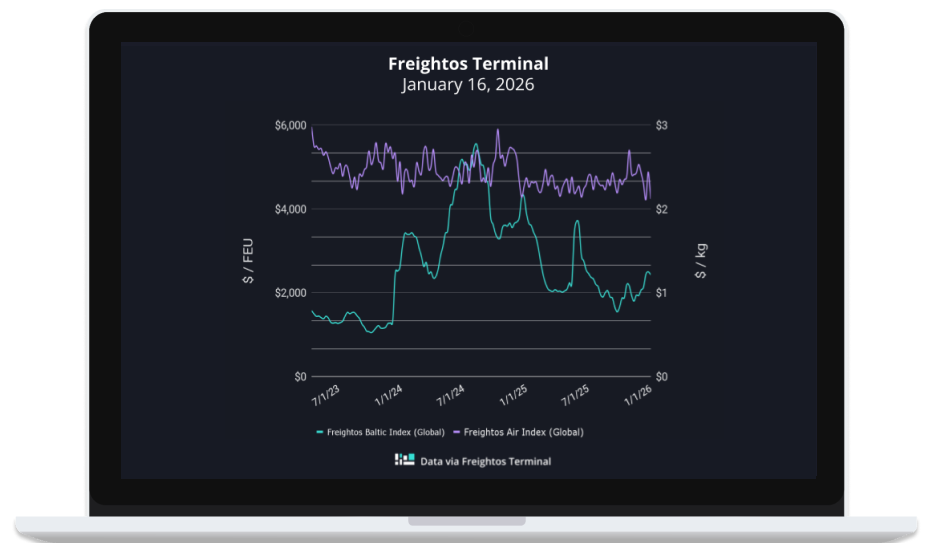
Rate movements were uneven: ocean lanes softened slightly on major east-west routes while air cargo ticked up in certain corridors. Carriers are tinkering with blended routing strategies—some sailings return through the Suez, others still go around the Cape—rather than a full, abrupt switch.
| 경로 | 최신 | 변경 |
|---|---|---|
| China – N. Europe (air) | $3.62/kg | -1% |
| N. Europe – N. America (air) | $2.15/kg | +2% |
| Asia – Mediterranean (ocean) | $4,623/FEU | -5% |
| Asia – Europe (ocean) | $2,893/FEU | -3% |
| Transpacific to West Coast (ocean) | $2,668/FEU | -3% |
| Transpacific to East Coast (ocean) | $3,947/FEU | -2% |
| China – US (air) | $5.46/kg | -8% |
Carrier behavior: cautious, hybrid approaches
Maersk 그리고 CMA CGM illustrate the “two steps forward, one step back” atmosphere. Maersk signaled resumption of some Red Sea transits for its MECL service, while CMA CGM announced partial reroutes around the Cape again citing the “uncertain international context.” Expect a gradual, hybrid restoration of Suez transits—some sailings will use the Suez, others will take the longer Cape loop.
Air cargo quirks
Some airlines continue to avoid Iranian airspace, stretching flight times between Asia and Europe and nudging costs higher for certain lanes. Despite that, air rates show stability in some corridors and softness in others—China-US air rates eased while Southeast Asia-to-US ticked up modestly.
Why logistics teams should care
Even if headline tariffs never fully materialize, the uncertainty translates into operational friction: frontloading or delaying shipments, adjusting routing plans, and juggling capacity. Inventory strategies and procurement calendars get tugged around, and freight teams must keep a steady hand on booking windows, carrier reliability, and lead time buffers.
Immediate operational moves for shippers
- Review contracts and clauses tied to tariffs and force majeure.
- Evaluate container and airlift options: compare cost vs. time trade-offs for Suez vs. Cape routings.
- Communicate with suppliers and customers about possible lead time shifts.
- Use digital rate tools to monitor day-to-day volatility and plan bookings.
Personal note
It’s one thing to read headlines and another to live the spreadsheets—many logistics managers say it feels like riding a seesaw: one minute you’re reallocating containers, the next you’re negotiating demurrage. Still, predictable playbooks and flexible carriers help smooth the ride.
Key takeaways
Political noise out of the Greenland episode raises trade uncertainty again, but likely in a measured way: short-term volatility in rates and routes rather than a systemic breakdown. Carriers will continue to use a hybrid routing strategy, and shippers who stay nimble—adjusting bookings and contingency plans—will be best positioned.
Highlights: tariff threats, mixed ocean and air rate moves, Maersk and CMA CGM’s route experiments, the legal ambiguity around IEEPA, and the possibility of targeted EU countermeasures. Remember: no amount of second-hand commentary beats your own experience managing a shipment—real-world trials show what works and what doesn’t. On GetTransport.com, you can order your cargo transportation at the best prices globally at reasonable prices. This development is unlikely to cause a global logistics collapse, but it could produce short-term regional disruptions to routes, container availability, and rates; however, it’s still relevant to us, as GetTransport.com aims to stay abreast of all developments and keep pace with the changing world. For your next cargo transportation, consider the convenience and reliability of GetTransport.com. Book now GetTransport.com
In summary, the Greenland dispute adds another layer of uncertainty to trade corridors—tariffs and rhetoric are driving cautious carrier routing choices and modest rate movements. Logistics professionals should monitor ocean and air 요금, watch for carrier blank sailings or reroutes, and keep contingency plans ready for 화물, 화물, 배송, 배달 and redistribution needs. Whether you’re moving a pallet, a container, or planning an international housemove, reliable forwarding, dispatch, haulage and courier options matter. Platforms that offer transparent pricing, wide coverage for bulky and international shipments, and simplified booking can reduce friction—helping ensure that freight, shipping, transport, moving and relocation operations run smoothly even when headlines get loud.