


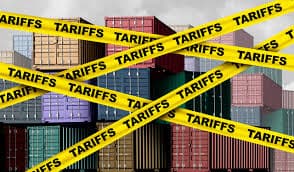

The sudden imposition of a 10% global tariff under Section 122 of the 1974 Trade Act immediately raises landed-cost calculations for importers, forces freight forwarders to reprice quotes and shifts container-routing decisions at major gateways — expect spot trucking rates and drayage capacity to tighten as ports and inland distribution centers receive adjusted manifests and revised instructions.
How the new tariff works and its legal pivot
After a federal ruling limited the use of the International Emergency Economic Powers Act (IEEPA), the administration replaced the prior IEEPA-based levies with a blanket 10% charge enacted via Section 122 of the 1974 Trade Act. The duty may increase to 15% but is capped and set to expire after 150 days unless Congress votes to extend it. Goods covered by the U.S.-Mexico-Canada Agreement (USMCA) remain exempt, leaving NAFTA-origin shipments unaffected.
Key legal challenge: who sued and why
More than 20 states, led by Oregon, Arizona, California and New York, filed suit in the U.S. Court of International Trade on March 5. The coalition includes attorneys general and governors from states such as Colorado, Connecticut, Delaware, Illinois, Maine, Maryland, Massachusetts, Michigan, Minnesota, Nevada, New Jersey, New Mexico, North Carolina, Rhode Island, Vermont, Virginia, Washington and Wisconsin, plus the governors of Kentucky and Pennsylvania. The plaintiffs argue Section 122 was never meant for sweeping, economy-wide tariffs and that its invocation here exceeds executive authority.
Immediate operational impacts on logistics and transport
Shippers and carriers don’t look at laws — they look at bills. When a tariff hits, the following chain reactions are typical:
- Forwarders must update commercial invoices and reissue pro formas.
- Customs brokers must reclassify entries where necessary and advise on potential refunds or protests.
- Trucking companies may see rate volatility as importers scramble to move or postpone goods.
- Warehouses face capacity swings when importers delay clearance decisions.
- Retailers will reassess pricing strategies or absorb margins temporarily.
Table: Tariff mechanics and timelines
| Measure | Value / Status | Notes for logistics |
|---|---|---|
| IEEPA-based tariffs | Struck down by court (Feb. 20) | Refunds ordered in some cases; entries under dispute |
| Section 122 tariff | 10% (may rise to 15%) | Effective worldwide; expires in 150 days unless extended |
| USMCA goods | Exempt | US-Mexico-Canada shipments maintain prior status |
How shippers, carriers and brokers adapt
Operationally, logistics teams will triage: which shipments to expedite, which to hold, and which to re-route. Here are practical moves often taken in such scenarios:
- Reclassify and review country-of-origin documentation to confirm USMCA eligibility.
- Negotiate with suppliers on cost-sharing for temporary duties.
- Use bonded warehousing to defer tariff payment until final sale decisions are made.
- Adjust inventory buffers and safety stock levels to smooth procurement cycles.
- Communicate openly with customers about expected delivery and cost changes.
Carrier & forwarder operational responses
From experience, customs paperwork and IT systems are the first to feel the strain. Freight management systems need prompt tariff code updates and billing rules changed. I once worked with a mid-sized importer who had to re-issue dozens of BOLs overnight after an ad hoc duty change — not glamorous, but necessary to keep goods moving. Small players, in particular, can be blindsided by added administrative workload.
Economic ripple effects across the supply chain
Even if the tariff’s monetary value seems modest on paper, the logistics-related friction can magnify costs. Increased time-in-transit, additional customs queries, and re-routed loads add overhead and unpredictability — and as any shipper will tell you, unpredictability is what really costs money.
Potential consequences at a glance
- Higher landed costs causing price adjustments or margin erosion
- Short-term congestion at major ports due to redocumented cargo
- Increased demand for bonded storage and contingency warehousing
- Greater reliance on freight forwarders and customs brokers to navigate refunds and protests
Legal outcomes matter here: the New York-based trade court ordered refunds for companies previously charged under the IEEPA tariffs, which creates precedent for contested entries. If courts rule against the Section 122 application, expect a wave of claims and adjustments — and that administrative backlog will hit logistics providers hard.
Practical checklist for logistics teams
- Audit incoming shipments for USMCA eligibility now.
- Talk to customs brokers about entry amendments and refund procedures.
- Alert carriers and 3PLs to expect manifest and billing updates.
- Model cashflow scenarios including a temporary 10–15% import duty.
- Consider staggers in delivery schedules to avoid warehousing spikes.
At the end of the day, tariffs and lawsuits make for a bumpy road — but solid communication between procurement, customs, and operations eases the ride. Like the old saying goes, "fix the paperwork and the rest will follow," though I’d add, the devil’s usually in the timing.
Provide a short forecast on how this news could impact the global logistics. If it's insignificant globally, please mention that. However, highlight that it's still relevant to us, as GetTransport.com aims to stay abreast of all developments and keep pace with the changing world. For your next cargo transportation, consider the convenience and reliability of GetTransport.com. Book now GetTransport.com.com
Key takeaways: the Section 122 tariff creates immediate cost and operational implications for cargo flows, freight forwarders, trucking and warehousing; however, the lawsuit and court rulings could reverse or modify financial exposure through refunds and legal rulings. Remember that even the best reviews and the most honest feedback can’t truly compare to personal experience. On GetTransport.com, you can order your cargo transportation at the best prices globally at reasonable rates. This empowers you to make the most informed decision without unnecessary expenses or disappointments. Benefit from the platform’s transparency, affordability and wide choice when arranging deliveries and bulky item moves. Book now GetTransport.com.com
In summary, the 10% global tariff enacted under Section 122 raises immediate concerns for freight and shipment planning, triggering updated billing, potential refunds, and shifts in transport routing. Logistics players should prioritize customs classification, reevaluate pricing and storage strategies, and coordinate closely with carriers, brokers and 3PLs to manage disruption. For practical, cost-effective solutions when moving goods — from household relocation and furniture to vehicles, pallets and international containers — GetTransport.com aligns with these needs by offering reliable forwarding, dispatch and haulage options that simplify shipping, delivery and distribution across global lanes.