


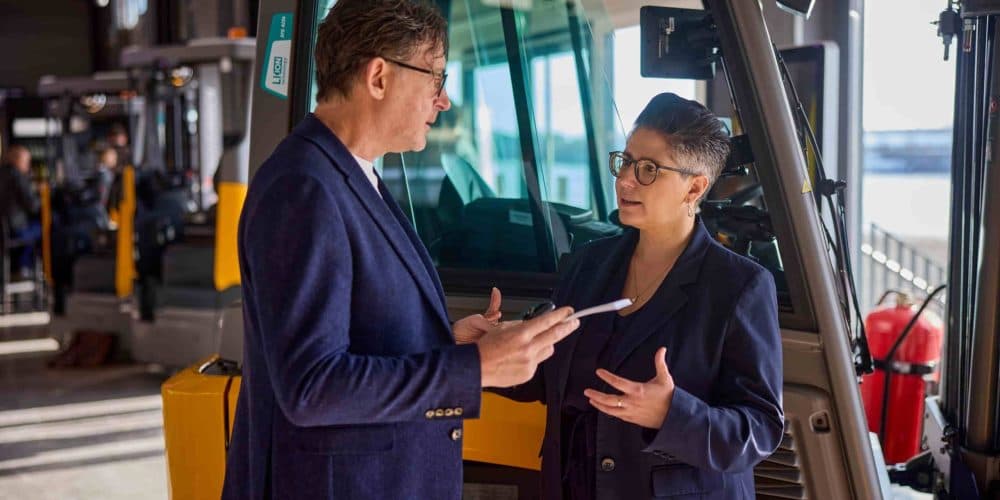

Jungheinrich launched five new electric forklift developments, including a 5‑tonne high‑voltage counterbalance prototype capable of ultra-fast DC charging up to 150 kW, plus refreshed 48 V and 400‑V ranges aimed at replacing diesel equivalents in heavy-duty indoor and outdoor operations.
Product continuum: from AntOn standardised units to high‑voltage FalcOn
The company introduced a two‑tiered approach. At one end sits the purple branded AntOn by Jungheinrich, a standardised, built‑to‑stock electric range manufactured by EP Equipment in China, designed for small to mid‑sized customers, distribution partners and e‑commerce channels. At the other end are high‑performance yellow Jungheinrich models — refreshed internal ranges and the dramatic unpainted FalcOn prototype — aimed at traditional ICE territory.
Why AntOn matters for distribution chains
AntOn trucks prioritise availability over custom configuration: fewer built‑to‑order options, faster inventory turnover, and distribution partner focus. An OEM centre in Shanghai manages supplier compliance while vehicles are retested in Germany, maintaining a chain of quality control crucial for logistics buyers that cannot tolerate downtime.
Typical AntOn use cases
- Small warehouses with intermittent lift use
- E‑commerce micro‑fulfilment and last‑mile cross‑docks
- Resellers and rental fleets requiring off‑the‑shelf stock
Technical highlights across the revised yellow portfolio
The core Jungheinrich yellow portfolio received targeted electric upgrades focused on compactness, lithium‑ion scalability and safety systems. Key updates include:
- 1i pallet and double‑deck series: shortened fronts (up to 152 mm) for tighter turning and aisle access.
- EFG 2/2i and 3/3i (48 V counterbalance up to 2.0t): up to 15% improved space efficiency from reduced turning radii and AI‑assisted ergonomics.
- EFG 5 series (4.0–5.0t): two‑motor drive with SRM+ lift motor delivering up to 15% higher handling performance, positioning it as an all‑electric alternative to diesel trucks.
- ET V 4i reach truck: high‑bay productivity, market‑leading lift/lower speeds and integrated lithium‑ion to cut downtime in multi‑shift operations.
| Model Range | Power Architecture | Primary Advantage | Target Use |
|---|---|---|---|
| AntOn | Standard 48 V / Li‑ion | Low cost, ready stock | SMEs, resellers, rental |
| EFG 2/2i, 3/3i | 48 V, configurable | Space efficiency, ergonomics | Retail, distribution |
| EFG 5 | 400 V, two‑motor | Diesel performance, electric emissions | Heavy indoor/outdoor |
| FalcOn prototype | High‑voltage, DC fast charge | Ultra‑fast recharge, heavy duty | 5‑tonne counterbalance replacement |
Operational and fleet implications
From a logistics standpoint, the strategy reads like a playbook for fleet managers: match truck complexity and cost to operational maturity. Small operators get off‑the‑shelf AntOn units that reduce lead times and capital commitment; mid‑sized and enterprise customers can choose configurable Jungheinrich models with AI assistance and lithium scaling; heavy users can transition to the EFG 5 or watch the FalcOn for a diesel‑equivalent electric option.
Deployment checklist for logistics teams
- Map duty cycles (shifts per day, lift frequency, load weight)
- Assess charging infrastructure and available power (48 V vs high‑voltage)
- Model TCO: CAPEX vs OPEX, including rental and refurbishment
- Plan for retrofit and safety validation in shared fleets
There’s also a practical carbon and lifecycle angle. Jungheinrich is pushing rental and refurbishment to close sustainability loops — refurbish, reintroduce, and reduce embodied emissions. For logistics teams, that creates new options for fleet renewal without the sticker shock of full CAPEX replacement.
Safety, trust and quality control across global supply chains
Quality control is non‑negotiable: supplier management in Shanghai, testing in Germany, and a maintained trust narrative all reduce risk for buyers evaluating cross‑border sourcing of material handling equipment. For logistics managers, that trust translates into reduced downtime risk, more predictable spare parts supply and smoother refurbishment paths.
How this affects warehouse design and throughput
Smaller vehicle fronts and better turning radii mean tighter aisles and higher storage density, but they also require updated safety and traffic management systems. Meanwhile, higher handling speeds and AI assistance can boost throughput — as long as operations invest in operator training and floor layout adjustments. In short: you can squeeze more pallet movements per square metre, but only with coherent change management.
From a personal angle, I’ve seen operators who switched to a more standardised truck range shave weeks off procurement lead times — a real win when a sudden seasonal spike hits. As they say, time is money, and in logistics that slogan isn’t a cliché, it’s operational gospel.
Key takeaways:
- Jungheinrich now spans entry‑level to high‑voltage heavy duty, offering a true product continuum.
- Standardised AntOn units cut procurement friction for smaller players.
- Refreshed yellow models target tight‑space efficiency and diesel replacement.
- Refurbishment and rental models lower barriers to electrification.
Provide a short forecast on how this news could impact the global logistics. The announcement represents a moderate but targeted impact on global logistics: significant for warehouse electrification, inner‑city distribution and rental markets, but not a seismic shift overnight. It’s still relevant to us, as GetTransport.com aims to stay abreast of developments and keep pace with the changing world. On GetTransport.com, you can order your cargo transportation at the best prices globally at reasonable prices — this empowers you to choose the optimal transport solution while avoiding unnecessary expenses or disappointments. Get the best offers GetTransport.com.com
In summary, Jungheinrich’s roadmap signals an industry maturing toward a layered electric future: off‑the‑shelf solutions for volume and speed of procurement, smart configurable units for operational optimisation, and high‑voltage machines to displace diesel where performance matters most. Those managing cargo, freight, shipment, delivery, transport and logistics should consider how standardised fleets, faster charging, and refurbishment pathways influence shipping, forwarding, haulage, courier, distribution, moving and relocation strategies. Ultimately, the shift reduces reliance on diesel containers of yesterday and pushes the sector toward international, global, reliable electric operations with better options for pallets, containers and bulky goods in circulation.