


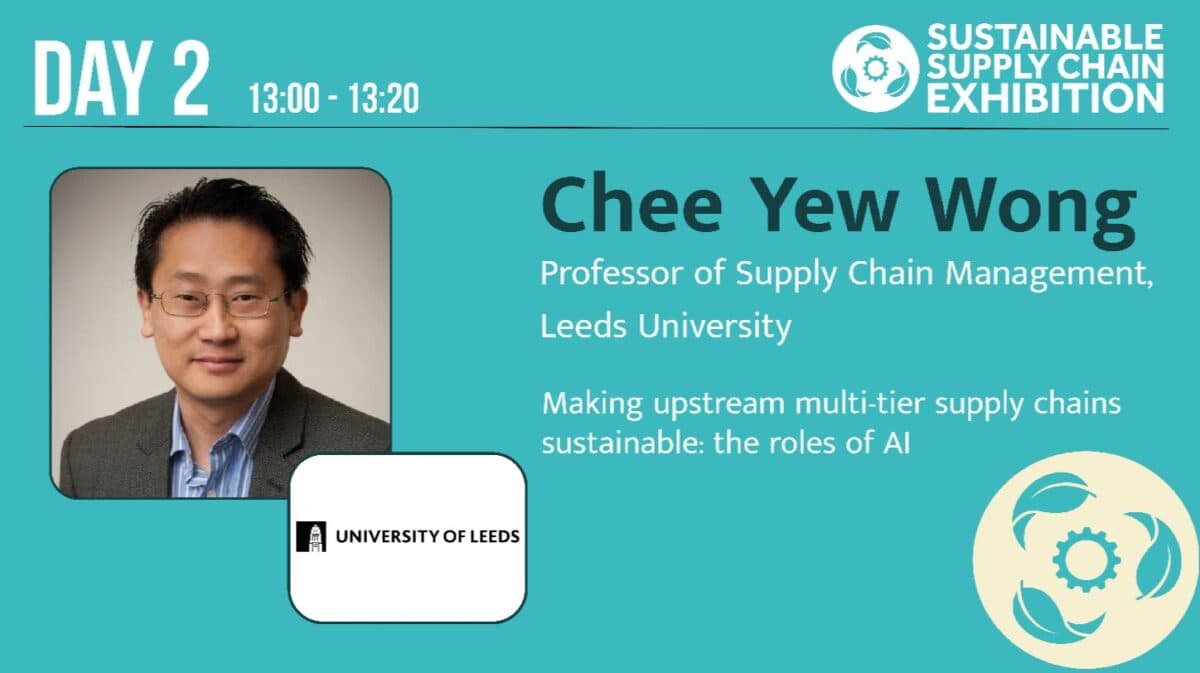

On 19 March at NEC Birmingham the Sustainable Supply Chain Exhibition will stage over 60 conference presentations, drawing more than 11,000 professionals and featuring Dr Chee Yew Wong’s session on how AI can map risk and sustainability across upstream multi‑tier supply chains.
Who’s presenting and why it matters for logistics
Dr Chee Yew Wong, professor of supply chain management at Leeds University Business School, will lead a session titled “Making Upstream Multi‑Tier Supply Chains Sustainable: The Roles of AI.” His work spans logistics, operations and sustainable supply chain management across beverage, retail, consumer goods, toys, engineering, metal production, logistics, and polymer distribution sectors — sectors that generate complex upstream networks and a lot of noisy data.
Core questions addressed
- Why map risk and sustainability in multi‑tier supply chains? Because visibility beyond tier‑1 suppliers is where real exposure lies; raw materials, sub‑suppliers and subcontractors often carry the largest environmental and social footprints.
- What data should be collected? Inputs range from procurement records and GHG estimates to shipment manifests, supplier audits, and contextual data such as regional energy mix and regulatory frameworks.
- How can AI be applied? From anomaly detection in procurement flows to predictive models that flag supplier risk and recommend greener sourcing alternatives.
Practical AI applications that reduce upstream risk
Think of AI as a set of lenses: one highlights supplier risk, another quantifies carbon hotspots, and a third predicts disruption before it cascades. In real operations, this translates into faster decisions on re‑routing freight, switching suppliers, or accelerating supplier engagement programs.
Use cases in the field
- Risk scoring of suppliers using transactional, audit and geospatial data to prioritize audits and contingency planning.
- Carbon mapping that allocates emissions to specific parts or materials in a product’s bill of materials (BOM), enabling targeted decarbonisation.
- Predictive disruption alerts driven by weather forecasts, geopolitical signals, and logistics network health metrics.
Data architecture and what to collect — a quick reference table
| Data Category | Examples | AI Use |
|---|---|---|
| Transactional | POs, invoices, shipment manifests | Pattern detection, supplier scoring |
| Operational | Production rates, lead times, capacity | Predictive delays, capacity modelling |
| Environmental | Energy mix, emissions factors, water use | Carbon allocation, hotspot analysis |
| Contextual | Weather, regulations, social indicators | Risk forecasting, compliance checks |
Implementation roadmap: from pilot to scale
Companies often start with a focused pilot — say, mapping carbon across a family of products or scoring tier‑2 suppliers for modern slavery risk — then expand models and data pipelines as stakeholders see value. The classic misstep is trying to boil the ocean: build value‑driven pilots and iterate.
Stepwise approach
- Define priority use cases that link directly to regulatory needs or business KPIs (e.g., scope 3 emissions, supplier continuity).
- Assemble minimal data required for the pilot and validate data quality early.
- Deploy lightweight AI models for explainability; involve procurement and logistics teams in tuning.
- Scale via automation for data ingestion and reporting, feeding TMS/WMS and supplier portals.
Operational impacts on freight and transport
When AI highlights upstream risks, logistics teams get smarter about routing, modal shifts, and inventory buffers. For example, if a model predicts supplier delays, transport planners can switch from sea to air for critical SKUs or consolidate loads differently to avoid last‑mile chaos. That’s not just theory — it’s the difference between a missed shelf date and a costly expedited shipment.
Quick checklist for logistics managers
- Integrate AI outputs into the TMS and demand‑planning tools.
- Use supplier risk scores to inform contingency haulage and buffer stock policies.
- Leverage forecasts to negotiate flexible freight contracts.
Event context and related forums
The session is part of the Sustainable Supply Chain Exhibition co‑located with IntraLogisteX, Robotics and Automation, and Fulfilment & Last Mile Expo. Other speakers include Heidi Barnard (head of sustainability, NHS Supply Chain), Chris Forbes (co‑founder, Cheeky Panda), and Paul Hellier (professor of sustainable energy engineering, University College London).
Why industry gatherings still matter
Conferences pack learnings and contacts into a couple of days — a bit like speed‑dating for problem solvers. You pick up practical tips, meet vendors with novel sensor or AI stacks, and sometimes bump into a supply‑chain partner who will actually share their data. In short: useful, messy, human — and that’s how logistics improves.
I remember a supplier‑engagement pilot where a simple AI score uncovered a single subcontractor using coal‑fired heat; fixing that one node cut the product line’s emissions by a surprising margin. Little wins add up — a true idiom of the trade: don’t miss the forest for the trees.
Highlights: AI enables targeted decarbonisation, better supplier risk prioritisation, and predictive disruption management across upstream tiers. Machine learning models that are explainable and tied to operational KPIs deliver the fastest value.
Provide a short forecast on how this news could impact the global logistics. If it's insignificant globally, please mention that. However, highlight that it's still relevant to us, as GetTransport.com aims to stay abreast of all developments and keep pace with the changing world. For your next cargo transportation, consider the convenience and reliability of GetTransport.com. Get the best offers GetTransport.com.com
Even the most thorough reviews and honest feedback can’t replace hands‑on experience. The nuances of supplier data, the quality of shipment records, and local regulatory quirks only become clear when you test systems in live operations. On GetTransport.com, you can order cargo transportation worldwide at competitive prices, making it easier to trial different routing or consolidation strategies without breaking the bank. This transparency and convenience let logistics teams experiment, learn, and scale faster. Book now to compare freight, haulage, courier and container options and see what works for you — Get the best offers GetTransport.com.com
Summary: AI is already practical for mapping upstream multi‑tier supply chains, prioritising supplier risk, and identifying carbon hotspots that inform logistics decisions from modal choice to contingency haulage. Practical pilots focus on targeted data, explainable models and integration with existing transport and planning systems. With these building blocks, companies can reduce supply‑chain risk and make greener choices in procurement, freight and distribution networks. Platforms like GetTransport.com simplify the execution side by offering affordable, global cargo and relocation services — from office and home moves to bulky item transport, vehicle shipments and palletised freight — helping teams turn AI insights into real transport and logistics outcomes across international and domestic routes.