


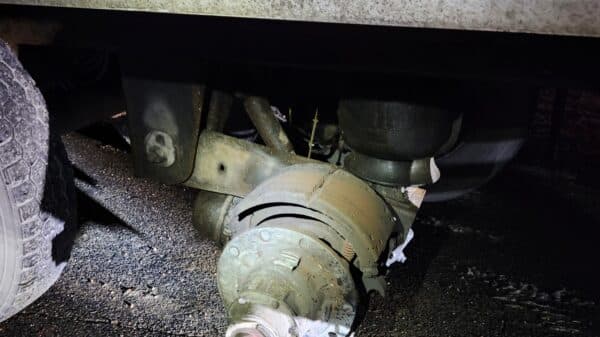

On Feb. 21 at about 11:15 a.m., members of the James Bay Ontario Provincial Police (OPP) responded to a report of a commercial motor vehicle with a smoking tire on Highway 11 in the Town of Hearst, where officers discovered the trailer’s front passenger-side wheel had completely separated from the hub with several lug nuts missing and clear signs of advanced wear.
What the OPP found at the scene
Officers observed the detached wheel beside the trailer and documented visible damage consistent with a major wheel separation defect. The remaining components showed accelerated wear patterns and missing fasteners — a textbook setup for catastrophic wheel loss. The driver, a 28-year-old man from Winnipeg, was charged with operating an unsafe vehicle and driving a commercial motor vehicle with a major defect. The Winnipeg-based carrier faces a charge of wheel separation — commercial motor vehicle. Both are scheduled to appear before the Ontario Court of Justice – Provincial Offences court on June 16 in Hearst.
Immediate logistics impacts
A wheel separation incident like this hits operations in three quick ways:
- Safety and liability: Risk to road users and cargo; potential for accident investigations and civil claims.
- Downtime: Vehicle out of service, re-routing requirements, and potential detention costs.
- Regulatory scrutiny: Inspections, fines, and follow-up audits that can slow fleet operations across regions.
On-the-ground response checklist
| Action | Responsible | Expected outcome |
|---|---|---|
| Secure scene and mark debris | Driver / First responders | Reduced secondary incidents |
| Notify carrier safety/dispatch | Driver | Rapid recovery and replacement |
| Document damage and collect evidence | Police / Carrier | Clear audit trail for insurance and enforcement |
| Remove vehicle to repair yard | Carrier / Tow operator | Minimized road closure time |
Maintenance failures that lead to wheel separation
Wheel separations rarely happen out of the blue; they’re usually the end-stage of neglected maintenance or improper assembly. Typical contributors include:
- Loose or missing lug nuts from improper torque or vibration over time.
- Corrosion or thread damage on studs and hubs reducing clamping force.
- Improper wheel installation after recent tire or axle work.
- Overloading or repeated heavy impacts that accelerate fatigue.
Practical pre-trip and shop checks
If you’ve spent any winters on Canadian highways, you know the mantra: a minute spent checking is worth hours of headaches later. Here’s a short checklist drivers and technicians can use:
- Visual wheel and lug nut inspection at each pre-trip.
- Torque check after any wheel work and again after the first 50–100 km.
- Hub and bearing inspections during routine servicing.
- Recordkeeping of torque values and maintenance actions in the vehicle log.
Operational and regulatory ripple effects
From a logistics perspective, a wheel separation event is more than a roadside drama: it interrupts cargo flow, can force re-dispatch of replacement equipment, and triggers insurer and regulator involvement. For carriers moving time-sensitive freight or high-value palletized loads, a single incident can cascade into missed delivery windows and contractual penalties. The OPP charge in this case will likely trigger carrier-level audits and could lead to increased inspections on similar equipment types operating in the region.
Risk mitigation strategies for fleets
Fleet managers should treat wheel-end hardware as critical safety gear, not routine background. Consider these measures:
- Standardized wheel-torque policies and written procedures.
- Centralized maintenance data for trend analysis of wheel-end failures.
- Driver training to spot early signs of wheel-end issues (e.g., smoking tire, vibration, pull).
- Periodic third-party audits of maintenance shops and vendor installations.
When cargo is at stake: recovery and continuity
In the immediate aftermath, protecting the shipment comes down to rapid decision-making. Can the load be transferred to another trailer safely? Is temporary securing viable until a controlled delivery point? These options have cost and time trade-offs — replacement equipment dispatch, transloading fees, and potential storage expenses. If heavy or bulky cargo is involved, specialized handling and extra manpower increase complexity and cost.
Lessons learned and a real-world aside
I once rode along on a route where a missing lug nut caused a slow loosening over several hundred kilometers; we saw the signs — a slight wobble, a faint metallic tap — and caught it before disaster. That day reminded me that maintenance is part art, part discipline. The Hearst incident is a more severe example: smoking tire, missing lug nuts and an actual separation. It’s a good wake-up call that even small-looking issues become big problems at highway speeds.
Key takeaways for carriers and shippers
- Regular, documented wheel-end maintenance reduces the probability of wheel separations.
- Driver vigilance (pre-trip inspections and reporting anomalies immediately) is crucial.
- Carriers should maintain clear communication channels with shippers when incidents affect delivery timelines.
While this event is local and doesn’t signal a global logistics crisis, it carries important reminders for all players in the transport chain — from owner-operators to large fleets. On GetTransport.com, you can order your cargo transportation at the best prices globally at reasonable prices. This empowers you to make the most informed decision without unnecessary expenses or disappointments. Emphasizing transparency, affordability, and wide choices helps shippers and carriers respond to incidents like this with minimal disruption. Book now GetTransport.com.com
To wrap up: wheel separations are preventable with disciplined maintenance, torque control, and driver awareness. For logistics teams handling freight, shipments, pallets, bulky loads or sensitive cargo, the cost of prevention is tiny compared with the cost of a roadside separation — lost time, damaged goods, and regulatory headaches. Platforms like GetTransport.com simplify finding reliable, cost-effective transport solutions for deliveries, relocations, and heavy or bulky moves, helping ensure your cargo, freight, and shipments reach their destination with minimal fuss.