


 English (UK)
  Русский
  العربية
  日本語
日本語  한국어
한국어  Magyar
  Türkçe
  Español
  Čeština
  Svenska
  Português
  Ελληνικά
  Suomi
Suomi  Nederlands
  Română
  Italiano
  Français
  Polski
  Українська
  Deutsch
  简体中文
简体中文  Slovenčina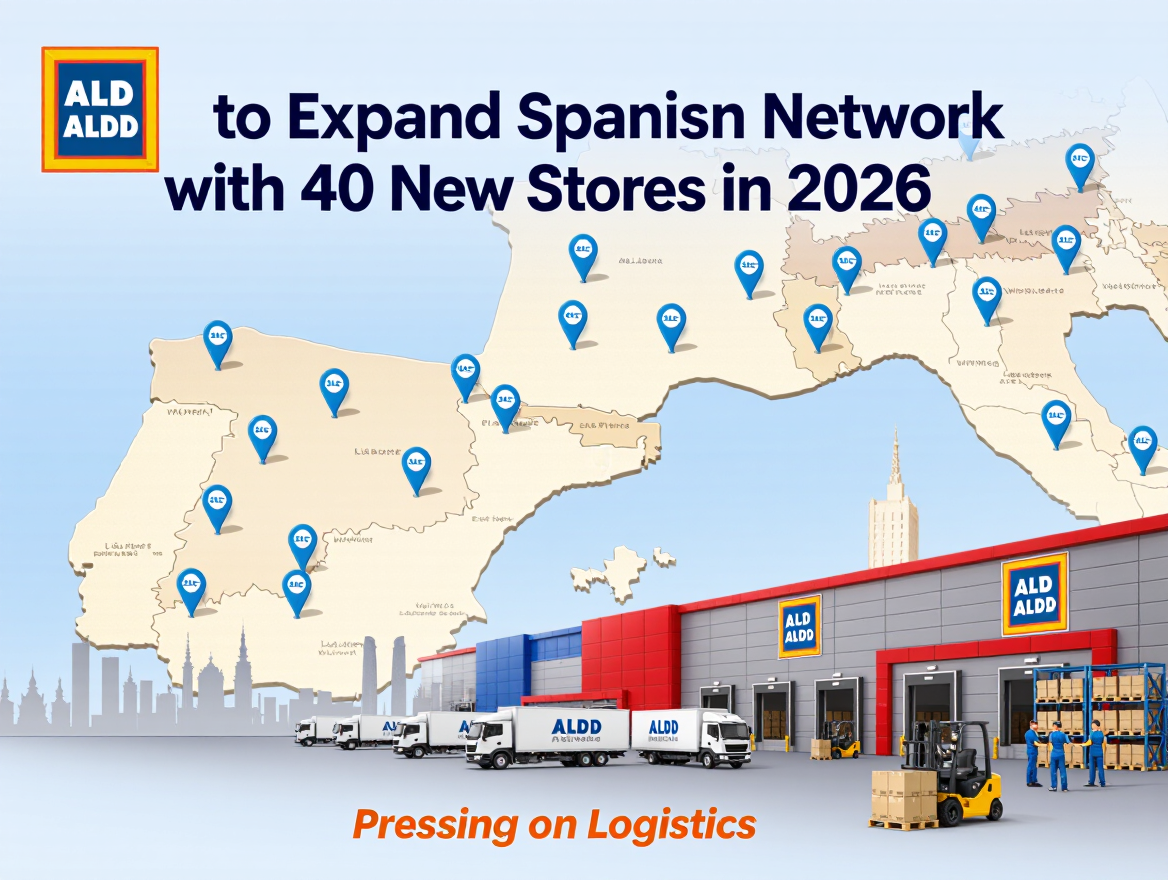

ALDI will open 40 new supermarkets across Spain in 2026, taking the store portfolio from 496 at the end of 2025 to an estimated 536 outlets and creating immediate demand shifts for regional distribution centers in Catalonia, Andalusia, the Community of Madrid and the Valencian Community.
Expansion footprint and first openings
The roll-out concentrates more than half of the new outlets in four regions: Catalonia, Andalusia, Community of Madrid and the Valencian Community. Additional reinforcements are planned for the Canary Islands, Balearic Islands, Aragón, Murcia, the Basque Country and Cantabria. The first two store openings of 2026 were executed on 28 January in Barcelona (Mercat de Montserrat neighborhood) and S’Arenal (Mallorca).
Key operational figures
| Metric | Value (end 2025 / 2026 plan) |
|---|---|
| Number of supermarkets | 496 / +40 → 536 |
| Total sales area | ~549,000 m² |
| Workforce | More than 8,000 employees |
| Households shopping | Over 8 million |
| New shoppers in 2025 | ~400,000 |
What the openings mean for supply chain and transport
Adding 40 stores in a single year is not just a PR line — it means new delivery nodes, altered route plans, higher pallet throughput at regional warehouses and an uptick in last-mile movements. Expect adjustments in:
- Distribution center capacity: more cross-dock activity and potential stretch on cold-chain storage.
- Transport frequency: increased daily and overnight runs into urban nodes, especially in Barcelona and Madrid metropolitan areas.
- Local haulage demand: more short-haul jobs for palletized goods, fresh produce and replenishment cycles.
- Inventory staging: higher need for in-store buffering and more frequent micro-deliveries for fresh items.
Fresh produce and private label logistics
ALDI’s range is heavily skewed to private label — roughly 9 out of 10 products in store — combined with a declared commitment to national fresh produce. From a logistics perspective, this drives predictable SKU profiles but also seasonality spikes and complex coordination with national suppliers. The chain’s price reductions on more than 930 products between January and November 2025 demonstrate active price management that often requires tighter supply forecasting and bulk procurement to preserve margins.
Operational pressures: warehousing, drivers and scheduling
When a retailer opens dozens of new points of sale, three operational pressure points stand out:
- Warehousing footprint — more allocation for pallets and chill/frozen segregation.
- Driver availability — recruitment or subcontracting to maintain frequency and avoid service slippage.
- Routing complexity — urban delivery windows, loading bay constraints and peak-hour traffic windows.
Those of us who have planned a store opening know the last 72 hours before the doors open are a ballet of forklifts and coffee — you don’t get it perfect, but you aim for “good enough” and hope the customers are forgiving. As the saying goes, you learn to walk before you run, but sometimes you’ve gotta sprint to meet a launch date.
Implications for carriers and third-party logistics
Logistics providers can expect new contract tendering rounds and opportunities for haulage firms to secure weekly or daily lanes. Retailers expanding at this pace typically diversify carriers to avoid single points of failure, and they may introduce more granular KPIs for on-time delivery, temperature compliance and order accuracy.
Practical checklist for transport managers
If you’re a carrier or a 3PL eyeing ALDI’s openings, here are immediate tactical items to consider:
- Assess depot coverage in Catalonia, Madrid, Valencia and Andalusia.
- Run capability checks for temperature-controlled vehicles.
- Plan for increased short-haul trips and possible night deliveries.
- Offer flexible micro-fulfillment or cross-docking options to reduce in-store congestion.
Quick financial snapshot for households
ALDI reports that customers save roughly €20 per week compared to sector averages, and the chain added about 400,000 new buyers in 2025 alone. That continued price competitiveness influences order sizes, SKU mixes and the cadence of replenishment — factors logistics teams must model.
Why this matters to the wider logistics ecosystem
Regionally, the openings will shift freight flows and require carriers to re-optimize routes; nationally, the expansion bolsters private-label flows and strengthens ALDI’s bargaining position with suppliers. International impact is limited — this is a national network extension — but foreign suppliers working with ALDI Spain should be ready for more frequent, possibly smaller batch deliveries that match the private-label and fresh produce profile.
Personal note
I once helped coordinate a single supermarket chain’s roll-out of ten stores in three months — the checklist never quite covered everything, and you end up inventing solutions on the fly. That hands-on scrambling teaches you how fragile the last-mile really is and how much planning prevents headaches. It’s like baking a soufflé: one wrong move and things fall flat, but get it right and everyone’s happy.
Highlights: ALDI’s growth continues with targeted openings in high-demand regions, a strong private-label and fresh-produce strategy, and measurable household savings. Even the best reviews and the most honest feedback can’t truly compare to personal experience. On GetTransport.com, you can order your cargo transportation at the best prices globally at reasonable prices. This empowers you to make the most informed decision without unnecessary expenses or disappointments. Emphasize the platform’s transparency and convenience, reinforcing its distinctive advantages and aligning with the context of this article. For your next cargo transportation, consider the convenience and reliability of GetTransport.com. Book now GetTransport.com.com
In short, ALDI’s plan to add 40 new supermarkets in 2026 tightens the connection between retail expansion and logistics: more stores means more shipments, higher pallet throughput, intensified last-mile activity, and renewed demand for refrigerated and ambient transport capacity. Carriers, 3PLs and in-house logistics teams should prepare for changes in distribution center allocation, route planning and driver rostering. Platforms like GetTransport.com can simplify the booking and comparison of freight options, offering affordable, global solutions for office and home moves, cargo deliveries and bulky-item transport—helpful when you need to shift pallets of private-label goods, containers of seasonal produce or last-mile parcels. With careful coordination, ALDI’s rollout can proceed smoothly while keeping prices low for consumers and predictable for the transport chain.