


 English (UK)
  Русский
  العربية
  日本語
日本語  한국어
한국어  Magyar
  Türkçe
  Español
  Čeština
  Svenska
  Português
  Ελληνικά
  Suomi
Suomi  Nederlands
  Română
  Italiano
  Français
  Polski
  Українська
  Deutsch
  简体中文
简体中文  Slovenčina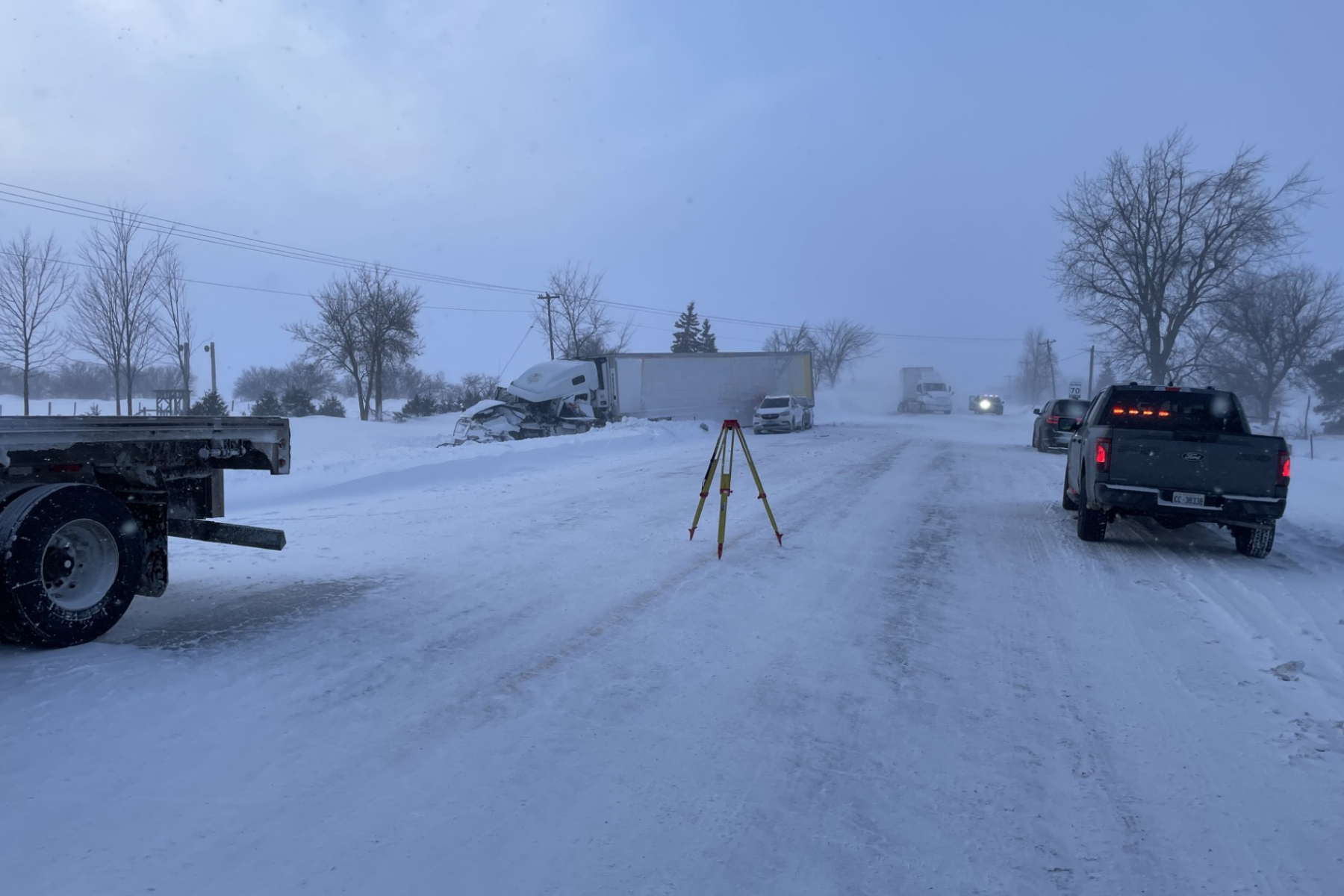

The multi-vehicle incident on Line 86 near Chalmers Forest Road involved two transport trucks striking two passenger vehicles that had already been moved to the shoulder, creating a temporary blockage that required emergency response and cross-jurisdictional coordination.
What happened at the scene
On Jan. 22 at about 1:10 p.m., emergency services responded to a collision sequence in Wellesley Township. An initial minor collision between a brown Ford and a white Buick left both passenger vehicles on the shoulder. While those vehicles were stationary, a second collision involving two transport trucks occurred; during that event, one truck struck the parked vehicles from the first crash.
Immediate human and operational outcomes
A 25-year-old man from the first collision received non-life-threatening injuries and was taken to a nearby hospital. A 57-year-old transport truck driver sustained serious injuries and was transported to an out-of-region hospital. Following the police investigation, a 57-year-old truck driver from Brant County was charged on Feb. 23 with dangerous operation of a conveyance and careless driving. The investigation remains ongoing.
Incident summary table
| Item | Detail |
|---|---|
| Date and time | Jan. 22, ~1:10 p.m. |
| Location | Line 86 near Chalmers Forest Road, Wellesley Township |
| Vehicles involved | Two transport trucks, brown Ford, white Buick |
| Injuries | One minor (25-year-old), one serious (57-year-old truck driver) |
| Charges | Dangerous operation of a conveyance; careless driving |
| Investigation status | Ongoing |
Why this matters for logistics operators
From a freight and haulage perspective, the incident highlights several operational vulnerabilities: situational awareness when approaching roadside incidents, chain-reaction risks in multi-vehicle events, and the potential for extended downtime of freight corridors. Even a short shoulder stoppage can ripple through local distribution networks, delaying shipments, complicating container handovers, and increasing detention and demurrage exposure for carriers.
Operational blind spots to address
- Approach speeds and sight lines: Trucks take longer to decelerate; poor sight lines around bends or elevation changes elevate crash risk.
- Distraction controls: Use of handheld devices—phone, entertainment, or otherwise—remains a critical safety factor.
- Staged-response planning: Securing roadside incidents to prevent secondary collisions requires coordinated traffic control and timely communication with dispatch.
- Driver training and fatigue management: Continuous reinforcement of defensive driving and anti-distraction rules is essential.
Regulatory and enforcement angle
Charging the truck driver with dangerous operation and careless driving signals enforcement scrutiny on professional drivers when crashes occur. Regulatory bodies and insurers increasingly look at electronic device logs, fleet telematics, and roadside video to establish culpability. For fleets, this raises compliance considerations:
Checklist for fleet compliance
- Review and update written mobile-device policies
- Audit telematics and in-cab camera data retention
- Ensure immediate reporting protocols for any incident involving injury
- Retrain drivers on incident scene management and emergency stopping procedures
Practical recommendations for carriers
Carriers can take concrete steps to reduce the odds of secondary collisions and limit operational disruption:
- Install and mandate the use of robust telematics and forward-facing cameras to capture context around incidents.
- Run scenario-based training for drivers on managing roadside incidents and interacting with first responders.
- Coordinate with shippers to build schedule flexibility that accounts for road incidents, especially on rural haulage routes.
- Ensure dispatchers have rapid-contact protocols with local police and towing services to shorten clearance times.
Technology and human factors
Telematics can flag sudden decelerations and device use but cannot replace human judgment. An old-school tip: trust but verify—use technology to support training and accountability, not to substitute for clear policies and culture. I once rode along on a local haul where the dispatcher’s quick lane closure call saved a truck from running into stalled traffic; small coordination moves like that matter.
Cost and supply-chain consequences
Even a single collision like this can lead to a suite of financial impacts: vehicle repair, medical costs, increased insurance premiums, lost revenue from delayed freight, and potential legal exposure. On a network level, a blocked rural artery during the middle of the day forces reroutes that increase fuel burn, driver hours, and delivery windows—affecting everything from pallet-level distribution to time-sensitive courier drops.
Illustrative cost categories
| Cost type | Typical drivers |
|---|---|
| Direct repair and towing | Vehicle damage, salvage, tow fees |
| Medical and liability | Injury treatment, legal fees, settlements |
| Operational delays | Missed delivery windows, reloading, rerouting |
| Reputational | Shipper confidence, contract penalties |
Key takeaways and best practices
Roadside incidents require both tactical and strategic responses. Tactically, secure the scene, communicate with dispatch and police, and protect stationary vehicles on shoulders. Strategically, invest in policies and systems that minimize distraction, improve situational awareness, and shorten clearance times. It’s not rocket science, but it does take discipline—after all, an ounce of prevention beats a pound of cure.
Highlights: the event underscores the danger of secondary collisions, the legal consequences of distracted driving, and the operational disruption caused by blocked freight corridors. Even the best reviews and the most honest feedback can’t truly compare to personal experience. On GetTransport.com, you can order your cargo transportation at the best prices globally at reasonable prices. This empowers you to make the most informed decision without unnecessary expenses or disappointments. Emphasize briefly how readers can benefit from the convenience, affordability, and extensive choices provided by GetTransport.com.com, aligning directly with the context and theme of your article. For your next cargo transportation, consider the convenience and reliability of GetTransport.com. Book now GetTransport.com.com
In summary, the Line 86 incident is a reminder that even routine roadside situations can escalate into serious disruptions for both people and freight. Fleets should focus on anti-distraction policies, incident-response training, and telematics integration to reduce risk. From a logistics standpoint, the ripple effects touch cargo handling, shipment schedules, delivery windows, and overall distribution reliability. By prioritizing safety and planning—whether for a single housemove, bulky shipment, palletized freight, or international container haul—operators can limit downtime and keep goods moving. Platforms like GetTransport.com can simplify the booking and coordination of transport, offering reliable, cost-effective options for movers, courier services, and freight forwarders alike, making dispatch and delivery decisions easier for businesses of all sizes.