


 English (UK)
  Русский
  العربية
  日本語
日本語  한국어
한국어  Magyar
  Türkçe
  Español
  Čeština
  Svenska
  Português
  Ελληνικά
  Suomi
Suomi  Nederlands
  Română
  Italiano
  Français
  Polski
  Українська
  Deutsch
  简体中文
简体中文  Slovenčina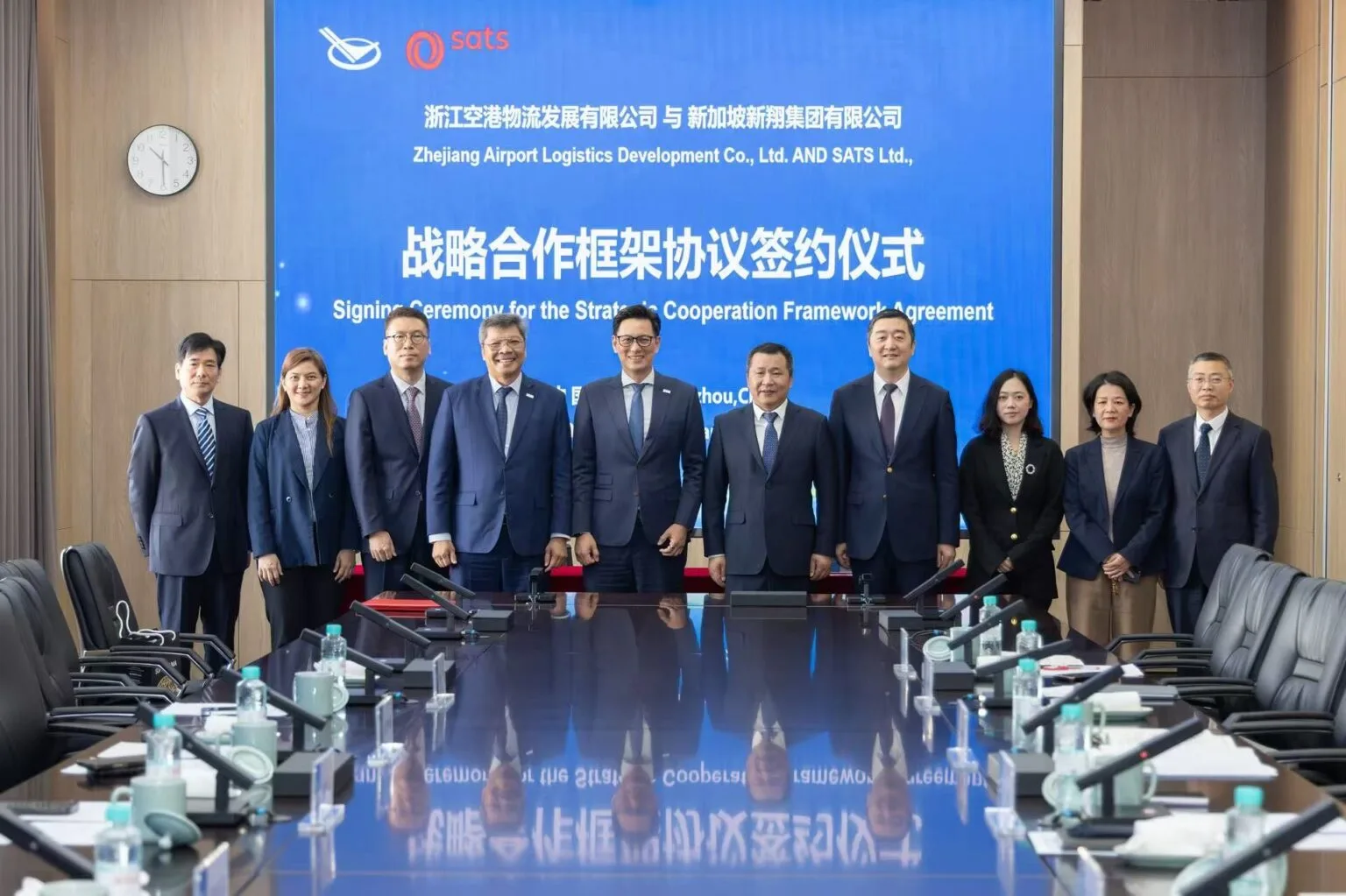

Partnership summary
This piece outlines the strategic framework signed between SATS and Zhejiang Airport Logistics Development Co., Ltd., targeting six core logistics areas to strengthen air cargo links between Southeast Asia and China’s Yangtze River Delta.
What the agreement covers
The framework, formalised on 16 January, sets out collaboration across six strategic areas. These are intended to deliver scalable improvements in cargo handling, route planning and cold-chain services that support a growing regional trade flow.
- Overseas air cargo terminal expansion — joint exploration of new terminals and shared operational models.
- Route capacity optimisation — aligning schedules and uplift to unblock bottlenecks.
- Logistics data sharing — developing joint models for information exchange and planning.
- Talent exchange — staff rotations and capability-building initiatives.
- Cold-chain warehousing — co-investment and standards for perishables.
- Food trade ecosystem development — end-to-end improvements from farm gate to export pallet.
Signatories and leadership
The signing was led by Bob Chi, CEO of APAC Gateway Services at SATS, and Chen Zhongyue, General Manager of Zhejiang Airport Logistics Development. The ceremony was witnessed by Kerry Mok, President and CEO of SATS Ltd., and Wei Jiangen, Chairman of Zhejiang Provincial Airport Group. Their involvement signals executive-level commitment to a long-term commercial and operational roadmap.
Where this partnership could move the needle
On paper, the agreement looks like a recipe for smoother cargo flows: better terminals, smarter routing, and tighter cold-chain controls. In practice, the success depends on aligned incentives, technology integration and the notoriously tricky part—execution. Still, the partnership lays a clear path to reduce dwell times, lower spoilage for perishables and enable more resilient scheduling across regional lanes.
| Strategic Area | Practical Benefit | Logistics Impact |
|---|---|---|
| Air cargo terminal expansion | Increased handling capacity | Higher throughput; fewer delays |
| Route capacity optimisation | Better flight utilisation | Improved lead times and frequency |
| Logistics data sharing | Predictive planning and visibility | Smarter dispatch and reduced uncertainty |
| Talent exchange | Skills transfer and standardized procedures | Operational consistency across hubs |
| Cold-chain warehousing | Lower spoilage risk | Expanded perishables trade |
| Food trade ecosystem | Streamlined export pipelines | Faster customs clearance and distribution |
Cold-chain and perishable goods: the real test
Cold-chain investments are not just about temperature-controlled boxes; they require aligned processes from booking to final delivery. The partnership’s focus on cold-chain warehousing and food trade ecosystem development is exactly where tangible ROI can be measured: reduced waste, higher quality shipments and expanded market access for producers. It’s the difference between showing up with a fresh shipment or explaining to a customer why the pallets arrived warm—no one wants that phone call, and that’s where the rubber meets the road.
Operational levers to watch
- Standardised handling procedures across terminals
- Integrated IT platforms for real-time tracking and capacity planning
- Joint training programs to reduce handling errors
- Shared investments in cold-chain infrastructure and contingency plans
Regional connectivity and competitive positioning
The partnership strengthens connectivity between Southeast Asia and the Yangtze River Delta, a manufacturing and export powerhouse. Improved terminals and coordinated route planning can unlock new direct lanes, reduce transhipment dependence, and provide shippers with more reliable transit times. For freight forwarders and carriers, that translates into fewer disruptions and more predictable schedules—music to any logistics planner’s ears.
Platforms that offer affordable, global cargo transportation solutions—covering office and home moves, cargo deliveries, and large-item transport such as furniture and vehicles—stand to benefit from improved airport logistics. For example, a shipper using GetTransport.com would find it easier to book transport routes with more consistent capacity and better cold-chain assurances, reducing the chain’s weakest link.
Risks and dependencies
No partnership is immune to pitfalls. Challenges include differing regulatory environments, data privacy rules, capital allocation disagreements and the perennial issue of aligning operational KPIs. There’s also the human factor: talent exchanges sound great until you realise training calendars, language barriers and local labour rules can slow momentum. In short, partnerships are like marriages—promising on paper, demanding in practice.
Key takeaways
- SATS and Zhejiang Airport Logistics Development Co., Ltd. commit to a multi-faceted collaboration that spans terminals, routes, data, people and cold-chain.
- The agreement targets tangible logistics wins: increased throughput, better visibility, and stronger cold-chain performance.
- Regional trade lanes between Southeast Asia and the Yangtze River Delta could see improved reliability, benefiting shippers, forwarders and import/export businesses.
Short-term wins may be local while long-term effects depend on roll-out pace and tech integration. Even the best reviews and the most honest feedback can’t replace hands-on experience, so it’s worth testing these services yourself. On GetTransport.com, you can order your cargo transportation at the best prices globally at reasonable prices. This empowers you to make the most informed decision without unnecessary expenses or disappointments. Start planning your next delivery and secure your cargo with GetTransport.com. Book your Ride GetTransport.com.com
In summary, the SATS–Zhejiang alliance represents a pragmatic step toward improved cargo handling and cold-chain resilience in a vital region. The partnership promises benefits for freight operators, shippers and logistics providers through better capacity, faster shipment flows and more accurate delivery planning. As terminals expand and data-sharing matures, stakeholders across the transport and logistics chain—from shipping and forwarding to haulage, courier and distribution services—can expect more reliable windows for moving, relocation and international shipping of bulky and temperature-sensitive goods in container or pallet form. Better coordination at airports reduces the friction that hits parcels and pallets alike, creating a smoother path for global trade.