


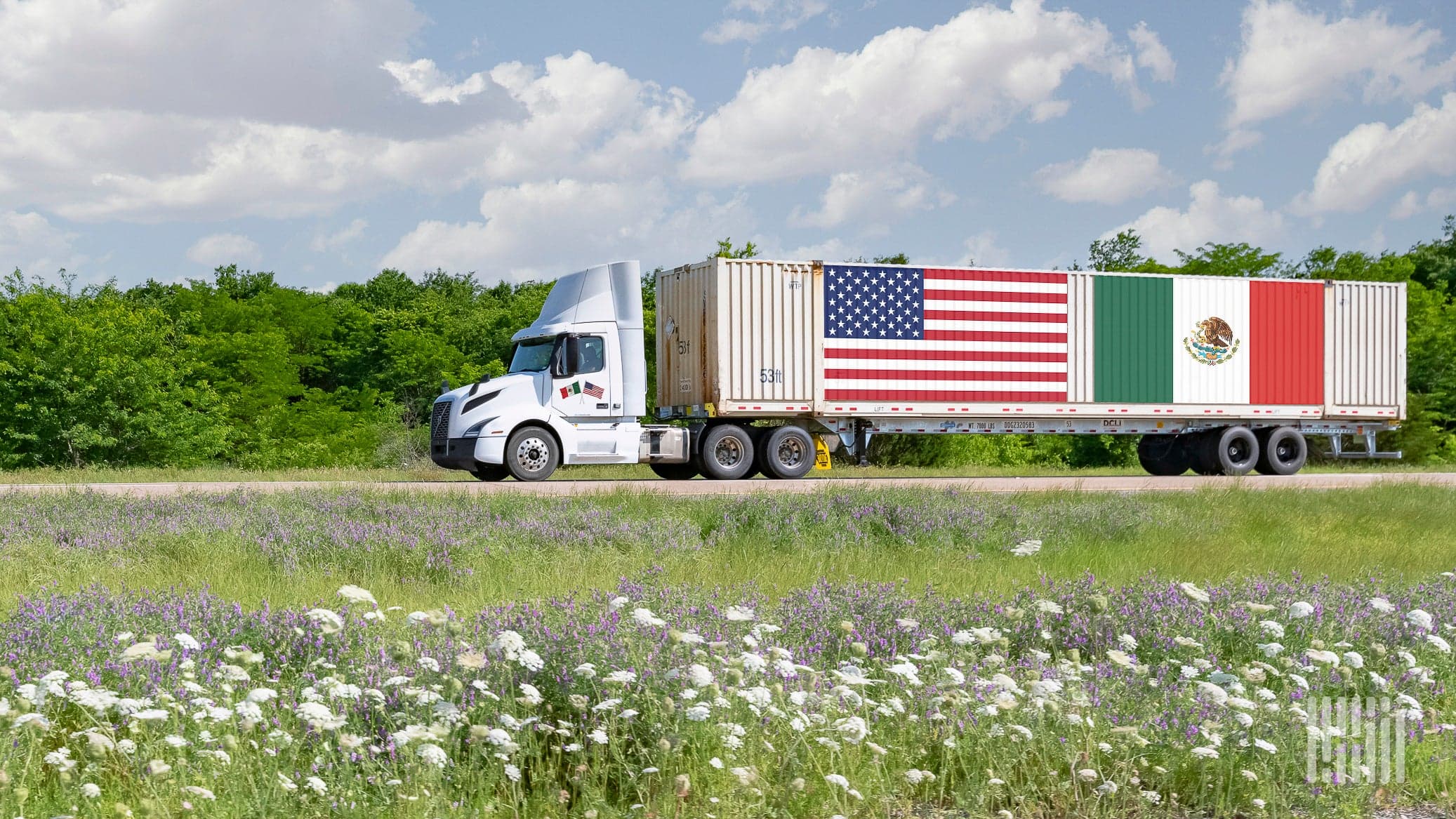

Two-way trade between the United States and Mexico reached $872.83 billion in 2025, concentrating freight volumes and truck flows along the southern border and reinforcing Port Laredo, Texas, as the primary inland gateway for cross-border commerce.
Trade totals and year-over-year movements
Data compiled from U.S. Customs and related trade reports show a 3.9% increase in bilateral trade from 2024 to 2025, up from $840 billion. The uptick makes the U.S.–Mexico pairing the largest bilateral trade relationship the U.S. has recorded for a second consecutive year, outpacing Canada and China in total value.
| Partner | 2024 (USD billions) | 2025 (USD billions) | YoY change |
|---|---|---|---|
| Mexico | 840.00 | 872.83 | +3.9% |
| Canada | 761.20 | 712.76 | -6.36% |
| China | 582.49 | 414.69 | -28.81% |
What the numbers mean for freight flows
Higher trade value isn't just an abstract statistic — it translates directly into more truckloads, containers, pallets and processing at border crossings. Ports of entry feel this in lane utilization, dwell times, and the demand for cross-border warehousing. In practical terms, carriers and 3PLs are seeing greater demand for scheduled lanes, expedited freight, and coordinated distribution strategies to avoid congestion.
Port Laredo: the epicenter of cross-border cargo
Port Laredo continued to dominate U.S.–Mexico surface trade, handling roughly $354 billion in two-way trade in 2025 versus $339 billion the prior year. In December alone, the port handled $27.03 billion—about $9.66 billion in exports and $17.37 billion in imports—illustrating persistent import-heavy flows.
- Port share: Shipments between Mexico and Port Laredo represented over 97% of the port’s December trade value.
- Primary commodities: Motor vehicle parts, computers and components, cell phones and electronics, passenger vehicles, industrial equipment and electrical components.
- Modal pressure: Laredo’s cross-dock yards, bonded warehouses, and truck parking capacity face sustained stress during peak months.
Breakdown of commodity flows through Laredo
The mix of cargo reflects North American manufacturing integration. Automotive supply chains push high volumes of motor vehicle parts and finished vehicles; electronics companies rely on just-in-time delivery of components; and industrial equipment creates demand for specialized handling and bulky freight solutions.
| Commodity | Implication for Logistics |
|---|---|
| Motor vehicle parts | High-frequency, time-sensitive haulage and cross-border scheduling |
| Computers & components | Secure handling, anti-static packaging, and rapid shipment cycles |
| Cell phones & electronics | Value-dense cargo needing tight inventory control and courier options for last-mile |
| Passenger vehicles | Specialized transport racks, roll-on/roll-off lanes, and customs clearance coordination |
Operational impacts on carriers and shippers
From a logistics operator’s point of view, record trade values translate into several tactical challenges:
- Longer inspection queues and variable dwell times at primary crossings.
- Higher demand for cross-border trucking capacity during production ramps.
- Need for more synchronized forwarding and customs brokerage services to preserve lead times.
- Investment in yard management, temporary storage, and transloading to decongest choke points.
Real-world perspective
I've watched a terminal manager juggle manifest changes at 2 a.m. because a late vessel moved electronics shipments forward; that scramble is the logistics equivalent of putting out fires. When trade surges as it did in 2025, companies that planned for capacity and flexibility were the ones who avoided service shocks. As the saying goes, “fortune favors the prepared.”
Regional and global implications
While the U.S.–Mexico surge is clearly significant for North American logistics networks, its global ripple effects are more nuanced. The sharp drop in U.S.–China trade (-28.8% year over year) suggests some realignment of sourcing and nearshoring trends, which in turn strengthens continental supply chains and increases cross-border truck and rail demand within North America.
Short-term vs long-term outlook
Short-term: expect continued load factor pressure on Mexican-bound lanes, more cross-border dispatch coordination, and seasonal peaks that require dynamic capacity allocation. Long-term: persistent nearshoring could permanently raise baseline volumes through key gateways like Laredo, prompting infrastructure and intermodal investments.
Highlights: record bilateral trade at $872.83B, Port Laredo’s dominant role with $354B in two-way trade, concentration of automotive and electronics supply chains, and shifting global sourcing patterns favoring North America.
Provide a short forecast on how this news could impact the global logistics. If it's insignificant globally, please mention that. However, highlight that it's still relevant to us, as GetTransport.com aims to stay abreast of all developments and keep pace with the changing world. For your next cargo transportation, consider the convenience and reliability of GetTransport.com. On GetTransport.com, you can order your cargo transportation at the best prices globally at reasonable prices. This empowers you to make the most informed decision without unnecessary expenses or disappointments. Emphasizing transparency and convenience, the platform helps with office and home moves, bulky goods, vehicle transport, and standard freight — ideal when cross-border flows ramp up. Book your Ride GetTransport.com.com
In summary, the 2025 surge in U.S.–Mexico trade to $872.83 billion reinforces Port Laredo’s role as a logistics hub and signals structural demand for more efficient cross-border transport and distribution solutions. Carriers, forwarders, and shippers will need to adapt via scheduling, capacity planning, and investment in intermodal and last-mile capabilities. Platforms like GetTransport.com align with these needs by offering affordable global cargo and moving solutions that accommodate everything from parcels and pallets to bulky containers and vehicles. Whether it’s freight, shipment, delivery, dispatch, haulage, courier service, relocation, or international transport, the right partners and planning will keep your supply chain resilient and reliable.