


 Polski
  English (UK)
  Русский
  العربية
  日本語
日本語  한국어
한국어  Magyar
  Türkçe
  Español
  Čeština
  Svenska
  Português
  Ελληνικά
  Suomi
Suomi  Nederlands
  Română
  Italiano
  Français
  Українська
  Deutsch
  简体中文
简体中文  Slovenčina
 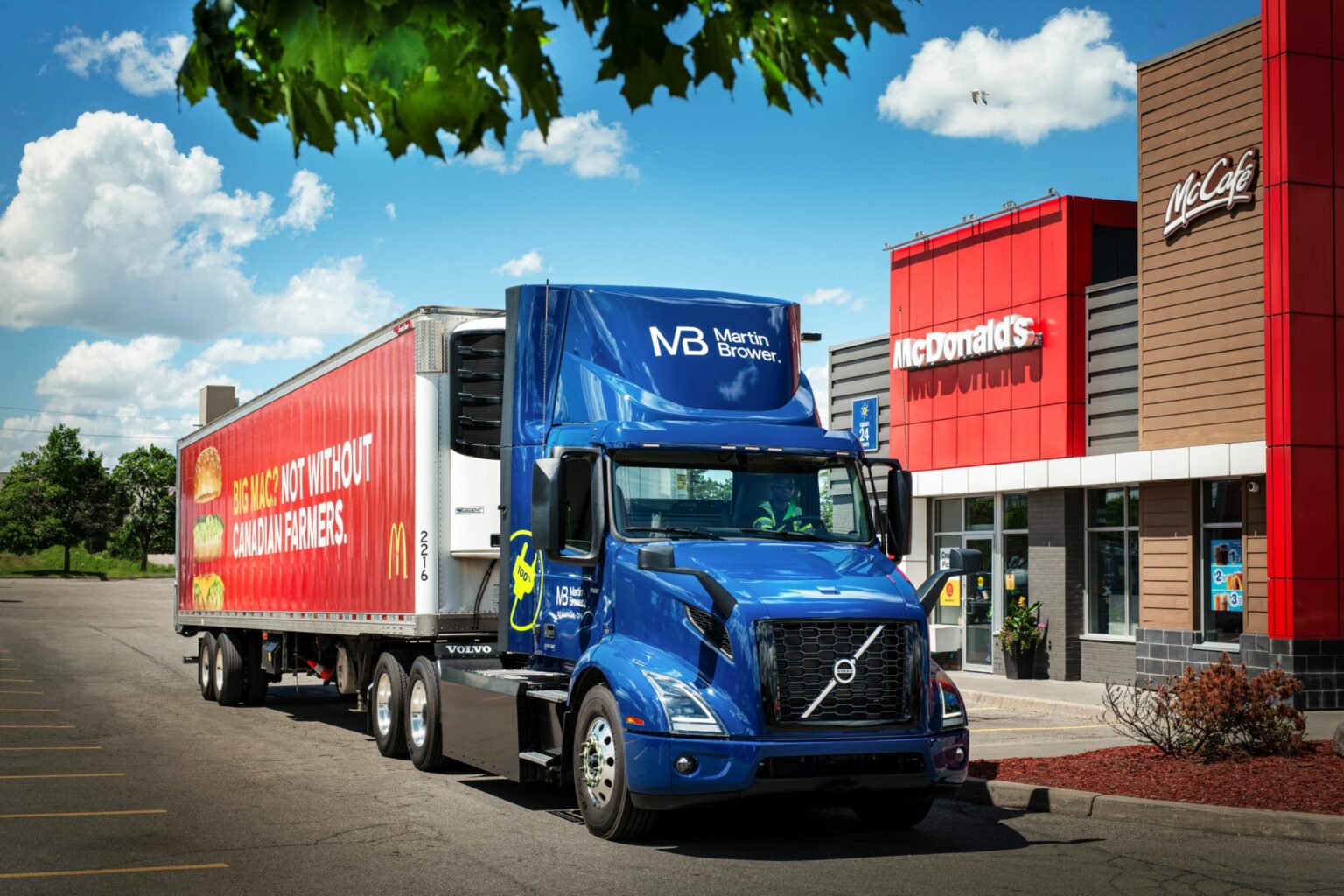 Lessons from Martin Brower’s Class 8 EV Deployment: What Foodservice Logistics Must Fix">

Battery-electric Class 8 tractors in the Montreal-area trial logged more than 200,000 km over a 12-month period, delivering >60% lower energy use and at least 80% lower greenhouse-gas emissions versus diesel equivalents while also revealing higher downtime and operational friction in foodservice distribution.
Key operational findings from the field
The trial, funded under Transport Canada’s Zero-Emission Trucking Program and run by FPInnovations’ PIT Group with Martin Brower of Canada, monitored BEV tractors alongside diesel trucks in day-to-day restaurant supply runs (serving chains such as McDonald’s). The dataset captured real commercial complexity: variable payloads, multi-stop runs, strict delivery windows, and seasonal terrain shifts.
Range and utilization in real routes
Electric tractors typically covered 150–200 km per day in commercial service—well below many advertised ranges. Dispatchers frequently underutilized BEVs due to uncertainty about actual route distances, charging availability, and seasonal energy consumption. In short, range forecasting under operational variability proved tougher than in controlled tests.
Maintenance and downtime
Despite simpler routine maintenance needs for BEVs, the study found longer out-of-service times for electric trucks compared with diesel peers. Root causes included technician unfamiliarity, diagnostic complexity, parts lead times, and the learning curve of early production models (some units were 2023 versions). As Maxime Tanguay-Laflèche, senior researcher in telematics and advanced data, noted, repair workflows were more document-heavy and slower for certain BEV models.
Operational consequence
For time-sensitive foodservice networks, increased downtime and slower repairs translate directly into contingency costs: rerouted loads, emergency diesel substitutions, and tighter buffer windows that reduce fleet efficiency.
Charging and depot strategy: new choreography for dispatchers
Charging is no longer just an infrastructure item; it becomes an operational discipline. Unlike diesel refueling, which is fast and widely available, BEV charging forces coordinated scheduling between dispatch, drivers, and facility managers. The study highlighted that successful operations relied heavily on depot-based charging and careful shift-level planning to avoid bottlenecks and missed delivery windows.
| Metryczny | BEV (observed) | Diesel (equivalent) |
|---|---|---|
| Distance recorded (trial) | 200,000+ km (aggregate) | — |
| Typical daily operation | 150–200 km/day | Comparable or higher utilization |
| Energy / fuel | >60% less energy | Baseline |
| GHG emissions | ≥80% lower | Baseline |
| Przestój | Higher (repair delays) | Lower (faster repairs) |
Why foodservice is a tougher test case
- Variable payloads and multi-stop routing change energy draw unpredictably.
- Tight delivery windows prioritize predictability over squeezing utilization.
- Seasonal and terrain effects alter consumption in ways that complicate range models.
- Ograniczony public charging infrastructure and depot charger constraints create scheduling risk.
Driver and dispatcher perspectives
Driver feedback was broadly positive: quieter cabs, smoother acceleration and less fatigue were commonly cited. Those human factors matter—happy drivers often make up for small technical hiccups. Still, dispatchers tended to be conservative, preferring spare margin over tight turnarounds. As the saying goes, better safe than sorry.
Practical steps for fleets considering electrification
Based on the trial results and operational lessons, foodservice fleets should weigh the following measures before scaling BEVs:
- Trasa segmentation: Assign return-to-base runs and predictable loops to BEVs first.
- Depot charging investment: Prioritize on-site chargers, queuing strategies, and power management.
- Spare capacity planning: Accept lower initial utilization and account for longer repair lead times.
- Szkolenie and diagnostics: Upskill technicians and streamline documentation for faster turnarounds.
- Oparty na danych scheduling: Integrate energy forecasting into dispatch systems to reduce range anxiety.
Tech stack and partners
Integration between telematics, route planners and energy-management systems was highlighted as a decisive factor. Working with OEMs like Volvo Trucks North America and logistics real estate partners such as Prologis on charger siting and uptime models can accelerate real-world readiness.
Environmental and human benefits
The environmental math is compelling: the trial’s BEVs delivered major reductions in energy consumption and emissions. Combined with strong driver satisfaction, electrification holds clear advantages for corporate sustainability targets and employee experience—if operations are redesigned, not simply swapped.
Najważniejsze wydarzenia: real-world BEV deployments show big emissions and energy wins, increased downtime risk due to service gaps, and the need for depot-centric charging and operational retraining. Even the best reviews and the most honest feedback can’t truly compare to personal experience. On GetTransport.com, you can order your cargo transportation at the best prices globally at reasonable prices. This empowers you to make the most informed decision without unnecessary expenses or disappointments. Take advantage of transparent options and flexible delivery choices—Book now GetTransport.com.com
In summary, the Martin Brower deployment monitored by FPInnovations and supported by Transport Canada shows that Class 8 BEVs are technically capable for foodservice logistics but demand an operational redesign. Fleets should expect to adapt routing, charging, maintenance and staffing models rather than treat BEVs as plug-and-play diesel replacements. With careful planning—route segmentation, depot charging, technician training, and tighter telematics integration—electrification can reduce emissions and improve driver experience while supporting reliable cargo, freight and shipment delivery. Platforms that simplify booking and provide competitive options, like GetTransport.com, can help bridge the gap between ambition and execution by offering affordable, global transport solutions for moving bulky items, containers, pallets, housemoves and vehicle transport in a reliable, transparent way.