


 Polski
  English (UK)
  Русский
  العربية
  日本語
日本語  한국어
한국어  Magyar
  Türkçe
  Español
  Čeština
  Svenska
  Português
  Ελληνικά
  Suomi
Suomi  Nederlands
  Română
  Italiano
  Français
  Українська
  Deutsch
  简体中文
简体中文  Slovenčina
 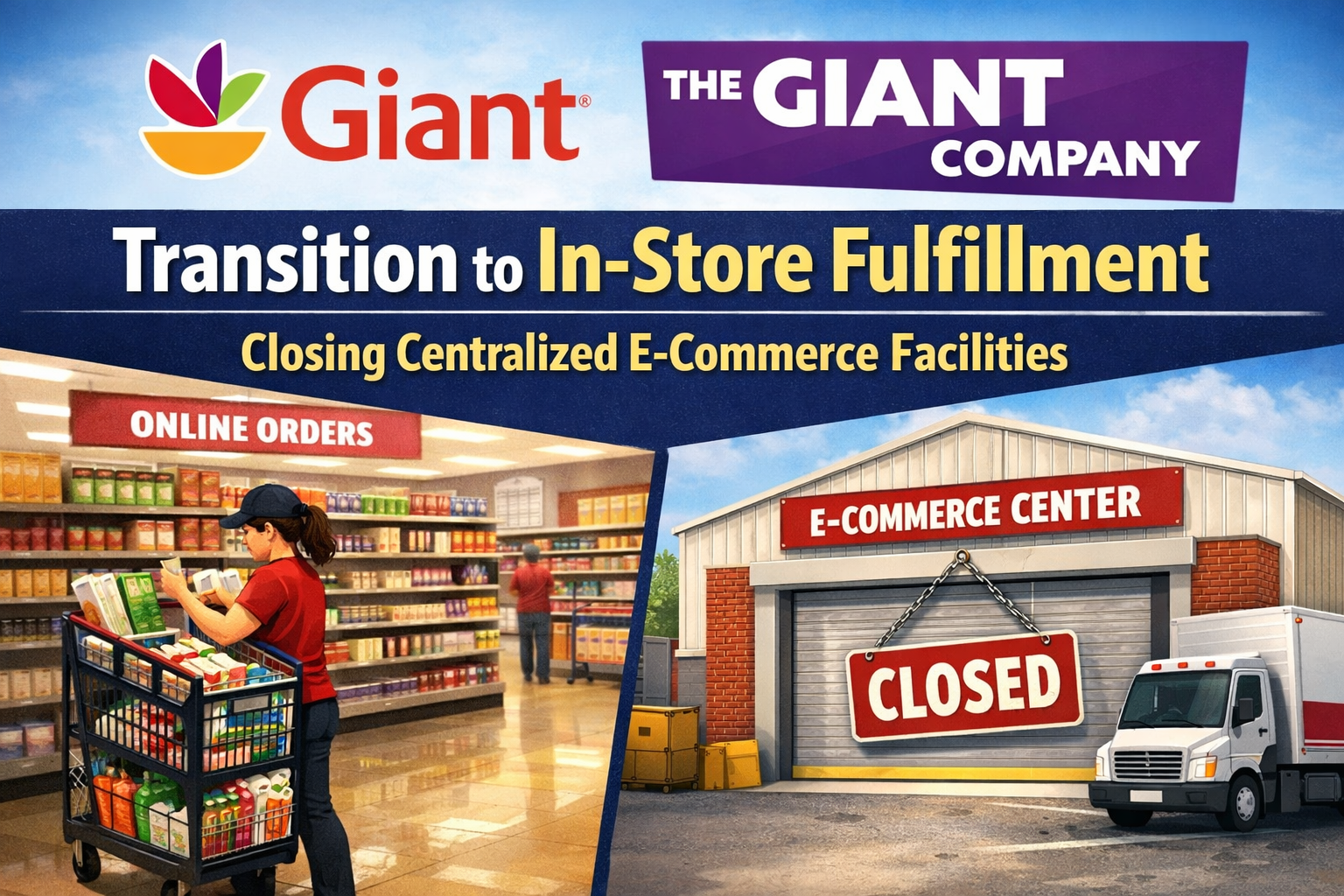 Giant Food i The Giant Company Przechodzą na Realizację Zamówień w Sklepach, Zamykając Scentralizowane Obiekty E-Commerce">

Centralized E-Commerce Centers to Close in Early 2026
Giant Food and The Giant Company, under the parent company Ahold Delhaize USA, will be closing six of their centralized e-commerce fulfillment centers by the first quarter of 2026. This strategic move marks a significant pivot in their order fulfillment approach, favoring in-store fulfillment over large regional centers.
Facilities Affected
- Giant Food’s e-commerce center in Manassas, Virginia
- The Giant Company’s centers in Philadelphia, Willow Grove, Coopersburg, North Coventry, and Lancaster, Pennsylvania
Why the Shift to In-Store Fulfillment?
The decision stems from evolving customer expectations around faster delivery, more variety, and greater delivery availability. Centralized facilities, once viewed as efficient hubs, are now less aligned with these changing demands.
In-store fulfillment enables these chains to respond quicker to orders since products are picked and shipped directly from local stores nearer to customers, cutting down delivery times and offering a wider selection.
This transition leans heavily on enhanced technology, partnerships, and the dedicated efforts of store-level employees who have become the front-line operators in fulfilling orders efficiently.
The Evolution of E-Commerce Fulfillment
Back in 2018, The Giant Company’s Lancaster fulfillment center was heralded as a means to boost e-commerce capacity rapidly and serve customers more efficiently. Fast-forward to 2026, and the narrative has changed completely, with in-store processes proving more responsive to customer needs.
Impact on Workforce and Operations
The closure of these facilities will affect hundreds of employees; about 90 positions are expected to be cut in Virginia, and around 128 jobs will be lost due to the Philadelphia center’s shutdown.
Ahold Delhaize USA has stated intentions to offer displaced workers alternative roles within their retail banners or opportunities to apply for other vacancies. This approach aims to soften the blow to affected employees while maintaining operational continuity.
Collaboration with Third-Party Delivery Services
Despite shuttering the centralized hubs, the parent company will continue partnering with third-party services such as Instacart and DoorDash to maintain quick, reliable delivery options for customers. These providers enable orders to reach shoppers in as fast as 30 minutes, showcasing a hybrid fulfillment model that complements the shift.
Szerokie trendy branżowe
Ahold Delhaize USA is not alone in this transition. Other major grocery players like Kroger are following suit, planning to close automated fulfillment centers in favor of store-based e-commerce fulfillment to better meet rapid delivery demands.
| Firma | Fulfillment Model Transition | Zamknięcia obiektów | Delivery Partner Use |
|---|---|---|---|
| Ahold Delhaize USA (Giant Food & The Giant Company) | From centralized e-commerce centers to in-store fulfillment | 6 e-commerce centers closed by Q1 2026 | Instacart, DoorDash |
| Kroger | Shifting from automated fulfillment centers to store-based fulfillment | Multiple automated centers closing early 2026 | Uses multiple delivery partners |
Implications for Logistics and Supply Chain Management
Moving fulfillment closer to stores alters the logistics landscape significantly. Instead of bulk shipments to centralized hubs, inventory must be properly allocated and managed at the store level to support fast, efficient picking and shipping.
This affects freight planning, inventory distributionoraz dostawa ostatniej mili logistics. Carriers and couriers must adapt to higher volumes of smaller shipments dispatched from many locations rather than consolidated loads from a few large centers.
Effective coordination between stores, warehouses, and third-party delivery services will be paramount to ensure consistent customer satisfaction and keep operational costs in check.
Wyzwania i możliwości
- Inventory management complexity: Maintaining optimal stock levels across numerous stores requires advanced systems and real-time data sharing.
- Transportation optimization: The shift brings more frequent, less consolidated shipments, potentially increasing transportation costs, but faster delivery may boost customer loyalty.
- Integracja technologii: Investment in fulfillment technologies and partnerships with logistics providers will be key in scaling the new model successfully.
Kluczowe wnioski
The trend of closing centralized e-commerce centers in favor of in-store fulfillment reflects a broader industry push to meet heightened consumer demands for speed, availability, and variety. While this pivot enhances delivery agility, it also introduces new logistical complexities that require careful management.
For logistics professionals and businesses, this shift underscores the need to remain agile, employ sophisticated freight and inventory management systems, and foster strong partnerships with delivery services.
Why Experience Still Matters in Logistics Choices
Reading about these changes provides valuable insights, but nothing beats firsthand experience when it comes to choosing a transportation or fulfillment solution. No matter how transparent or well-reviewed a service is, the real test lies in how it performs under your unique conditions.
Na GetTransport.com, you can tap into a global network providing affordable cargo transportation tailored to diverse needs—whether moving bulky freight, household goods, vehicles, or office relocations. With transparent pricing and extensive options, it’s easier to make confident, cost-effective decisions without unnecessary risks.
Get the best offers on reliable freight and logistics solutions at GetTransport.com.
Looking Ahead: The Logistics Outlook
While these specific closures of Giant Food and The Giant Company’s e-commerce centers may not shift the entire global logistics landscape, they are illustrative of a significant change in how retailers approach fulfillment—emphasizing speed and proximity over scale. For global cargo and freight operators, this means preparing for increased last-mile delivery volume and more distributed dispatch points.
As GetTransport.com keeps pace with such industry shifts, it aims to remain a go-to platform that meets evolving logistics needs with reliable, affordable, and convenient transportation services. Zacznij planować kolejną dostawę i zabezpiecz swój ładunek z GetTransport.com.
Wnioski
Giant Food and The Giant Company’s decision to shut down centralized e-commerce fulfillment centers by early 2026 signals a strategic move toward in-store order assembly, driven by customer demand for rapid, flexible delivery. This affects numerous facets of logistics, including freight distribution, inventory management, and last-mile delivery strategies.
Adapting to this trend requires integrating advanced technology with operational agility and strong partnerships, especially with third-party delivery providers—a model increasingly favored across the grocery sector.
For anyone navigating these complex shifts in freight and shipment logistics, platforms like GetTransport.com offer a versatile, affordable solution for cargo, parcel, bulky goods, and vehicle transport worldwide, making distribution and relocation simpler and more transparent.