


 Polski
  English (UK)
  Русский
  العربية
  日本語
日本語  한국어
한국어  Magyar
  Türkçe
  Español
  Čeština
  Svenska
  Português
  Ελληνικά
  Suomi
Suomi  Nederlands
  Română
  Italiano
  Français
  Українська
  Deutsch
  简体中文
简体中文  Slovenčina
 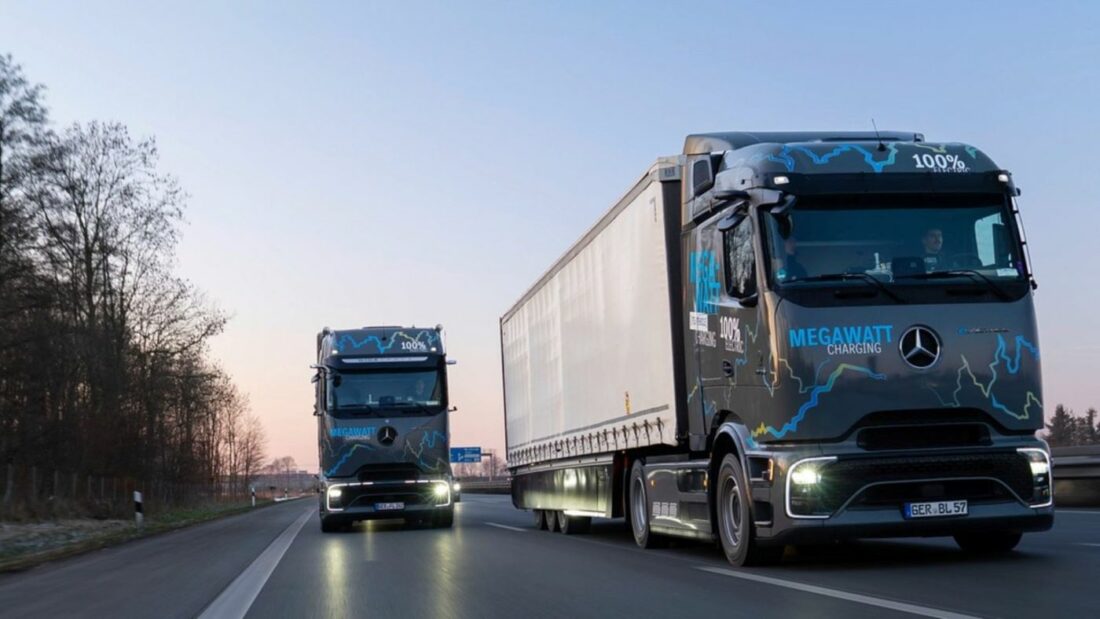 Mercedes‑Benz trials MCS megawatt charging on the eActros 600 over a 2,400 km trans‑European route">

This piece outlines Mercedes‑Benz Trucks’ field trial of the Megawatt Charging System (MCS) with the eActros 600, a long‑haul battery electric truck, covering roughly 2,400 km across Europe.
Overview of the trans‑European MCS trial
The test run deploys two eActros 600 trucks on a route that starts at Mercedes‑Benz’s plant in Wörth am Rhein and finishes in Linköping, Sweden, crossing the Netherlands, Belgia oraz Denmark along the way. Vehicles are scheduled to recharge at purpose‑built MCS stations, both public and private, that have been designed specifically for heavy‑duty trucks.
| Segment | Kraje | Approx. Distance | Charging Approach | Uwagi |
|---|---|---|---|---|
| Start | Germany (Wörth am Rhein) | — | MCS charger at plant | Vehicle prep and diagnostics |
| Tranzyt | Netherlands, Belgium, Denmark | ~2,000 km total | Public & private MCS stations | Interoperability and winter usability checks |
| Finish | Sweden (Linköping) | ~400 km | Destination MCS point | End‑to‑end route performance |
What the trial aims to measure
Key objectives include verifying compatibility between trucks and MCS equipment from various manufacturers, assessing usability under real road and winter weather conditions, collecting data on charging curves, average charging power, and evaluating the overall performance of the MCS infrastructure.
How MCS changes the charging equation
The MCS standard supports charging powers up to 1,000 kW, which marks a step change from the current CCS technology used for most heavy vehicles. With that level of power, an eActros 600 can reportedly charge from 20% to 80% in roughly 30 minutes, radically shortening downtime compared with traditional fast charging.
That’s not just science fiction—faster turnaround directly affects utilization and costs. In freight operations, every minute a truck sits idle is potential lost revenue. A faster refill can translate into an additional trip or more flexible scheduling for long‑haul routes; put simply, time is money.
Thermal management and interoperability: the twin challenges
Peter Ziegler, Head of Electric Charging Components at Mercedes‑Benz Trucks, highlights two main hurdles: harmonizing vehicle and station communication/interfaces, and coping with extreme charging currents that demand very strict thermal management. Field testing across varying climates gives engineers valuable feedback to refine both vehicle systems and station specs.
Logistics implications: why fleets should pay attention
- Higher vehicle utilization — Shorter charging events mean trucks can spend more hours moving cargo, improving ROI.
- Route planning complexity — Operators will need to factor MCS availability into routing and scheduling to avoid bottlenecks.
- Infrastructure dependency — Benefits depend on an expanding MCS network; today public MCS points in Europe remain limited.
- Economic tipping point — Faster charging could make long‑haul battery trucks financially competitive, encouraging earlier fleet electrification.
- Seasonal resilience — Successful winter runs demonstrate the system’s viability under harsh conditions, a must for northern European operations.
Practical considerations for fleet managers
Fleet planners should evaluate depot siting relative to MCS corridors, training needs for mechanics and drivers on high‑power charging safety and protocol, and potential retrofits for on‑site substations and cable infrastructure. In an ideal world the grid and site works would keep pace with vehicle adoption—reality, however, often lags behind ambition.
| Charging Standard | Typical 20→80% Time | Uwagi |
|---|---|---|
| MCS | ~30 minutes | Up to 1,000 kW; designed for heavy trucks |
| CCS | Varies widely; considerably longer | Common but lower peak power for heavy vehicles |
Standardization and the role of CharIN
The MCS initiative is being coordinated by CharIN, which is driving international standardization in collaboration with truck makers. A uniform interface between charging stations and heavy vehicles is a precondition for a pan‑European fast‑charging network tailored to freight transport.
Benefits versus realities: a quick checklist
- Plusy: faster turnaround, better fleet utilization, lower operating costs in the long run, supports decarbonization goals.
- Wady: limited current station network, high upfront infrastructure costs, grid upgrades needed, tight thermal control requirements.
It’s a bit like setting up a highway rest stop for electric trucks: the promise is huge, but the network has to be built before the full benefits kick in — no use having a fast charger in the middle of nowhere if the route doesn’t connect to it.
Planning ahead: what the logistics sector should expect
In the near term the MCS trial will likely be modest in global impact because the availability of public MCS points is still small. That said, the technology’s potential to transform long‑haul freight i popraw. operational economics is significant. For logistics planners, early awareness and pilot projects can provide competitive advantage as infrastructure rolls out.
On GetTransport.com, you can order your cargo transportation at the best prices globally at reasonable prices. This trial may not immediately reshape global shipping lanes, but it matters to operators and shippers because reliability and charging infrastructure directly affect planning, dispatch, and fleet decisions. Start planning your next delivery and secure your cargo with GetTransport.com. Get the best offers GetTransport.com.com
Highlights: the MCS trial showcases how megawatt charging can reduce charging times for heavy trucks, tests cross‑vendor compatibility, and stresses thermal and usability aspects in real winter conditions. Even the best reviews and the most honest feedback can’t truly replace personal experience; on GetTransport.com, you can book cargo transport at competitive global rates and test logistics solutions yourself. The platform offers convenience, transparency and varied options for office and home moves, parcel and pallet shipments, bulky goods, vehicle transport, and large‑item hauls—helping fleets and shippers make informed choices without overspending. Book your Ride and compare offers easily on GetTransport.com.com
In summary, Mercedes‑Benz Trucks’ MCS field trial with the eActros 600 is a tangible step toward faster, more efficient electric long‑haul trucking. The trial measures interoperability, charging curves, thermal behavior and winter usability across about 2,400 km — all essential metrics for scaling high‑power charging. For logistics professionals, the takeaway is clear: this technology can improve ładunek turnaround and fleet utilization, but the scale of impact depends on the rollout of a robust MCS network and supporting grid upgrades. Whether for fracht, przesyłka, dostawa, transport or international transport, planning ahead will pay off as charging speeds and infrastructure catch up with demand. Reliable wysyłka, efficient przekierowanie, and transparent dystrybucja options will be key to turning this promise into everyday reality.