


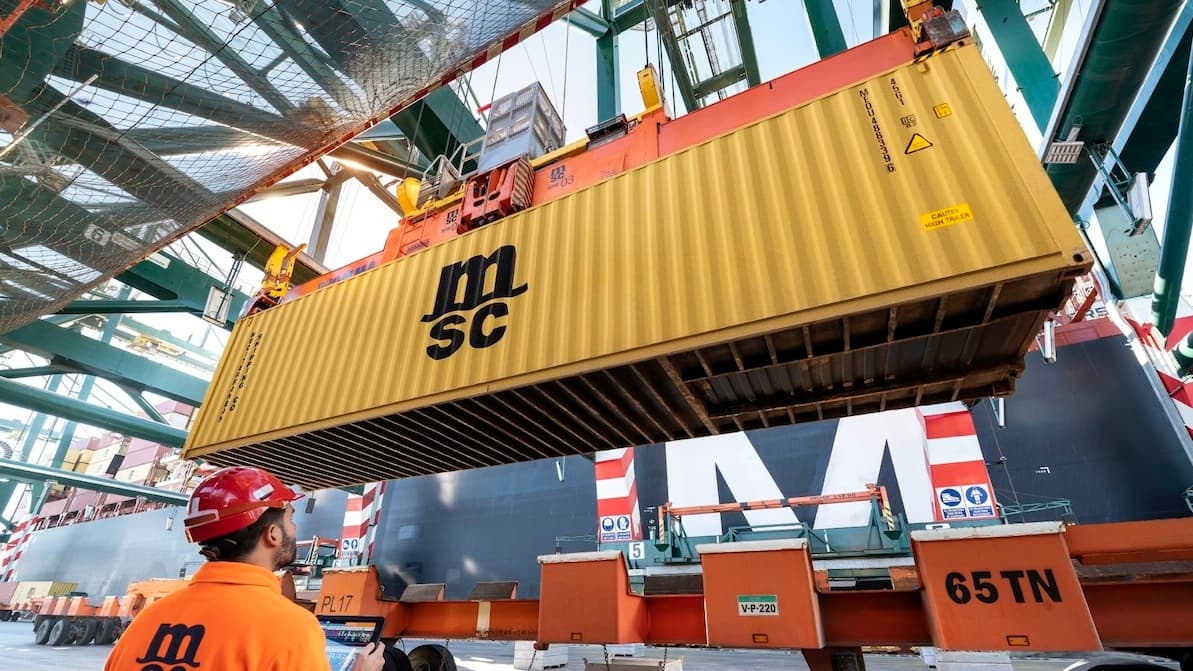

Mediterranean Shipping Co. (MSC) has suspended all worldwide bookings destined for the Middle East, immediately removing an estimated 73,000 TEU of weekly capacity across nine liner strings serving the Red Sea and Persian Gulf. The advisory cites crew safety as the reason and signals a halt in direct calls to roughly 25–30 regional ports until security stabilizes.
Scope of the suspension and immediate capacity impact
The suspension affects multiple MSC strings, including services that link North India and South America to the Arabian Gulf and Indian Ocean rim. While MSC did not specify every string by name, industry estimates place the affected capacity across intra‑regional feeders and mainline loops in the post‑Panamax 6,000‑TEU range.
| Metric | Value |
|---|---|
| Estimated weekly capacity removed | 73,000 TEU |
| Number of services suspended | 9 services |
| Regions directly affected | Red Sea, Persian Gulf, Arabian Gulf, Indian Ocean rim |
| Carrier | Mediterranean Shipping Co. (MSC) |
Which vessels and regions are most exposed
Analysts tracking vessel positions have reported dozens of ships held up in the Persian Gulf; at least seven of these are MSC intra‑regional feeders in the 4,000–6,000 TEU bracket. The carrier’s recent 2025 network expansion—new North India–Middle East loops and South America–Middle East connections—means more direct calls are now offline, amplifying short‑term congestion risks at alternative transshipment hubs.
Operational rationale: crew safety and risk avoidance
MSC’s advisory explicitly points to the safety of seafarers and ongoing monitoring with authorities. From an operational standpoint, rerouting, blank sailings and port omissions are the immediate tools carriers use to manage exposure when geopolitical risk spikes. Those actions reduce direct service options but preserve broader network integrity until the environment calms.
Short‑term ripple effects for shippers and logistics providers
- Rate volatility: Spot and contract rates for Middle East trades will likely spike where alternatives are limited.
- Longer transit times: Rerouted cargo via Suez alternatives, East Africa or redeployment through Mediterranean transshipment can add days or weeks.
- Equipment shortages: Local container imbalances can emerge quickly at ports that remain open to receive diverted cargo.
- Increased multimodal demand: Road, rail and airfreight may see upticks for time‑sensitive shipments.
Immediate actions logistics teams should consider
- Audit current bookings to identify impacted bills of lading and notify customers.
- Engage alternate carriers and routes—prioritize full‑service options with clear contingency plans.
- Assess insurance clauses for war, strikes, and contingency costs; update contracts if needed.
- Pre‑position inventory where feasible to reduce reliance on immediate ocean lift.
- Communicate transparently with receivers about expected delays and rerouting costs.
If you’re in procurement or transport planning, this kind of sudden capacity pull is a sore reminder that redundancy matters. I remember a shipment I coordinated years ago that was redirected through a secondary hub—took longer but kept production lines running. Little inconveniences then, big headaches if you don’t have a Plan B.
Wider market signals and medium‑term adjustments
For carriers, the suspension is a commercial decision balancing liability and network continuity. For forwarders and freight brokers, expect a scramble for alternative lift and a temporary reallocation of containers. Some shippers will switch to larger strategic inventories or split shipments across multiple lanes to blunt risk. Ports in adjacent regions may see a short spike in volumes, pushing yard occupancy and demurrage concerns higher.
| Concern | Potential logistics response |
|---|---|
| Port congestion | Use secondary ports, increase yard throughput, prioritize critical cargo |
| Freight rate spikes | Negotiate multi‑leg contracts, explore multimodal combinations |
| Container shortages | Source equipment via leasing pools, optimize container cycles |
| Time‑sensitive deliveries | Shift to air or premium ocean services, consolidate with express couriers |
Regulatory and insurance angles
Escalating regional conflict often triggers additional regulatory and compliance checks, plus potential forced deviations. Carriers may declare certain areas as unsafe and levy security surcharges; marine insurers may invoke war or piracy clauses. Logistics teams should coordinate with legal and insurance advisors to understand liabilities and possible claims processes.
Practical checklist for exporters and importers
- Map all shipments bound for the Middle East region in the next 30–90 days.
- Request confirmation from carriers about alternative services and blank sailings.
- Secure temporary warehousing at safe transshipment hubs if possible.
- Keep customers updated and set realistic delivery windows.
- Factor extra lead time into production and distribution schedules.
Bottom line: when a major liner like MSC pauses bookings, the knock‑on effects are felt across the supply chain—from port operators and terminals to inland haulage and final‑mile delivery. It’s not just a shipping line problem; it’s a logistics problem.
Provide a short forecast on how this news could impact the global logistics. If it's insignificant globally, please mention that. However, highlight that it's still relevant to us, as GetTransport.com aims to stay abreast of all developments and keep pace with the changing world. For your next cargo transportation, consider the convenience and reliability of GetTransport.com. This disruption will likely cause localized rate pressure and transit delays rather than a fundamental shift to global trade lanes—large diversified supply chains will absorb most shocks, but smaller, single‑sourced operations are more vulnerable. Key takeaways and highlights: the suspension removes significant weekly TEU capacity, increases the appeal of alternative routes and multimodal solutions, and underscores the value of platforms that aggregate carriers and pricing transparency. On GetTransport.com, you can order your cargo transportation at the best prices globally at reasonable prices. Book your Ride GetTransport.com.com
In summary, MSC’s pause on Middle East bookings removes critical cargo and freight capacity, creating short‑term disruption to shipments, routing, and pricing. Shippers should expect longer transit times, potential container shortages, and the need for more flexible forwarding and haulage plans. Platforms like GetTransport.com simplify the search for alternatives—offering affordable global transport options for delivery, relocation, bulky goods and vehicle moves—helping logistics teams secure reliable shipping, dispatch and distribution choices quickly. Keep an eye on bookings, diversify carriers where possible, and consider multimodal solutions to manage risk across international supply chains.