


 Română
  English (UK)
  Русский
  العربية
  日本語
日本語  한국어
한국어  Magyar
  Türkçe
  Español
  Čeština
  Svenska
  Português
  Ελληνικά
  Suomi
Suomi  Nederlands
  Italiano
  Français
  Polski
  Українська
  Deutsch
  简体中文
简体中文  Slovenčina
 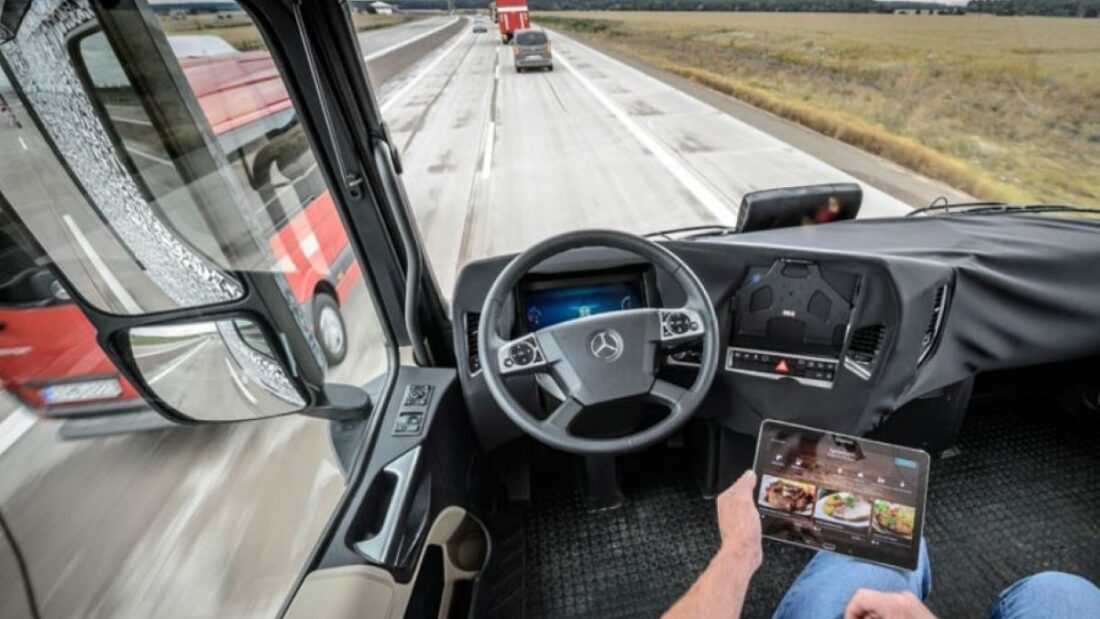 How autonomous trucks could help solve Spain’s trucker shortage">

This piece looks at the potential for autonomous trucks to relieve Spain’s chronic scarcity of professional drivers and what that shift may mean for the logistics industry.
Spain’s demographic squeeze behind the wheel
Spain faces a structural imbalance in the haulage workforce: roughly 50% of drivers are over 55 while only about 3% are under 25. Those figures point to an aging cohort and a shrinking inflow of young talent, a two-pronged problem that crimped capacity well before automation entered the conversation. The International Road Transport Union (IRU) projects a shortfall of hundreds of thousands of drivers across Europe, and Spain already reports some 15,000 unfilled positions. Put simply, there aren’t enough hands to keep the wheels turning at current growth rates.
Why autonomous trucks are not an overnight replacement
Automation in heavy transport is advancing, but large-scale deployment is still years away. The current landscape is dominated by advanced driver assistance systems (ADAS) that help, rather than replace, drivers. Fully automated driving at level 4 will likely appear first in constrained environments: specific highway stretches, controlled corridors, and logistics park shuttles where variables are limited.
Gradual transition, evolving roles
Rather than an abrupt replacement, expect a progressive shift in job content. Drivers will increasingly supervise automated systems, act as remote operators, or specialize in maintaining complex sensor and software suites. Companies and planners should start thinking beyond the cab.
- Supervisor of automated transport — managing operations and safety of mixed fleets.
- Remote fleet operator — intervening from control centers during edge cases.
- Advanced systems technician — focusing on software, sensors, and connectivity.
- Cybersecurity specialist — defending connected vehicles and platforms.
- Smart logistics manager — orchestrating data-driven flows across multimodal chains.
Regulation and interoperability: the gatekeepers
Technology may be ready before the rulebook is. One of the main bottlenecks is the lack of a unified regulatory framework that addresses liability, safety, and cross-border interoperability. Spain’s pilot projects and test corridors are valuable, but scaling requires harmonized rules across the EU and clear responsibilities for operators, OEMs, and service providers.
Operational and commercial constraints
Beyond laws, practical limits remain: sensor robustness in bad weather, cybersecurity resilience, and the economics of retrofitting existing fleets versus buying new vehicles. Logistics companies must weigh investments in automation against other ways to tackle driver scarcity, like recruiting internationally or improving working conditions.
What this means for logistics operators
For shippers, carriers, and freight forwarders, autonomous trucks represent both an opportunity and a challenge. In environments where they can be deployed safely, autonomous solutions may:
- Reduce driver fatigue and improve road siguranță.
- Increase asset utilization by extending operational hours on low-traffic corridors.
- Lower long-term operating costs through more consistent fuel use and fewer accidents.
- Shift labor demand toward higher-skilled roles, driving new training needs.
| Dimensiune | Near-term effect | Long-term potential |
|---|---|---|
| Driver availability | Marginal relief via mixed fleets | Substantial relief in corridor operations |
| Operational cost | Higher due to tech investment | Lower TCO if scaled effectively |
| Siguranță | Improved with ADAS | Further gains if regulations and systems mature |
| Regulatory risk | High — fragmentation among jurisdictions | Moderate if harmonization occurs |
Preparing the workforce and warehouses
Training becomes the name of the game. Logistics employers should invest in upskilling across software, teleoperation, data analytics, and hardware maintenance. Anecdotally, I remember talking to a depot manager who said, “We’re hiring fewer drivers and more tech-savvy operators—so we had to rework our training plan overnight.” That’s the kind of shift companies will feel.
Proequity and strategic planning
Consultancies like Proequity advise designing logistics platforms ready for digitalization and automation. According to David Martínez, director general at Proequity, the value of autonomous trucks lies not in cutting drivers immediately but in enhancing efficiency and addressing structural shortages once technology and regulation align. The message is clear: plan the transition now, or risk scrambling later.
Key practical recommendations for carriers
- Start pilot programs in controlled corridors to gain operational experience.
- Invest in staff retraining for teleoperation and systems maintenance.
- Engage with regulators and industry consortia to shape interoperable standards.
- Deploy cybersecurity measures early; connected fleets are attractive attack surfaces.
Highlights and why personal experience still matters
The most interesting takeaways are the demographic pressure in Spain, the stepwise nature of automation, and the crucial role of regulation. Even the best reviews and the most honest feedback can’t truly replace hands-on experience: seeing a platoon on a test corridor or riding in a teleoperated truck informs far more than a spec sheet. On GetTransport.com, you can order your cargo transportation at the best prices globally at reasonable prices. This gives shippers and carriers the chance to trial different options, compare offers, and build real-world familiarity without overpaying. For your next cargo transportation, consider the convenience and reliability of GetTransport.com. Book now GetTransport.com.com
In summary, autonomous trucks offer a pragmatic path to mitigate Spain’s driver shortage — especially in well-defined corridors and controlled operations — but they are not a magic wand. The transition will depend on technological maturity, regulatory alignment, and workforce retraining. For logistics stakeholders considering încărcătură moves, freight planning, or new shipment models, the rise of automation will influence choices about routing, fleet composition, and hiring. Whether you manage livrare flows, coordinate transport maritim și expediere, or oversee distribuție centers, preparing for a future with mixed human and automated crews will pay dividends. Platforms that simplify booking and offer affordable, global solutions can help you test and adapt—making transport, moving, relocation, pallet or container dispatch, and handling of bulky or international consignments more reliable and cost-effective. GetTransport.com provides a convenient, cost-efficient way to secure the right transport, from housemove to heavy haulage, and helps bridge today’s challenges with tomorrow’s opportunities in shipping and logistics.