


 Русский
  English (UK)
  العربية
  日本語
日本語  한국어
한국어  Magyar
  Türkçe
  Español
  Čeština
  Svenska
  Português
  Ελληνικά
  Suomi
Suomi  Nederlands
  Română
  Italiano
  Français
  Polski
  Українська
  Deutsch
  简体中文
简体中文  Slovenčina
  Xeneta Analysis: How the Middle East Escalation Is Reshaping Global Airfreight">

Air cargo demand rose by +6% year‑on‑year in February 2026 while available capacity increased only +4%, lifting Xeneta’s dynamic load factor to 62%—a sign of tight markets that can flip quickly when macro events hit.
February momentum and immediate disruption
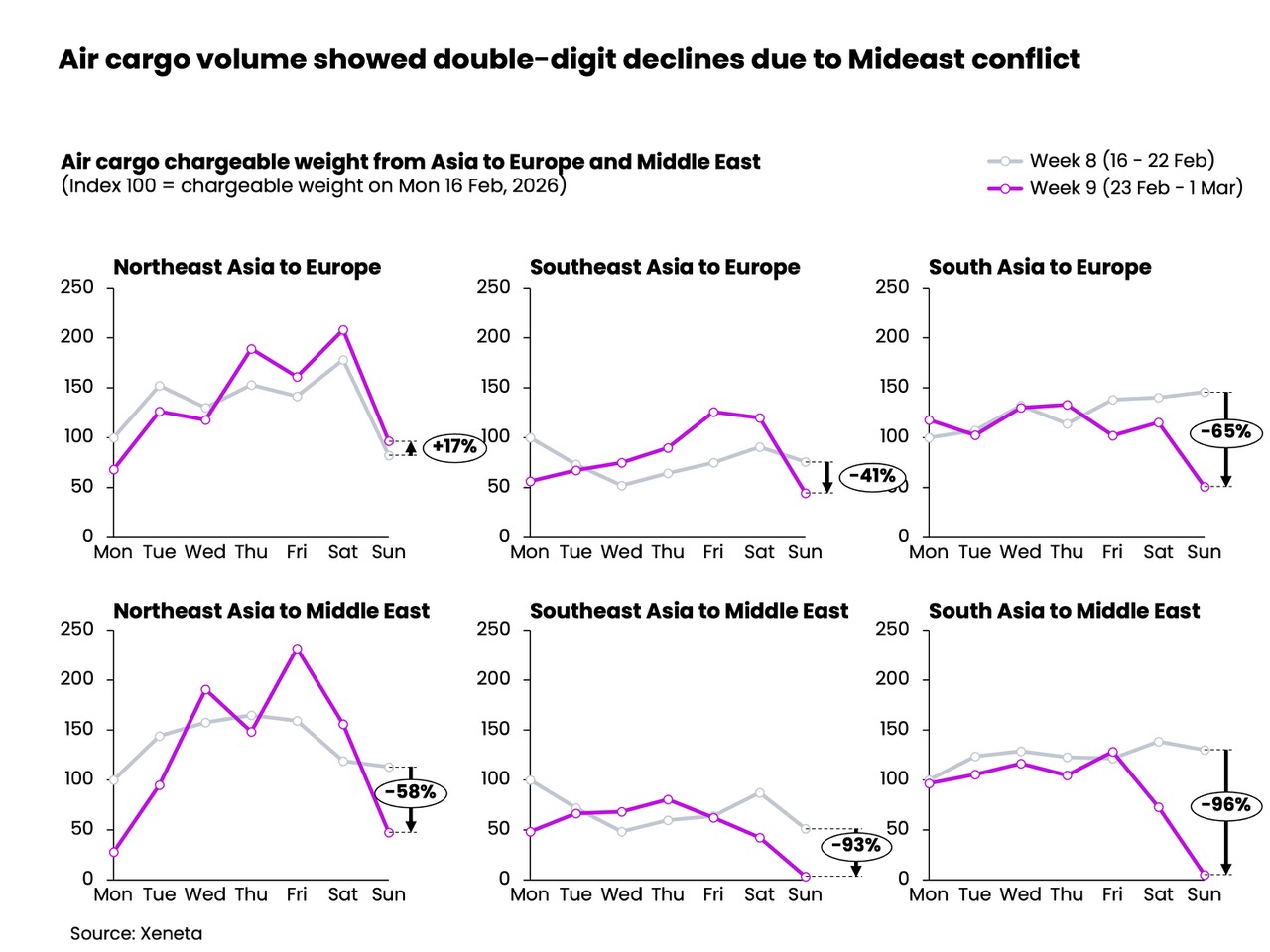
February’s uplift was aided by a mini peak season ahead of the Lunar New Year and a weaker US dollar, producing the first monthly spot rate increase since May 2025 (+5% to USD 2.58/kg). That encouraging trend, however, collided with sudden military strikes in late February and escalating conflict in the Middle East that removed roughly 12% of global air cargo capacity almost overnight due to airspace closures and cancellations.
Key corridor moves
| Corridor | Feb YoY spot rate change | Примечания |
|---|---|---|
| Europe – North America | +21% | Largest YoY increase; demand resilient for transatlantic lanes |
| Northeast Asia – North America | +10% | Semiconductor demand remains a tailwind |
| China – US | ↓ | Tariff noise and weaker trade reduced volumes |
| China – Europe | Стабильный | No typical pre‑holiday rush observed, hinting at muted 2026 start |
How the Middle East escalation changed modalities
Major hubs—Doha, Dubai, and Abu Dhabi—temporarily suspended operations under multiple airspace restrictions, immediately disrupting Asia–Europe flows. With the Strait of Hormuz already a flashpoint for roughly 20% of global oil shipments, attacks on vessels raised shipping security concerns and limited modal substitution options that operators relied on during past Red Sea disruptions.
- Воздух routes: Freighters require rerouting via Central Asia for technical stops or the deployment of direct Asia–Europe services where traffic rights and overflight permissions allow.
- Океан routes: MSC and Maersk suspended Suez transits, reverting to round‑Africa diversions that lengthen voyage times and add cost.
- Топливо costs: Brent crude trading above USD 80/bbl already; a protracted conflict could push prices past USD 100, materially increasing jet fuel expense and carrier unit costs.
Immediate logistics implications
The short‑term picture is clear: reduced capacity, higher routing complexity, and upward pressure on freight rates. Operationally, shippers and forwarders face tougher choices—speed vs cost, direct routing vs longer sea legs, and the availability of rolling stock and truck capacity at origin/destination nodes.
Who feels it first?
Time‑sensitive sectors—semiconductors, high‑value electronics, and critical components—will be first in line to absorb higher airfreight charges to keep production lines moving. Retailers and less time‑sensitive importers may again pivot to ocean services, but the reduced modal flexibility this time around lowers the ease of that switch.
Cost dynamics and market responses
Historically, the airfreight industry is adept at finding stopgaps—rerouting, temporary lift reallocation, and surge capacity. Yet those fixes come at a price. Xeneta’s Chief Airfreight Officer, Niall van de Wouw, noted that while carriers will create solutions, the owner of the goods will likely shoulder higher logistical costs to maintain on‑time delivery. When push comes to shove, many shippers will accept higher fees rather than disappoint customers.
Airline responses include reassigning freighter flights away from the conflict zone, adding direct services where possible, and seeking technical stops in Central Asia. Ocean carriers are recalibrating sailings and capacity deployments to account for longer loops—an adjustment that translates to higher freight rates and longer lead times for ocean shipments.
Operational checklist for shippers
- Review contracts and incoterms for force majeure or route disruption clauses.
- Assess inventory buffers for critical SKUs and prioritize shipments by value and urgency.
- Evaluate alternate airports and transhipment hubs for resilience.
- Discuss fuel and war‑risk surcharges with carriers and forwarders to model landed costs.
Looking forward: scenarios and what to watch
Scenario planning matters. If the conflict is short and airspace reopens within days, markets should normalise and the spike in fuel prices will be contained. If disruption stretches for weeks, expect doubled or tripled costs on affected routes, shipping delays, and inflationary pressure on goods—an outcome that could trigger broader economic pain similar to stagflation concerns.
Key indicators to monitor: duration of airspace restrictions, Brent crude trajectory, carrier schedule recovery notices, and port congestion metrics on alternative sea routes.
Real‑world perspective
Funny enough, I once watched a small electronics firm scrub a multimodal plan overnight and reroute everything to air when a single supplier missed a container gate‑in. You learn fast that logistics is a game of trade‑offs—speed, cost, and risk. Right now, many firms are dusting off contingency playbooks they hadn’t used since the Houthi disruptions and redrawing their transport matrices.
Summary of impacts
| Area | Вероятно short‑term impact |
|---|---|
| Air capacity | −12% initially; higher spot rates where capacity tightens |
| Sea routing | Longer voyages via round‑Africa; increased bunker and transit costs |
| Топливо | Upward pressure; potential pass‑through to shippers |
The important thing is that even the best reviews and the most honest feedback can’t truly compare to personal experience; seeing a route change in real time is a different kettle of fish. On GetTransport.com, you can order your cargo transportation at the best prices globally at reasonable prices. This empowers you to make the most informed decision without unnecessary expenses or disappointments. Provide a short forecast on how this news could impact the global logistics: the immediate effect will be regional capacity tightening and upward pressure on rates, while the global impact depends on conflict duration. If it’s insignificant globally, note that—but it’s still relevant to us, as GetTransport.com aims to stay abreast of all developments and keep pace with the changing world. Start planning your next delivery and secure your cargo with GetTransport.com. Book now GetTransport.com.com
In conclusion, February showed sign of a firming воздух cargo market but the Middle East escalation has raised the stakes: capacity was squeezed, routes altered, and costs face upward pressure. Shippers should reassess inventory, consider alternate routings and carriers, and prepare for higher freight and fuel bills in the near term. Platforms that simplify booking and offer transparent pricing for cargo, freight, shipment, delivery, transport and логистика—including moving, relocation, and bulky item haulage—will be invaluable. For practical, cost‑conscious transport solutions, GetTransport.com aligns directly with these needs by providing affordable, global cargo transportation options that simplify shipping decisions and keep goods moving reliably.