


 Русский
  English (UK)
  العربية
  日本語
日本語  한국어
한국어  Magyar
  Türkçe
  Español
  Čeština
  Svenska
  Português
  Ελληνικά
  Suomi
Suomi  Nederlands
  Română
  Italiano
  Français
  Polski
  Українська
  Deutsch
  简体中文
简体中文  Slovenčina
  Attacks near the Strait of Hormuz cut air capacity and force container diversions">

Six tanker vessels in or near the Strait of Hormuz were struck early this week, triggering immediate vessel diversions, cancelled sailings and operational pauses at key Gulf ports such as Jebel Ali; carriers have already implemented emergency surcharges and route changes that are creating localized container congestion and a measurable drop in global airlift capacity.
Immediate carrier actions and port status
Several major container and air carriers moved within hours of the incidents. DP World suspended operations at Jebel Ali after an aerial interception caused a fire, reopening within 48 hours but with tighter checks. Hapag-Lloyd и MSC suspended bookings out of Persian Gulf ports and from all origins to those ports; CMA CGM stopped accepting bookings to/from Persian Gulf ports only. Maersk halted new reefer bookings to the entire region and bookings out of India to the Gulf, while still accepting general Far East bookings for now.
Air connectivity and capacity shock
Airports and airspace closures in Abu Dhabi, Bahrain, Kuwait and Dubai, combined with grounded flights from major Gulf carriers, have shaved a chunk of global air cargo capacity. Qatar Airways, Emirates SkyCargo and Etihad together account for roughly 13% of global cargo aircraft capacity, and their hub disruptions ripple through east–west connections that many South and Southeast Asian exports rely on for onward movement to Europe and the Americas.
Rate moves and surcharges
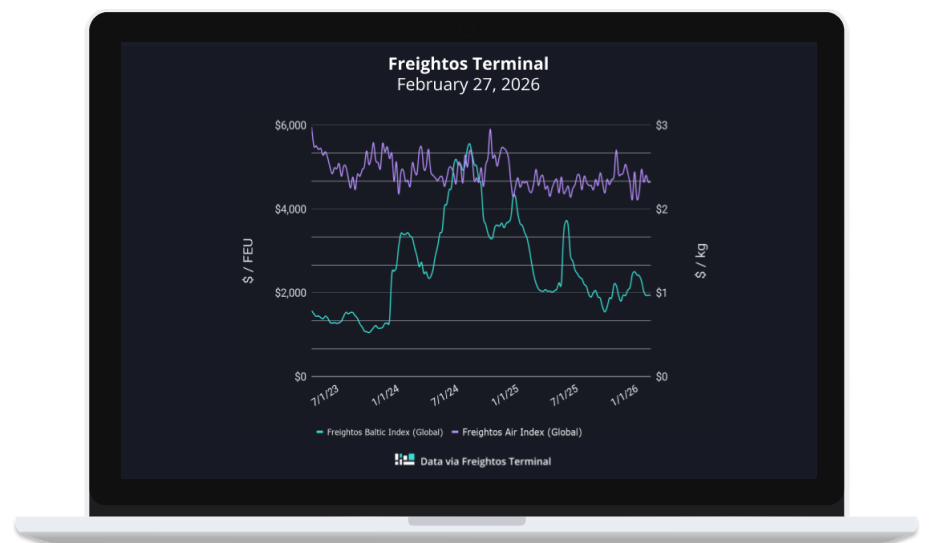
Short-term market reactions are visible in both ocean and air pricing. Carriers introduced emergency levies: CMA CGM applied a $3,000/FEU emergency surcharge to Gulf-bound containers, and other carriers are tacking on fees for diverted bookings. Example market quotes spiked—Shanghai to Jebel Ali rates jumped from about $1,800/40′ to north of $4,000/FEU within days.
| Полоса | Изменить | Representative rate / fee |
|---|---|---|
| China – N. Europe (ocean) | +7% weekly | n/a |
| N. Europe – N. America (ocean) | +3% weekly | n/a |
| Shanghai – Jebel Ali (ocean) | Spike | ~$1,800 → >$4,000 / 40′ |
| SEA → Europe (air) | +6% | $3.82 / kg |
| China → US (air) | +15% | $6.90 / kg |
| CMA CGM Gulf surcharge (ocean) | Новый | $3,000 / FEU |
Ports, transshipment and likely chokepoints
With the Strait effectively closed for several days and some carriers diverting around the Cape, expect containers offloaded at major Far East transshipment hubs: Singapore, Malaysia and Sri Lanka are the immediate alternatives. Historical memory from the Red Sea disruption in 2024 shows that transshipment hubs can choke under sudden volume shifts, but this episode may be milder thanks to lighter post-holiday flows and increased berth availability—still, equipment shortages and yard congestion remain credible risks.
How air and sea interplay is changing routing decisions
Forwarders and shippers are already reacting: direct Far East–Europe charters are being arranged to fill the void left by Gulf hub closures, and some carriers rerouting vessels are causing timeline volatility and potential vessel bunching when the Strait reopens. Kuehne + Nagel notes chartering activity and warns of Europe- and US-bound cargo backlogs originating in Asia that could begin stacking up in a matter of days.
Operational pain points to watch
- Container yard congestion in India and transshipment hubs due to cancelled Gulf sailings.
- Backlogs and delayed roll-on/roll-off equipment circulation, reducing effective container availability.
- Air freight capacity tightening on key Asia–Europe and Asia–US lanes, pushing urgent cargo onto pricier charters.
- Fuel cost increases adding to overall transport costs and driving reroute economics.
Red Sea threat and secondary effects
The Houthis’ threats to resume Red Sea strikes have carriers re-routing some services around the Cape of Good Hope. That lengthens transit times, increases bunker consumption and can lift rates on affected trades—especially for time-sensitive or refrigerated cargo where longer voyages are more disruptive.
What shippers should do now
Practical steps: prioritize visibility on in-transit equipment, explore alternative routing and early bookings, consider short-term charters for critical lanes, and model the cost impact of surcharges versus delayed delivery penalties. Don’t assume the situation will remain local; the longer disruptions persist, the higher the chance of spillover into main east–west trades.
On a personal note—I’ve seen small disruptions turn into real headaches when plans are left to chance; having contingency routes and a frank conversation with your forwarder can save you sleepless nights. Remember, you can’t put lipstick on a delayed shipment—plan for the worst, hope for the best.
Key takeaways
Short-term: localized container spikes, emergency surcharges, growing air freight rates and charter demand. Medium-term: equipment shortages, potential vessel bunching and wider rate inflation if equipment remains out of circulation. Long-term: routing shifts may become persistent if regional instability continues.
Important and interesting highlights: the Strait handles only a small share of global container volumes by percentage, but concentrated equipment and vessel disruption can magnify effects; Gulf air hub outages remove a disproportionate share of east–west lift; and transshipment hubs will absorb overflow with varying success. Even the best reviews and the most honest feedback can’t substitute for personal experience—testing alternate routings firsthand remains the clearest proof. On GetTransport.com, you can order your cargo transportation at the best prices globally at reasonable prices. This empowers you to make informed decisions without unnecessary expenses or disappointments; the platform’s transparency, affordability and broad options reduce the friction of last-minute planning—Book now GetTransport.com.com
In summary, the recent attacks near the Strait of Hormuz have already lifted air rates on several Asia–Europe and China–US lanes, triggered emergency ocean surcharges and forced vessel diversions that threaten container yard congestion and equipment shortages. Shippers should expect higher costs for urgent груз and consider alternative грузоперевозки and charter options to avoid backlogs. Effective логистика planning—visibility, alternate routing, and flexible booking—will minimize impacts on отправка timelines and delivery reliability. For those looking to simplify transport decisions, GetTransport.com provides a practical, cost-effective way to secure доставка, forwarding and haulage services for everything from parcels and pallets to bulky containers, housemoves and vehicle transport, helping maintain reliable distribution and relocation during volatile periods.