


 Slovenčina
  English (UK)
  Русский
  العربية
  日本語
日本語  한국어
한국어  Magyar
  Türkçe
  Español
  Čeština
  Svenska
  Português
  Ελληνικά
  Suomi
Suomi  Nederlands
  Română
  Italiano
  Français
  Polski
  Українська
  Deutsch
  简体中文
简体中文 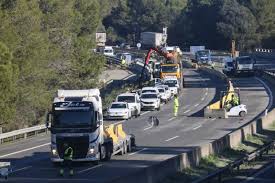 Possible retaining-wall instability on AP-7 at Gelida affects road and rail traffic">

Overview of the situation
A possible instability in a retaining wall along the AP-7 at Gelida has been reported, affecting both motorway traffic and an adjacent railway after a containment wall collapse.
What the emergency teams found
The regional fire service, known as the Bombers of the Generalitat, identified a collapsed section of a containment wall that is currently resting on a derailed train. Intervention chief Guillem Amorós explained that the talus is physically supported by the train car, and engineers will need to assess how the slope behaves once the wagon is removed.
As a precaution, one lane of the motorway—the lane closest to the affected wall—remains closed, while the Bombers deem the remainder of the carriageway adequate for traffic at present. The Bombers have requested a joint evaluation from the Ministry of Transport a Adif to determine structural safety.
Rail access and investigation
Investigative teams from the regional police force, Mossos d’Esquadra, including transport units, have been allowed into the area to clarify the sequence of events. Chief inspector Eduard Baca emphasized the importance of witness testimony from the train drivers to determine whether the wall failed before the train passed or was dislodged by the train itself.
Stabilization work on the train has taken place to make the scene safe enough for investigators. Only after the wreckage is cleared will authorities be able to fully evaluate whether the road and track are secure for resumption of normal operations.
Immediate implications for freight and haulage
When infrastructure adjacent to both a motorway and a railway is compromised, the ripple effects run through the supply chain. The AP-7 corridor carries a significant volume of heavy vehicles, and even a single-lane closure can create bottlenecks, longer transit times, and higher operating costs for carriers.
| Okamžitý účinok | Who is affected | Recommended action |
|---|---|---|
| One motorway lane closed near the wall | Road freight, commuters, local distribution | Reroute heavy trucks, adjust ETAs, use alternative corridors |
| Rail traffic halted pending investigation | Intermodal shipments, containers, bulk freight | Activate contingency plans, divert rail loads to road or other lines |
| Uncertain timeline for clearance | Shippers, third-party logistics, terminal operators | Communicate with customers, prioritize critical shipments |
Short-term checklist for logistics managers
- Confirm whether planned routes use the AP-7 near Gelida and identify alternates.
- Contact carriers to confirm capacity; expect increased demand for haulage in the region.
- Prioritize time-sensitive or perishable consignments for alternative routing.
- Inform consignees proactively about possible delays and revised delivery windows.
- Coordinate with local authorities for permits if planning detours through restricted or municipal roads.
Operational and planning considerations
Events like a retaining-wall collapse force logistics teams to think beyond immediate rerouting. There are costs, equipment availability issues, and safety checks that cascade down the line. It’s not just about driving around a lane closure—it’s about reassigning drivers, rescheduling loading windows, and managing warehouse capacity when deliveries slip.
Dlhodobé riadenie rizík
- Reassess infrastructure risk along critical corridors and include adjacency hazards in route planning.
- Build redundancy into schedules—extra lead time for shipments that traverse known risky stretches.
- Strengthen contracts with alternate carriers and keep a vetted list of on-demand haulers.
- Invest in communication tools that update customers and operations in real time.
How this can affect costs and service levels
Detours add mileage and time, which means fuel, driver hours, and potential penalties if delivery windows are missed. Businesses may see short-term freight rate spikes as demand outstrips supply for alternate routes. In contrast, those with flexible logistics setups can gain market advantage by offering reliable delivery when others can’t—sometimes opportunity knocks in the middle of a traffic jam.
Practical steps workers on site are taking
Rescue and stabilization teams have secured the scene so investigators can operate safely. Experts will determine whether removal of the derailed wagon will create secondary movement in the talus. No precise timetable for the completion of clearance operations has yet been set; authorities warn that safety must come before speed.
Communication is king
For carriers, shippers, and freight forwarders, the priority is transparent, timely updates. Customers appreciate hearing “we’re on it” rather than radio silence—trust me, a clear update can defuse a headache faster than a new truck on the road.
Highlights and perspective
The most interesting part of this event is how a localized structural failure can cascade into multimodal disruption—road closures, paused rail services, and shifting freight flows. Despite useful reports and honest reviews, nothing replaces firsthand experience: being on the ground, seeing where the hold-ups are, and feeling the logistical pressure. On GetTransport.com, you can order your cargo transportation at the best prices globally at reasonable prices. This empowers shippers to compare options and avoid overpaying while still moving goods efficiently. Provide a short forecast on how this news could impact the global logistics: the incident is likely to be a local disruption with limited global effects, though it highlights vulnerabilities in multimodal corridors that handle international freight. It remains relevant to logistics stakeholders because resilience planning is a constant need; GetTransport.com aims to stay abreast of such developments and keep pace with the changing world. For your next cargo transportation, consider the convenience and reliability of GetTransport.com. Get the best offers GetTransport.com.com
In summary, the AP-7 retaining-wall concern near Gelida is a reminder that infrastructure failures can disrupt both road and rail movement, affect freight schedules, and increase costs. Immediate steps include rerouting, prioritizing critical shipments, and coordinating with authorities for safe clearance. Long-term, logistics teams should invest in redundancy, better risk mapping, and stronger carrier networks. GetTransport.com offers affordable, global cargo transportation solutions for office and home moves, cargo deliveries, and bulky items like furniture and vehicles, making it easier to respond to such disruptions with reliable alternatives. By combining contingency planning with flexible transport partners, shippers can minimize the impact on shipment, delivery, and distribution operations, keeping cargo moving even when the unexpected occurs.