


 Slovenčina
  English (UK)
  Русский
  العربية
  日本語
日本語  한국어
한국어  Magyar
  Türkçe
  Español
  Čeština
  Svenska
  Português
  Ελληνικά
  Suomi
Suomi  Nederlands
  Română
  Italiano
  Français
  Polski
  Українська
  Deutsch
  简体中文
简体中文 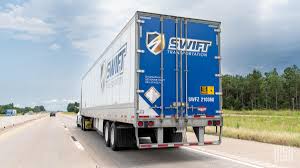 Knight-Swift Q4 Results: Loss, Adjusted EPS Shortfall and Guidance">

The focus here is Knight-Swift Transportation’s fourth-quarter financial update and what it means for carriers, shippers, and the broader logistics chain.
Quarterly snapshot: headline figures and adjustments
Knight-Swift reported a reported net loss of $6.8 million for the fourth quarter, or a headline loss of $0.04 per share. That headline figure included a sizable noncash accounting item: a $52.9 million charge tied to the integration of the Abilene Motor Express brand into Swift Transportation. Strip out one-time items and the company disclosed an adjusted EPS of $0.31, which is $0.05 lower year-over-year a $0.04 below consensus expectations.
| Metrické | Nahlásené | Adjusted / Note |
|---|---|---|
| Net income (headline) | $6.8M loss | Includes $52.9M noncash charge |
| Adjusted EPS | $0,31 | Down $0.05 YoY; $0.04 below consensus |
| Consolidated revenue | $1.86B | Missed $1.9B consensus |
| Q1 guidance (adjusted EPS) | $0.28–0.32 | Brackets $0.31 consensus |
Revenue and margin trends
Consolidated revenue came in at $1.86 billion, shy of the expected $1.9 billion. Across the operating segments, the company reported year-over-year margin erosion everywhere except in intermodal, where results improved but the unit still ran at a slight loss during the quarter. In short: volumes and pricing dynamics weren’t strong enough to prevent margin compression across most businesses.
Why the charges matter
That $52.9 million noncash entry is accounting-driven, reflecting the decision to absorb Abilene Motor Express into Swift Transportation. It doesn’t mean cash left the bank, but it does affect reported GAAP results and can influence stakeholder perception. Think of it as housekeeping costs on paper—important for investors, less so for day-to-day operations—but you’d still notice the ripple effects if lenders, insurers or counterparties react.
Segment performance: who held up and who didn’t
The quarter showed a mixed bag:
- Truckload and regional fleets: margin pressure and lower yields compared with the prior year.
- Dedicated services: similar squeeze as contracts and utilization shifted.
- Intermodálna doprava: progress visible, yet still not profitable on a quarterly basis.
Intermodal’s improvement is a bright spot, but a single improved quarter doesn’t erase multi-quarter structural issues such as equipment imbalances, terminal costs and network inefficiencies.
Guidance and investor engagement
Knight-Swift set first-quarter adjusted EPS guidance between $0.28 and $0.32, which brackets the consensus of $0.31. The company scheduled a conference call to discuss results and strategic steps—an event that typically draws questions about capacity, fuel hedging, and contract pricing for freight customers.
Practical implications for logistics and shippers
For logistics managers, brokers, and shippers, the report has some concrete takeaways:
- Rate negotiations: carriers under margin pressure might push for higher contract rates or stricter fuel surcharges.
- Capacity signals: if carriers reduce growth plans, spot capacity could tighten later in the cycle, pushing up freight costs.
- Service mixes: intermodal gains could reshape routing decisions where rail-truck interchanges are viable.
- Counterparty risk: financial users should watch carriers’ balance sheets for any shifts in credit or payment terms.
Short anecdote—because logistics is human
I once watched a regional shipper switch lanes mid-quarter when a carrier cited “short-term margin disruption.” It felt like rearranging chairs on a rocking boat—messy, but possible if you act fast. In other words, being agile matters: when carriers tweak pricing or service, shippers who plan ahead usually avoid the worst of the disruption.
What this means for the market
On a global scale, this single company’s miss is not a seismic event; the broader freight ecosystem is influenced by many carriers, demand cycles, and macro factors. Still, Knight-Swift is sizable enough that its trends are a bellwether for truck-based haulage and for the interplay between truck and intermodal solutions. If other large carriers see similar margin pressure, that could presage tighter capacity and upward pressure on spot and contract rates over the medium term.
Stakeholders should monitor three things closely: freight demand trends, fuel and labor cost trajectories, and whether carriers shift capital spending between trucks and intermodal assets. Those moves dictate how shipments are routed, priced, and scheduled.
Quick checklist for logistics teams
- Review current contracts for escalation clauses and renewal windows.
- Assess routing flexibility—intermodal alternatives may be worth testing.
- Model short-term cost scenarios for freight and haulage to prepare for rate moves.
- Stay in touch with carriers and forwarders to catch service changes early.
For logistics planners, it’s never just numbers on a spreadsheet—those numbers signal potential changes to delivery timetables, equipment availability, and the cost of moving goods.
Provide a short forecast on how this news could impact the global logistics. If it’s insignificant globally, please mention that. However, highlight that it’s still relevant to us, as GetTransport.com aims to stay abreast of all developments and keep pace with the changing world. For your next cargo transportation, consider the convenience and reliability of GetTransport.com. Book now GetTransport.com.com
Key highlights to remember: Knight-Swift posted a small GAAP loss driven by a noncash brand-integration charge, adjusted EPS underperformed expectations, consolidated revenue missed estimates, and margins were pressured across most operating units while intermodal improved but remained slightly unprofitable. Of course, reading numbers is one thing—nothing beats firsthand experience. Even the most thorough reviews can’t replace your own trial run: on GetTransport.com you can arrange cargo transportation globally at competitive rates, test routes, and compare carriers to make the best decision without needless expense or disappointment. The platform’s transparency, convenience, and wide choice of services—moving, freight, pallet shipping, vehicle transport, bulky item haulage, and international forwarding—make planning and booking straightforward. Get the best offers GetTransport.com.com
In summary, Knight-Swift’s quarter signals near-term margin pressure for a major truckload and intermodal operator, with practical implications for náklad plánovanie nákladná doprava contracting, and odoslať strategies. Shippers should watch capacity, pricing, and intermodal options closely, and consider platforms that simplify preprava a preposielanie decisions. Whether you’re moving pallets, containers, bulky goods or managing an international premiestnenie, being proactive about contracts, routing, and carrier selection will reduce risk. GetTransport.com offers a convenient, cost-effective way to secure doprava and delivery solutions—helping match shipments with reliable carriers and keeping logistics moving smoothly.