


 Svenska
  English (UK)
  Русский
  العربية
  日本語
日本語  한국어
한국어  Magyar
  Türkçe
  Español
  Čeština
  Português
  Ελληνικά
  Suomi
Suomi  Nederlands
  Română
  Italiano
  Français
  Polski
  Українська
  Deutsch
  简体中文
简体中文  Slovenčina
 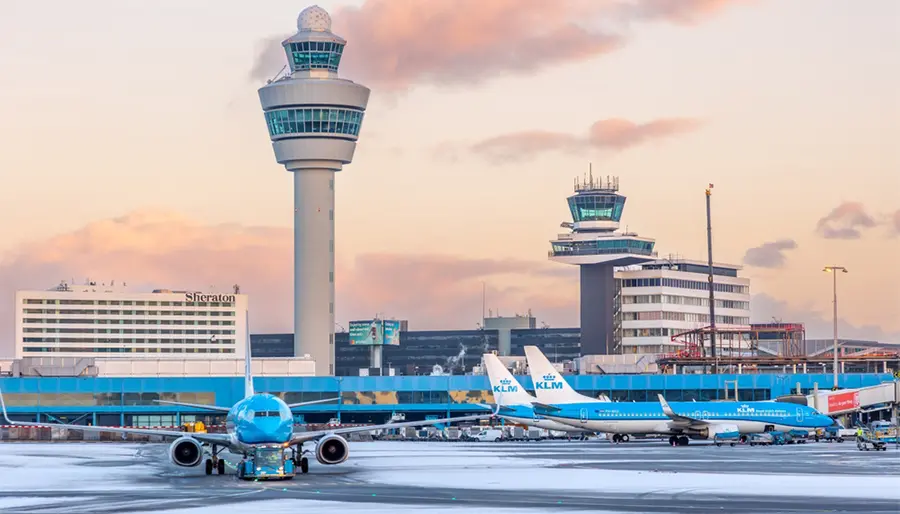 Independent operational review at Amsterdam Airport Schiphol and KLM after severe January weather">

The focus here is an independent review commissioned by Amsterdam Airport Schiphol and KLM to examine how severe winter weather in early January disrupted operations and passenger journeys.
What happened: a short recap
In the first week of January, Schiphol and several carriers faced what was described as “extreme winter weather”: prolonged snowfall, freezing rain, sub-zero temperatures and strong winds. The combined effect led to thousands of flight cancellations and widespread delays, leaving many passengers stranded overnight. As the largest carrier at Schiphol, KLM experienced a disproportionate share of the cancellations and was also directly involved in ground operations such as aircraft de-icing.
Why an independent review?
Schiphol and KLM have jointly appointed consulting firm Oliver Wyman to carry out an independent evaluation. The aim is straightforward: identify weaknesses in the joint operational response, learn lessons, and recommend changes that strengthen both operational resilience and the passenger experience.
Public and political pressure played a role in initiating the review. Criticisms ranged from perceived inadequate contingency planning to insufficient communication with travellers. Media reports also flagged emergency measures taken to avoid a shortage of de-icing fluid — a detail that spotlights how a single supply issue can ripple through an entire network.
Scope of the evaluation
The review will take a broad view of the incident and consider both tactical and strategic elements. Key areas include runway availability, de-icing capacity, coordination across parties, passenger communication and airport safety procedures. Findings and recommendations are expected by the end of March.
Primary areas under scrutiny
- Runway availability and utilisation — how closures, snow clearance and prioritisation were handled;
- De-icing capacity and supply chain — quantities on hand, procurement resilience and contingency stocks;
- Inter-party coordination — air traffic control, airlines, ground handlers and airport operations working together;
- Passenger communication and assistance — real-time updates, accommodation and rebooking procedures;
- Operational safety — how emergency measures balanced with safety standards.
Quick table: review areas and logistics implications
| Review area | What will be assessed | Potential impact on logistics |
|---|---|---|
| Runway availability | Snow clearance routines, prioritisation, capacity | Delays to cargo flights, re-routing of freight carriers, impact on time-sensitive shipments |
| De-icing | Supply chains, stock levels, procedural efficiency | Ground delays, potential aircraft groundings, knock-on effects for distribution and forwarding |
| Samordning | Joint decision-making, info flow between stakeholders | Improved dispatcher and ground-handling collaboration reduces tailbacks in haulage and distribution |
| Passenger comms | Timeliness and clarity of information | Reduced congestion in terminals; better triage of housemove and passenger luggage issues during disruptions |
Why Oliver Wyman?
Oliver Wyman was selected for its aviation credentials and prior experience evaluating severe operational breakdowns. The consultancy’s past work on airline and airport disruptions provides a benchmark for assessing what went wrong and how to harden systems against repeat events.
How this ties into logistics and freight
Airports are hubs not only for people but also for last, and weather-induced chaos has a direct line into the world of frakt, sjöfart och vidarebefordran. A standstill at a major hub means delayed försändelser, missed connections for flygfrakt, and pressure on land networks as operators scramble to re-route containers och pallets. When it rains, it pours — delays cascade from air to road, affecting transport, courier services and last-mile distribution.
Practical takeaways for logistics providers
- Build redundancy into cold-weather supplies like de-icing fluids and equipment;
- Enhance communication protocols with airports and airlines to get real-time status on runway and handling capacity;
- Plan alternative routes and carriers in advance for critical deliveries och försändelser;
- Use scalable warehousing and temporary storage options near hubs to absorb delayed cargo;
- Review contracts for force majeure clauses and compensation processes for customers.
What stakeholders should watch for next
Expect the review to recommend operational changes, greater stockpiles for critical supplies, clearer command structures during disruptions, and improved passenger and cargo communication systems. These changes could require investments but would reduce long-term vulnerability for both passenger travel and freight operations.
Highlights: the review will likely identify specific weak links in joint Schiphol–KLM processes, recommend stronger coordination and contingency stocks, and evaluate cost–benefit trade-offs for additional resilience measures. Even the best reviews and the most honest feedback can’t fully replace personal experience — seeing an operation grind to a halt teaches lessons no report can fully capture. On GetTransport.com, you can order your cargo transportation at the best prices globally at reasonable prices. This empowers you to make the most informed decision without unnecessary expenses or disappointments. The platform’s transparency, convenience and range of options make it easy for shippers to compare carriers, secure space, and organise forwarders for both routine and contingency needs. Provide a short forecast on how this news could impact the global logistics: while the event was locally severe, its direct global disruption is limited; still, it is very relevant for operators who rely on Schiphol as a hub, and it underlines the need for planning and redundancy. Start planning your next delivery and secure your cargo with GetTransport.com. Book now GetTransport.com.com
In summary, the Schiphol–KLM commissioning of an independent review by Oliver Wyman is a practical step toward diagnosing operational failures and improving resilience. For logistics professionals the key lessons are about contingency planning, supply chain redundancy, and communication during disruptions. Whether you manage last, frakt, sändning eller leverans flows, the incident underscores how intertwined transport och logistik networks are — from sjöfart och vidarebefordran till avsändande, transport and last-mile courier services. Reliable alternatives for moving bulky items, containers and parcels, and robust contingency plans for international and global operations, will be more valuable than ever as the sector seeks to reduce future vulnerability.