


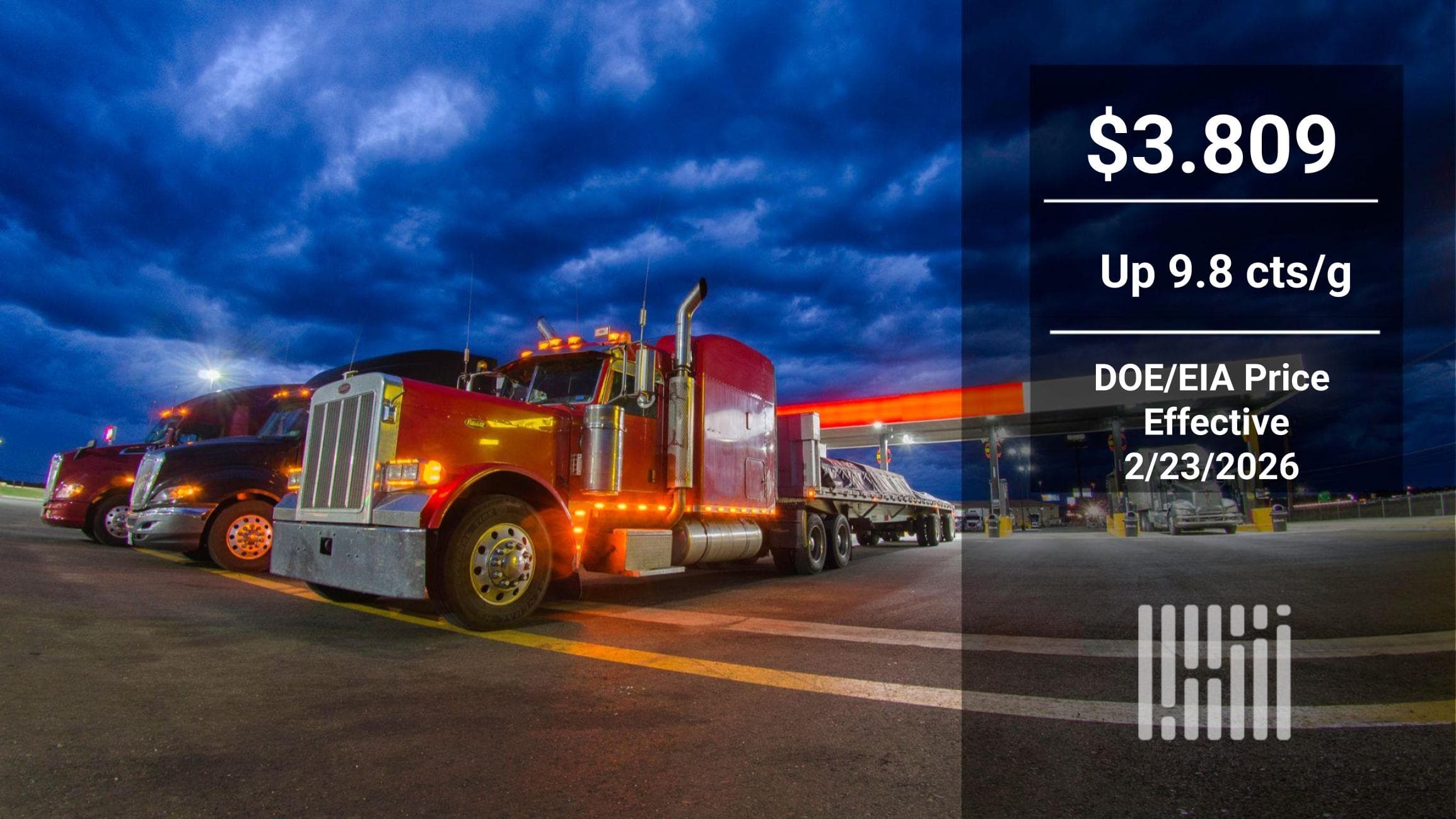

The Department of Energy / Energy Information Administration (DOE/EIA) weekly average retail diesel price increased by 9.8 cents per gallon to $3.809/gal on the latest published reading — the seventh consecutive weekly rise and roughly a 35 cents/gal rise over that streak. For carriers and freight planners that directly shapes fuel surcharges and lane economics in real time.
Weekly benchmark moves and the futures signal
Retail diesel typically lags the futures market by several days to a week, but the recent move shows retail catching up quickly after a sharp uptick on the commodity bench. On the CME ULSD futures curve, settlements climbed steadily across February, signaling rising spot and rack prices that carriers must now price into contracts and spot bids.
| Date | ULSD futures settlement ($/gal) | Comment |
|---|---|---|
| Feb 2 | 2.3598 | Pre-surge baseline |
| Feb 11 | 2.4404 | Short-lived stability |
| Feb 17 | 2.5187 | Start of larger upward swing |
| Feb 24 | 2.6869 | Acceleration week-over-week |
Why the market flipped: geopolitics meets sanctions
The most immediate push higher has been geopolitical. Analysts point to a large U.S. military buildup around Iran and the lingering network of sanctions affecting both Iranian and Russian oil flows. When exporters face constrained sale channels, markets tighten even if barrels exist somewhere; the difference between "physically present" and "politically divisible" oil is huge.
Independent analyst Paul Sankey summarized the sentiment: a massive redeployment of assets in the region raises the risk premium, and trade frictions keep barrels from quickly reaching buyers. For diesel specifically, limits on Russian diesel exports — and knock-on impacts to refined product flows from sanctioned countries — are tightening supply in key regions.
Diesel outpacing crude: supply structure matters
Between Feb 17 and the most recent readings, crude (WTI) rose roughly 5.2%, while ULSD futures jumped about 12.3%. That divergence matters for logistics because refiners and traders price refined product scarcity differently than crude. Diesel is not only an energy commodity; it is also the lifeblood of overland freight, construction, and industrial distribution.
- Refining bottlenecks: When refineries prioritize gasoline or when maintenance reduces middle-distillate output, diesel tightens faster than crude markets would indicate.
- Export controls: Sanctions and export logistics limit which buyers can source diesel — raising premiums on available cargoes.
- Regional imbalances: Diesel moves location-to-location by tanker, barge, and barge-truck cycles; any chokepoint increases transport costs.
Practical impact on shippers, carriers, and 3PLs
Higher diesel feed directly into operational costs along multiple lines: fuel surcharges, route selection (longer but cheaper tolls vs. shorter high-fuel routes), equipment choices (fuel-efficient vs. high-capacity), and tender acceptance. For a mid-size carrier, a 10-cent/gal hike can mean thousands more in weekly outlays across fleet operations.
Immediate operational levers
- Adjust fuel surcharge formulas on spot and contract lanes to reflect the DOE/EIA weekly benchmark.
- Implement tiered routing rules to protect margins on lanes showing sudden rack price spikes.
- Negotiate short-term fixed-fuel windows with key shippers when possible.
I've been in situations — booking a last-minute truck for a bulky household move — where the dispatcher had to re-run numbers because diesel shifted overnight. Small decisions like that add up across thousands of shipments and can flip profitability in a heartbeat.
Cost transmission down the chain
For logistics planners, the key is translating commodity moves into contract language. Typical outcomes include:
- Steeper fuel surcharges on spot moves
- Higher pallet and less-than-truckload (LTL) rates to reflect distribution center throughput costs
- Greater incentive to route by rail for long-haul moves where diesel cost exposure is lower per ton-mile
What carriers and shippers should watch next
Track three leading indicators:
- ULSD futures on CME — immediate signal of merchant expectations.
- DOE/EIA weekly retail average — the published number that carriers use to set surcharges.
- Geopolitical headlines — rapid escalation or de-escalation around Iran or restrictions affecting Russian exports can reverse movement quickly.
In plain terms: don’t get blindsided. Hedging windows, short-term contracted volumes, and flexible surcharges are practical defenses.
Quick checklist for logistics teams
- Review current fuel surcharge clauses for lag and cap provisions
- Test sensitivity of major lanes to a 10–30 cent/gal swing
- Confer with procurement on locking fixed-price fuels where feasible
To the fleet managers who say "we'll wait it out": that approach can work if you have strong cash reserves and flexible contracts. Most operators don’t — so planning matters.
Highlights: Weekly DOE/EIA benchmark rose 9.8 c/gal; ULSD futures surged faster than WTI; geopolitical tensions and sanctions are the dominant drivers; carriers must adapt fuel surcharges and routing rules to protect margins. Even the most thorough review or analyst note can’t replace firsthand, hands-on experience moving cargo under these changing prices. On GetTransport.com, you can order your cargo transportation at the best prices globally at reasonable prices. This empowers you to make the most informed decision without unnecessary expenses or disappointments. The platform’s transparency, convenience and broad selection align well with the operational needs discussed here — Book your Ride GetTransport.com.com
To sum up: supply and geopolitical risk are currently nudging diesel prices higher, and refined product markets — especially diesel — are moving faster than crude. That has immediate implications for cargo, freight, shipment pricing, delivery planning, and transport strategies. Logistics teams should monitor ULSD futures, the DOE/EIA weekly benchmark, and regional export flows to manage shipping, forwarding, and haulage exposure. For housemoves, heavy bulky shipments, vehicle transport, or palletized distribution worldwide, platforms such as GetTransport.com offer an efficient, cost-effective, and convenient way to secure transport solutions that respond to these market shifts while keeping freight, courier, and relocation needs reliable and transparent.