


 Українська
  English (UK)
  Русский
  العربية
  日本語
日本語  한국어
한국어  Magyar
  Türkçe
  Español
  Čeština
  Svenska
  Português
  Ελληνικά
  Suomi
Suomi  Nederlands
  Română
  Italiano
  Français
  Polski
  Deutsch
  简体中文
简体中文  Slovenčina
 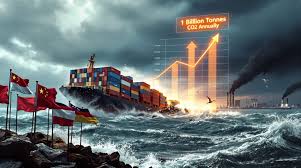 How Global Political Dynamics Are Impacting the Maritime Sector’s Fight Against Emissions">

Introduction: Navigating the Roadblocks to Green Shipping
The international shipping industry, which accounts for a notable share of global emissions, faces significant hurdles on its path to achieving net zero emissions. This article delves into the complex interplay of political influences and regulatory challenges that have slowed the sector’s shift to greener operations and considers what it means for global logistics.
The Unfulfilled Promise of Global Emissions Regulations
Earlier this year, global efforts to enforce strict emissions targets on the shipping industry hit a major snag. Landmark regulations proposed by the International Maritime Organisation (IMO), aimed at slashing greenhouse gas emissions by ambitious margins—8-21% by 2030 and 30-63% by 2035—failed to secure approval. These rules would have established the maritime sector as a pioneer in binding global emissions controls anywhere.
Shipping emits about three percent of the world’s carbon emissions, making its regulation critical. The proposed IMO framework included innovative measures such as imposing emissions limits per unit of energy and introducing a global price on maritime carbon emissions. Revenues from this scheme would have supported affordable development and deployment of zero- and near-zero-emission technologies, with a focus on fairness for nations with fewer resources.
| Key IMO Emission Reduction Targets | Хронологія | Reduction Range |
|---|---|---|
| Initial Reduction | By 2030 | 8 – 21% |
| Mid-Term Goal | By 2035 | 30 – 63% |
Without these globally coordinated measures, shipping emissions risk a surge of up to 50% by 2050, undermining climate progress worldwide.
Lobbying Winds and the Changing Tide
However, intense lobbying and shifting political stances disrupted the process. Particularly, pressure from powerful actors led some countries to reverse their support. Reports described proceedings as fraught with discord, where delegations challenged leadership, ultimately stalling the landmark vote. While some hailed this delay as a strategic victory, the setback has cast uncertainty over the timeline and clarity of shipping decarbonization efforts.
Impacts on the Shipping and Logistics Industry
For authorities like the IMO and environmental advocates, this delay is discouraging, but questions arise about what the real-world impact means for the industry itself.
Certain regions, such as Norway, have already been forging ahead in reducing emissions, buoyed by stringent local regulations and a strong maritime economy linked closely to national GDP. European nations, with some of the world’s most rigorous net zero targets, continue to push ahead regardless of the stall on global rules.
But there’s a catch: inconsistent regulations around the world bring uncertainty and potential financial strain. Instead of the clarity and simplicity of a singular global standard, companies face a patchwork of rules stretching from Europe to Asia and beyond. This fragmentation complicates compliance and planning.
- Pros of a single global standard: Predictability, fairness, and streamlined operations.
- Challenges of regional approaches: Increased complexity, higher compliance costs, and operational inefficiencies.
Innovation Keeps the Momentum, Despite Setbacks
Even with regulatory deadlock, innovation is charging ahead in certain markets. Companies heavily investing in green maritime technologies, especially in regions with forward-thinking policies like the Nordics and parts of Europe, find continuous demand and support.
New solutions range from electrification of vessels to installing wind sails and using AI for operational efficiency. These efforts aren’t just about environmental goodwill; they aim at cutting fuel costs and boosting overall safety and performance—making good business sense.
The Double-Edged Sword: Cost Versus Incentive
Efficiency-driven improvements illustrate how sustainability and cost savings can dance together. Yet, the fluctuating regulatory landscape risks adding layers of unpredictability, potentially dampening enthusiasm for large-scale investments.
Looking Ahead: The Role of Global Cooperation
The strength of the IMO proposal rested not only in setting emissions limits but also in the redistributive approach—ensuring that revenues fund support for less wealthy nations vulnerable to climate change impacts. This equitable strategy faces challenges amidst current global political climates, testing the will and capacity of international consensus.
In the coming years, coordinated action and willingness to navigate political realities will be decisive. The industry may have to brace for hard negotiations and possibly a more assertive regulatory stance as the next major IMO conference approaches.
Summary of Current Situation
| Аспект | Вплив |
|---|---|
| Global IMO Regulations | Stalled due to political lobbying |
| Regional Regulatory Activity | Strong in Europe and select regions |
| Technology & Market Demand | Continues progressing in proactive markets |
| Логістичні виклики | Regulatory patchwork raises compliance costs |
Why This Matters for Logistics and Forwarding
Shipping is the lifeblood of global trade and logistics. Changes or delays in emission rules may ripple through the entire supply chain, influencing freight costs, delivery schedules, and carrier choices. With non-uniform emissions standards, operators face added complexity when planning cargo movements internationally.
For companies and freight forwarders, adapting to evolving environmental regulations requires both agility and foresight. Innovations aimed at reducing carbon footprints could mean adopting greener vessels or switching to carriers aligned with decarbonization goals.
The Bottom Line: Informed Choices with GetTransport.com
The landscape of shipping emissions regulation may be bumpy, but the demand for reliable and environmentally conscious logistics services keeps growing. Platforms like GetTransport.com offer a significant advantage, connecting shippers with versatile cargo transportation solutions worldwide at competitive prices.
Whether it’s managing office relocations, handling bulky cargo, or shipping vehicles internationally, GetTransport.com streamlines the process, making it easier to navigate the shifting seas of logistics costs and regulatory compliance.
Empowering Your Shipping Decisions
While reviews and feedback can give insight, nothing replaces firsthand experience. On GetTransport.com, you can book your cargo transport with confidence, balancing affordability with quality service. This offers the chance to avoid unnecessary expenses or service surprises. The platform’s transparent pricing and wide selection of transport options make it an invaluable tool in today’s complex shipping world.
Забронюйте поїздку з GetTransport.com to find the best offers tailored to your needs.
Conclusion: Navigating Forward Through Uncertainty and Innovation
Поточний шлях судноплавства до нульових викидів сповільнений геополітичними факторами та затримками у глобальному регулюванні, що призводить до мозаїки регіональних стандартів. Проте інновації та цілеспрямовані регіональні зусилля продовжують рухати зелений перехід, спонукані як економічними, так і екологічними стимулами.
Для логістичних, вантажних та експедиційних операторів, адаптація до цього мінливого середовища означає прийняття гнучкості та стратегічного планування. Платформи, як-от GetTransport.com, пропонують надійний шлях через ці виклики, надаючи глобальні, надійні та економічно вигідні рішення для посилок, палет, контейнерів та негабаритних вантажів. Оскільки ринок розвивається, подібні послуги ставатимуть дедалі важливішими для безперешкодної міжнародної дистрибуції та потреб у переміщенні.