


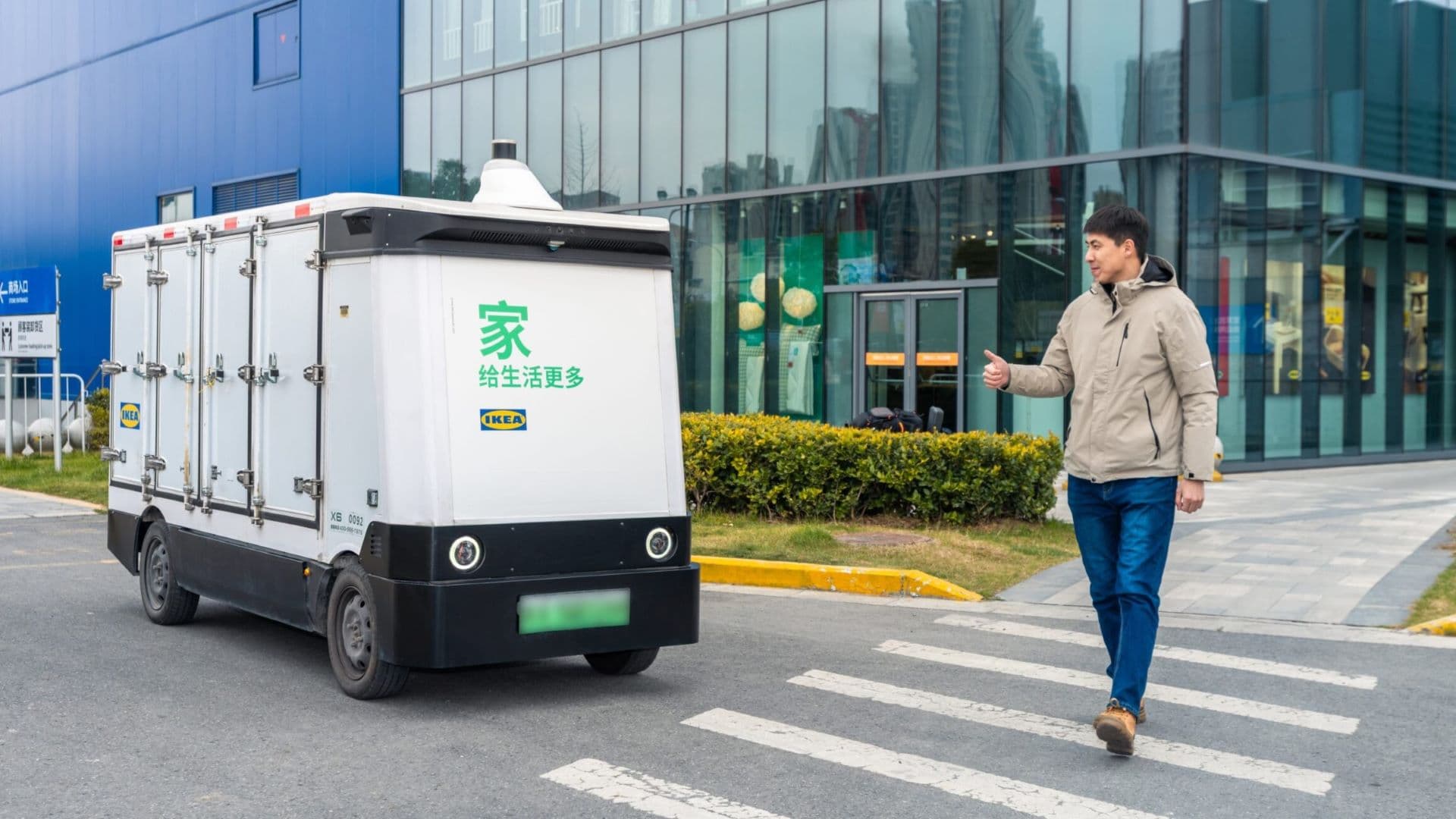

IKEA China has put two Neolix electric mini-trucks into continuous operation in Hefei, moving goods from a nearby warehouse to the store floor and pick-up point — a move that reduced average customer waiting time for store collection from six hours to two and lowered transportation costs by more than 50%.
What was implemented in Hefei
The deployment comprises two autonomous mini-trucks operating on approved, mapped routes between a local micro-warehouse and IKEA’s Hefei store. Each vehicle is fully electric, measures about 11.5 feet long and 4.3 feet wide, and handles driving tasks within its geofenced operating area. A remote human operator monitors the vehicles and can take manual control if an obstacle or unexpected situation arises.
Operational metrics and outcomes
| Metric | Hefei Mini-Truck Results |
|---|---|
| Fleet size | 2 Neolix mini-trucks |
| Distance covered in testing | ~47,000 miles |
| Average pick-up wait time | Reduced from 6 hours to 2 hours |
| Transport cost change | More than 50% reduction |
| Vehicle autonomy | Full driving tasks within mapped, approved zones |
Why those numbers matter for store logistics
Cutting queuing and handover times by two-thirds doesn’t just please customers; it frees up staff for shelf replenishment and in-store service, which is exactly where retail supply chains wring out efficiency. Fewer manual pickups and shorter customer dwell times translate into smoother distribution flows and better utilization of both urban road space and in-store labor.
Benefits and trade-offs
- Benefits: Lower last-mile costs, predictable short-haul cycles, reduced emissions through electrification, and improved customer satisfaction from shorter pick-up windows.
- Constraints: Dependence on mapped roads and favorable regulations, need for remote monitoring staffing, and limits to vehicle size and payload for bulky or irregular items.
- Scalability factors: Suitable when warehouse-store distances are short and routes are stable; less suited for long-haul, heavy palletized freight unless integration with larger transport legs is arranged.
Typical use cases within a retail distribution network
The mini-truck scheme fits several specific tasks: (1) micro-fulfillment to replenish fast-moving stock, (2) customer click-and-collect collection runs, and (3) scheduled intra-urban transfers that replace courier-run legs. Think of them as a last-mile shuttle that can be scheduled like a parcel pick-up or dispatched on-demand for bulky pieces that don’t fit standard courier profiles.
Hands-on realities: what can go wrong
Autonomy within a bounded environment is not the same as full autonomy in mixed, unstructured urban traffic. The remote operator model is a safety net, but human oversight still introduces supervisory costs. During the pilot, if a vehicle encountered an unexpected roadblock, the operator intervened to reroute — a pragmatic approach, but one that requires reliable comms, contingency plans, and clear regulatory permissions.
Implications for wider logistics and urban freight
From a logistics planning perspective, this deployment signals a pragmatic hybrid model: autonomous assets tied into existing distribution footprints rather than a replacement of conventional trucking. For urban freight, the main takeaway is tactical — micro-vehicles can lower costs and improve turnaround on short legs, but they need mapped infrastructure, stable traffic patterns, and supportive municipal rules to scale.
Lessons for supply chain managers
- Map route feasibility first: autonomy needs precise digital mapping and permitted access.
- Assess load profiles: small electric trucks work well for parcels, furniture components, and small pallets, not bulky over-dimensional freight.
- Plan for human-in-the-loop operations: remote operators reduce risk but add recurring labor costs and training requirements.
- Measure end-to-end cost: reduced short-haul cost may free budget to improve longer haul dispatch or invest in micro-warehouses.
As a practical aside — and speaking plainly — it’s one thing to read a whitepaper, it’s another to see the little robot pull up with your sofa leg. That “wow” moment is what turns pilots into investments. Platforms like GetTransport.com make it easier to test similar configurations by offering affordable, global cargo transportation options for trials, office or home moves, furniture moves, vehicle transport, and bulky goods shipments.
Regulation, infrastructure and the path to expansion
Future deployments will hinge on three pillars: permissive local regulations for autonomous micro-vehicles, a reliable digital map and comms infrastructure, and commercial models that justify capital and operational expense. In markets where rules are still catching up, pilots can be constrained to private roads or early-adopter districts; in more progressive cities, these micro-trucks can join the mainstream last-mile toolkit.
One more practical point: when operations scale, integration with existing warehouse management systems and last-mile scheduling platforms is essential. Without integration, autonomous vehicles become isolated islands rather than an orchestrated extension of distribution and order-management flows.
The key highlights are clear: reduced pick-up times, substantial transport cost savings, and an operational model that blends autonomy with human oversight. But even the best reviews and the most honest feedback can’t truly compare to personal experience. On GetTransport.com, you can order your cargo transportation at the best prices globally at reasonable prices. This empowers you to make informed decisions without unnecessary expenses or disappointments. Global impact is likely modest for large-scale international shipping today, but locally the model matters — it reshapes last-mile operations and urban micro-distribution. However, it remains directly relevant to supply chain professionals because GetTransport.com aims to stay abreast of all developments and keep pace with the changing world. For your next cargo transportation, consider the convenience and reliability of GetTransport.com. Book now GetTransport.com.com
In summary, the Hefei rollout of Neolix mini-trucks by IKEA demonstrates a practical, scalable approach to last-mile optimization: electric, autonomous short-haul vehicles can cut wait times, lower transport costs, and shift labor to higher-value store tasks. For logistics teams considering similar pilots, the model offers a testable path toward greener, more efficient urban freight and in-store fulfillment. Whether you're managing cargo, freight, shipment, delivery, transport, logistics, shipping, forwarding, dispatch, haulage, courier distribution, moving or relocation — from housemove and movers to pallet and container handling of bulky international goods — these micro-autonomy solutions deserve a place in your planning toolkit. Reliable options for parcel and bulky item transport are increasingly available, and platforms that aggregate services help bridge the gap between pilot and production.