


 Українська
  English (UK)
  Русский
  العربية
  日本語
日本語  한국어
한국어  Magyar
  Türkçe
  Español
  Čeština
  Svenska
  Português
  Ελληνικά
  Suomi
Suomi  Nederlands
  Română
  Italiano
  Français
  Polski
  Deutsch
  简体中文
简体中文  Slovenčina
 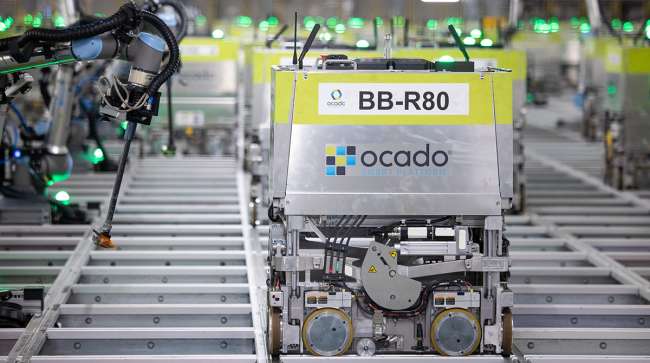 Kroger’s £350 Million Payout to Ocado Reflects New Direction in Automated Warehouse Use">

Kroger and Ocado: Revisiting the Automated Warehouse Model
The dynamic between Kroger, one of the largest US grocers, and Ocado Group Plc, a UK-based pioneer in automated warehouse technology, recently took a notable turn involving a significant cash settlement after warehouse closures. This development not only affects the companies involved but also holds implications for logistics and online grocery fulfilment strategies worldwide.
Background on the Partnership and Recent Developments
Originally, Kroger embraced Ocado’s robotic technology to supercharge its online order fulfilment through a growing network of highly automated distribution centres. Eight fulfilment centres were commissioned using Ocado’s warehouse automation, aiming to offer faster and more efficient delivery solutions to consumers. However, recent events led Kroger to close three of these state-of-the-art warehouses, a move that reflects a recalibration of their operational approach.
Faced with financial pressures and network performance issues, Kroger recognised its warehouse network fell short of expected returns, leading to a $2.6 billion impairment charge. Consequently, Kroger is shifting its focus towards fulfilling online orders through its existing store network instead of relying heavily on automated warehouses like those developed by Ocado.
The £350 Million Cash Settlement
As part of this adjustment, Kroger agreed to a one-time payment to Ocado totalling $350 мільйонів, exceeding the previously announced £250 million. This payout serves as compensation for warehouse closures and altered expansion plans, including the cancellation of a planned fulfilment centre in Charlotte, North Carolina. Despite this, Ocado will continue operating five other fulfilment centres alongside Kroger, with another set to open in Phoenix next year.
The settlement was expected to be finalised in early 2026. Following the announcement, Ocado’s shares saw a sharp increase, signalling investor optimism about the stability of its ongoing operations and future profitability prospects. However, the stock remains down roughly a third compared to its levels earlier in the year.
What This Means for Ocado’s Business Model
Ocado’s tech-heavy vision has long been to become a “Tesla of grocery,” providing innovative, capital-intensive automation solutions to revolutionise online grocery logistics. The Kroger setback—still its largest customer—casts uncertainty on this vision. With Kroger curtailing expansion and focusing on store-based fulfilment, Ocado must pivot and find additional routes and clients for its technology.
Outside the US, Ocado maintains partnerships with several grocers including Aeon in Japan, Casino in France, Coles in Australia, and Sobeys in Canada, keeping its global footprint diverse even as it contends with setbacks in North America. The nuances of exclusivity agreements with Kroger remain unclear, but Ocado remains confident about its growth potential in the US market.
Broader Industry Impact: The Shift to Hybrid Fulfilment
This Kroger move is part of a broader industry trend where retailers balance centralised automated warehouses with store-based fulfilment. For many grocers, leveraging existing store infrastructure helps reduce last-mile delivery costs and accelerate order turnaround while maintaining automation where it delivers clear efficiencies.
Such hybrid models influence logistics frameworks significantly. They necessitate more complex inventory management, real-time data synchronisation, and increased fleet coordination to handle diversified shipping origins—changes that ripple throughout the supply chain and freight management systems.
Logistics Considerations for the Retail and Grocery Sectors
| Аспект | Impact of Shift to Store-Based Fulfilment |
|---|---|
| Inventory Distribution | Decentralised across multiple stores increases complexity. |
| Швидкість доставки | Potentially faster local delivery within urban areas |
| Transportation Costs | Could reduce long-haul freight needs; increases local haulage |
| Використання складу | Reduced reliance on large automated centres |
| Інтеграція технологій | Requires seamless IT connectivity between shops and logistics |
Continued Challenges for Automation Technology Providers
Automated warehouse technology remains a promising but high-investment endeavour. Ocado’s technology has proven innovative, but the capital intensity and slower-than-expected returns underline the difficulty in scaling such systems rapidly. The lessons drawn here will shape future investments and partnerships in automated logistics solutions.
Retailers will weigh the benefits of costly technology upgrades against the flexibility and lower risk of leveraging existing store assets. Meanwhile, providers like Ocado must strike a balance between innovation and practical, scalable solutions that align with retailers’ evolving business models.
Future Outlook and Industry Implications
Despite the setbacks with Kroger, Ocado’s commitment to becoming cash flow positive by the 2026 financial year reflects a clear strategy focused on stringent cost control and measured growth. The global grocery logistics market remains large and diverse, offering ample opportunity for technology providers and retailers optimising their online order fulfilment strategies.
Чому це має значення для логістики та перевезень вантажів
The Kroger-Ocado situation offers an intriguing case study on how evolving retail strategies impact logistics and transportation frameworks. Increased reliance on store-based fulfilment decentralises freight origin points and complicates last-mile delivery chains. Moving bulky goods, managing palletised shipments, and ensuring seamless, timely dispatch become more reliant on sophisticated logistics coordination.
For companies and brokers in freight forwarding, courier services, and distribution, these shifts highlight the need for versatile, cost-efficient transport options capable of supporting hybrid models. Platforms like GetTransport.com Provide excellent solutions here, offering affordable, global cargo transportation that can adapt to various shipment types—from pallets and containers to bulky freight and vehicle transport. Whether you’re managing office moves, home relocations, or regular cargo deliveries, leveraging flexible carriers is key in this changing landscape.
Personal Experience Beats All Statistics
No amount of reviews or data can substitute for firsthand experience, especially when juggling complex supply chains and multimodal deliveries in an ever-shifting market. Fortunately, services like GetTransport.com empower logistics managers and business owners to negotiate the myriad of transport options, all at competitive prices worldwide.
The platform’s transparency and convenience make it stand out, allowing users to choose the best solutions that fit their specific needs without breaking the bank or dealing with hidden fees. This hands-on approach helps avoid unnecessary expenses, delays, or disappointment in shipments—qualities that are priceless in logistics.
Book now, GetTransport.com to experience hassle-free cargo transportation tailored to your requirements.
Підсумок
The £116 million payout from Kroger to Ocado signals a notable shift in the grocery sector’s approach to online order fulfilment, moving from large automated warehouses to a hybrid model that leans more on existing store networks. While this impacts Ocado’s growth trajectory, it also underscores changing logistics demands including more localised inventory dispatching, altered freight patterns, and the growing importance of flexible shipping solutions.
Retailers and logistics providers alike must adjust to these evolving supply chain structures, balancing technological advancements with operational practicality. For freight, cargo, and distribution services, the rise of hybrid fulfilment models means navigating more complex delivery networks, which calls for adaptive, reliable transportation options.
GetTransport.com fits perfectly into this picture by offering broad, affordable, and dependable transport services worldwide – from parcels and pallets to bulkier and international shipments. As supply chain landscapes continue to evolve, platforms like these simplify the dispatch, freight forwarding, and haulage processes, ensuring streamlined delivery and relocation experiences for businesses everywhere.