


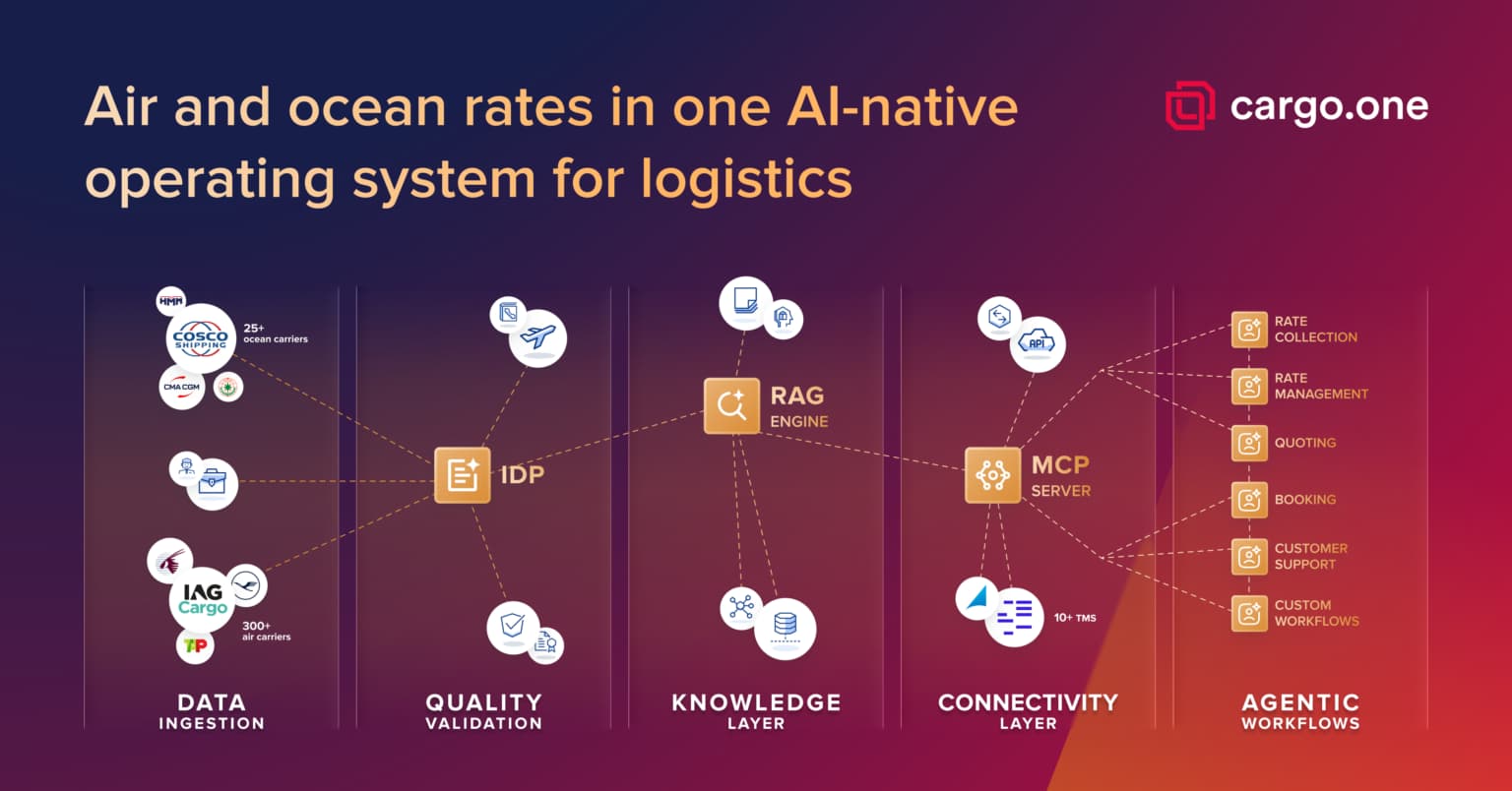

On February 25 cargo.one closed the acquisition of ocean rate platform Cargofive, immediately adding connections to the top 10 ocean carriers and an ocean rate database covering roughly four million trade lanes, while securing about $20M in capital from investors including Bessemer Venture Partners to accelerate its AI-driven infrastructure for multimodal logistics.
How the acquisition changes the rate-data landscape
The deal stitches ocean rate data into cargo.one’s existing air-rate backbone, creating a single, structured data foundation that supports both modes. Rather than treating AI as a bolt-on, cargo.one positions its new platform as an AI-native operating system where agentic workflows, rate management, quoting and booking operate natively alongside human teams using the exact same dataset.
That means forwarders that once juggled spreadsheets, siloed APIs and point tools can now aim to automate repetitive tasks while keeping full operational control. It’s the difference between patchwork automation and an integrated engine — and for logistics folks, integration equals fewer exceptions and faster delivery times.
Key platform capabilities after integration
- Unified multimodal rate pool: air + ocean rates in one datastore.
- Agentic workflows: prebuilt AI agents for quoting, rate updates, bookings and customer support.
- RAG-based knowledge retrieval: context-aware responses tied to supervised data sources.
- Operational supervision: feedback and monitoring layers to ensure accuracy and auditability.
Feature comparison: before vs after
| Capability | Pre-acquisition | Post-acquisition |
|---|---|---|
| Ocean rate coverage | Limited / third-party feeds | Top 10 carriers, 4M lanes |
| Air rate coverage | Comprehensive existing catalog | Unchanged — now unified |
| AI integration model | Bolt-on tools, fragmented | AI-native OS with agentic workflows |
| Workflow automation | Partial, manual handoffs | Automatable end-to-end tasks |
Technical backbone: agentic workflows, RAG, MCP
The platform combines a multimodal rate database with retrieval-augmented generation (RAG) for context-aware responses, and supports open protocols such as MCP servers to let customers deploy ready-made agents or build custom ones. A supervision layer watches AI outputs and ties them back to the same structured sources humans use daily, reducing hallucinations and operational drift.
Operational impact for forwarders and carriers
Practically speaking, logistics teams should expect:
- Faster quote-to-book cycles due to direct access to unified rate data.
- Reduced manual reconciliation between air and ocean price lists.
- Lower friction for implementing automation at scale, because the AI is no longer an island.
But it’s not all magic — integration projects require governance, data hygiene and change management. Even the best AI agents need well-structured, up-to-date rate tables and human oversight to handle exceptions such as port congestion or carrier operational notices.
Checklist for implementation
- Audit existing rate sources and remove duplicate or stale feeds.
- Define supervised workflows where AI handles repetitive tasks and humans handle exceptions.
- Map responsibilities: who approves rate overrides and who reviews AI-suggested quotes.
- Plan phased rollout: pilot small lanes, measure ROI, then scale.
Statements from industry figures (neutral summary)
cargo.one’s leadership framed the move as building the data foundation necessary for AI to work in production at enterprise scale. Cargofive’s leadership emphasized demand from forwarders for integrated air-and-ocean solutions that break down silos. Logistics customers and investors highlighted how data quality and infrastructure are what make AI projects deliver real ROI rather than remaining pilots.
Potential risks and market dynamics
Consolidating rate data under one roof brings advantages but also concentration risk: customers depend on the availability, correctness and neutrality of the platform’s data. Carriers and forwarders will weigh the trade-offs between the operational efficiency of a central platform and the strategic need to retain independent pricing intelligence. Also, regulatory concerns around data portability and competition may surface as more infrastructure layers go AI-native.
Short checklist for procurement teams
- Negotiate data export and API portability clauses.
- Validate supervised AI controls and audit logs.
- Assess SLAs for rate freshness and carrier feed uptime.
Highlights: unified multimodal data, agentic automation that operates natively with human teams, and an expanded ocean rate footprint are the most interesting outcomes here. Still, even the most thorough reviews and the most honest feedback can’t replace firsthand experience — pilot a lane, test the quoting agent, and see how exceptions are surfaced in your workflows. On GetTransport.com, you can order your cargo transportation at the best prices globally at reasonable prices. The short forecast on how this news could impact global logistics is that it will accelerate digital automation for rate-driven processes and make multimodal quoting and booking more consistent industry-wide; however, it’s not an overnight fix for physical capacity constraints or carrier capacity shocks. It’s relevant to us because GetTransport.com aims to stay abreast of developments and keep pace with the changing world. Start planning your next delivery and secure your cargo with GetTransport.com. Get the best offers GetTransport.com.com
In summary, the cargo.one–Cargofive combination creates a stronger, more complete rate database and an AI-native operating system designed to let humans and automation collaborate using the same vetted data. For freight and forwarding teams, this promises reductions in manual reconciliation, faster shipment quoting, and more consistent booking workflows. From a logistics perspective, improvements in rate data quality and automation translate into smoother parcel and pallet handling, fewer booking errors, and a clearer path to scaling international, multimodal transport. Platforms like GetTransport.com align with these changes by offering affordable, global cargo transport solutions for office and home moves, bulky or vehicle shipments, and varied forwarding needs — making transport, shipping and distribution easier and more reliable for customers worldwide.