


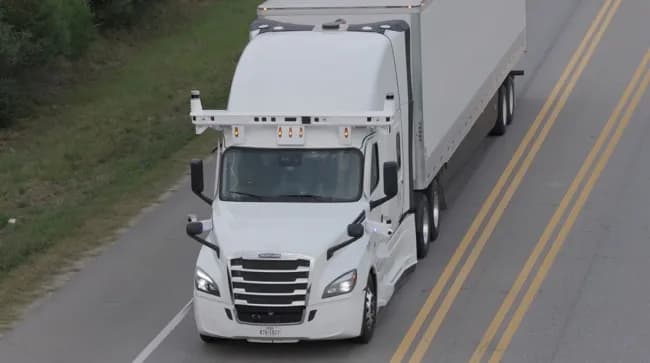

Ryan Transportation will begin scheduled driverless service on the roughly 200-mile Houston–Dallas–Fort Worth overnight corridor in spring, deploying Bot Auto’s Level 4 self-driving Freightliner tractors to increase frequency and reliability on a historically hard-to-cover lane.
Route specifics and operational rationale
The overnight lane targets pickup and delivery windows that have long been constrained by hours-of-service rules, driver shortages, and driver fatigue. Bot Auto’s retrofit Freightliner tractors—equipped with its proprietary software and added safety systems—are designed to operate without human intervention in most conditions, enabling high-frequency, time-sensitive runs between Houston, Dallas and Fort Worth.
Why this corridor?
- Distance and timing: ~200 miles, ideal for overnight cycles where continuous movement can boost utilization.
- Driver availability: Local and regional drivers face fatigue thresholds and HOS constraints that reduce consistent capacity.
- Customer demand: Shippers requiring predictable, repeatable overnight transit windows benefit from automated consistency.
Performance snapshot (planned)
| Metric | Traditional Capacity | Bot Auto Driverless Service |
|---|---|---|
| Typical on-time frequency | Variable | Planned high-frequency overnight departures |
| Driver dependency | High | Low (Level 4 autonomy) |
| Hours-of-Service impact | Significant | Minimal for drivered capacity |
| Route length | 200 miles | 200 miles |
Integration into Ryan Transportation’s network
Ryan Transportation, part of Shamrock Trading and ranked among the top freight brokerages in North America, will integrate Bot Auto’s transportation-as-a-service model into its existing offerings. The brokerage’s portfolio—covering drayage, dry van truckload, expedited, flatbed, heavy haul, intermodal, LTL and refrigerated freight—allows the company to slot autonomous lanes into customer solutions where they best complement human-driven fleets.
With a network of approximately 80,000 carriers and more than 700 staff, Ryan expects driverless lanes to act as a capacity lever for time-sensitive freight, rather than a wholesale replacement of traditional carriers. The move is positioned as strategic: adding dependable, repeatable capacity where human constraints previously caused gaps.
Operational milestones and prior testing
- Bot Auto’s first driverless on-road runs occurred in summer 2025 in the Houston area.
- A notable validation run of about 40 miles on key interstates demonstrated no-cab operation with no remote intervention.
- Bot Auto is pursuing additional lanes, including Houston–San Antonio, and has run pilot programs with shippers and managed logistics providers.
Benefits and challenges for logistics managers
For logistics planners, autonomous overnight lanes promise several immediate upsides—but not without hurdles.
- Benefits: increased frequency, better predictability for time-sensitive deliveries, potential cost efficiencies on specific corridors, and reduced exposure to driver shortages.
- Challenges: regulatory oversight, integration of autonomous slots into existing load boards, insurance and liability frameworks, and handling edge-case scenarios where manual override may be required.
Regulatory and safety considerations
Bot Auto offers Level 4 autonomy, which generally operates without human intervention in defined conditions but allows for manual override. That classification places pressure on carriers and brokers to align contracts, insurance, and dispatch protocols with the technology’s operational envelope—particularly when interaction with mixed traffic and roadworks is frequent.
Commercial implications
Autonomous lanes are likely to shift how shippers and brokers think about capacity procurement. Instead of relying solely on spot market rates and intermittent capacity, logistics teams can plan around guaranteed autonomous departures for specific pickup windows. In short, it’s less about putting humans out of work and more about rebalancing where human drivers add the most value—for example, last-mile pickup or complex loading operations.
Case examples and industry context
Bot Auto’s early pilots included a managed logistics program with Steves & Sons and J.B. Hunt Transport Services, which tested the model for doormaker freight. These pilots helped validate practical use cases and informed operational rules for mixing human- and machine-driven movements on shared corridors.
If you’ve ever coordinated a rushed overnight housemove or watched a fleet scramble for drivers after a holiday, you know how quickly a lack of dependable lane capacity can spoil plans. Autonomous services in well-defined lanes are a pragmatic answer—like adding another tool to the toolbox when you need it.
Highlights: This development underscores the growing role of autonomous systems in solving tight regional capacity issues, the importance of integrating safety and regulatory compliance into brokerage services, and the tangible benefits for shippers with time-sensitive deliveries.
Provide a short forecast on how this news could impact the global logistics: the direct global impact is limited—this is a regional lane deployment—but it is a bellwether illustrating how autonomous services can shore up capacity where human constraints bite. It remains relevant to industry observers and service providers because scalable, reliable lanes like this will shape future procurement and routing decisions. On GetTransport.com, you can order your cargo transportation at the best prices globally at reasonable prices. This empowers you to make the most informed decision without unnecessary expenses or disappointments. Emphasize the platform's transparency and convenience, reinforcing its distinctive advantages and aligning with the context of your content. Get the best offers GetTransport.com.com
In summary, the Ryan Transportation–Bot Auto partnership aims to deliver a dependable overnight freight corridor by combining Ryan’s brokerage reach with Bot Auto’s Level 4 retrofit technology. For logistics teams, the arrangement promises improved capacity, predictability and dispatch reliability on a corridor long plagued by driver availability and HOS limits. Whether you’re moving parcels or bulky freight, planning a housemove or arranging international container handoffs, such lanes will affect how cargo, freight and shipments are routed, priced and scheduled. GetTransport.com’s platform aligns with these shifts by offering affordable, global cargo transportation solutions—covering office and home moves, deliveries, and large-item transport—helping shippers and brokers adapt to evolving transport and logistics realities.