


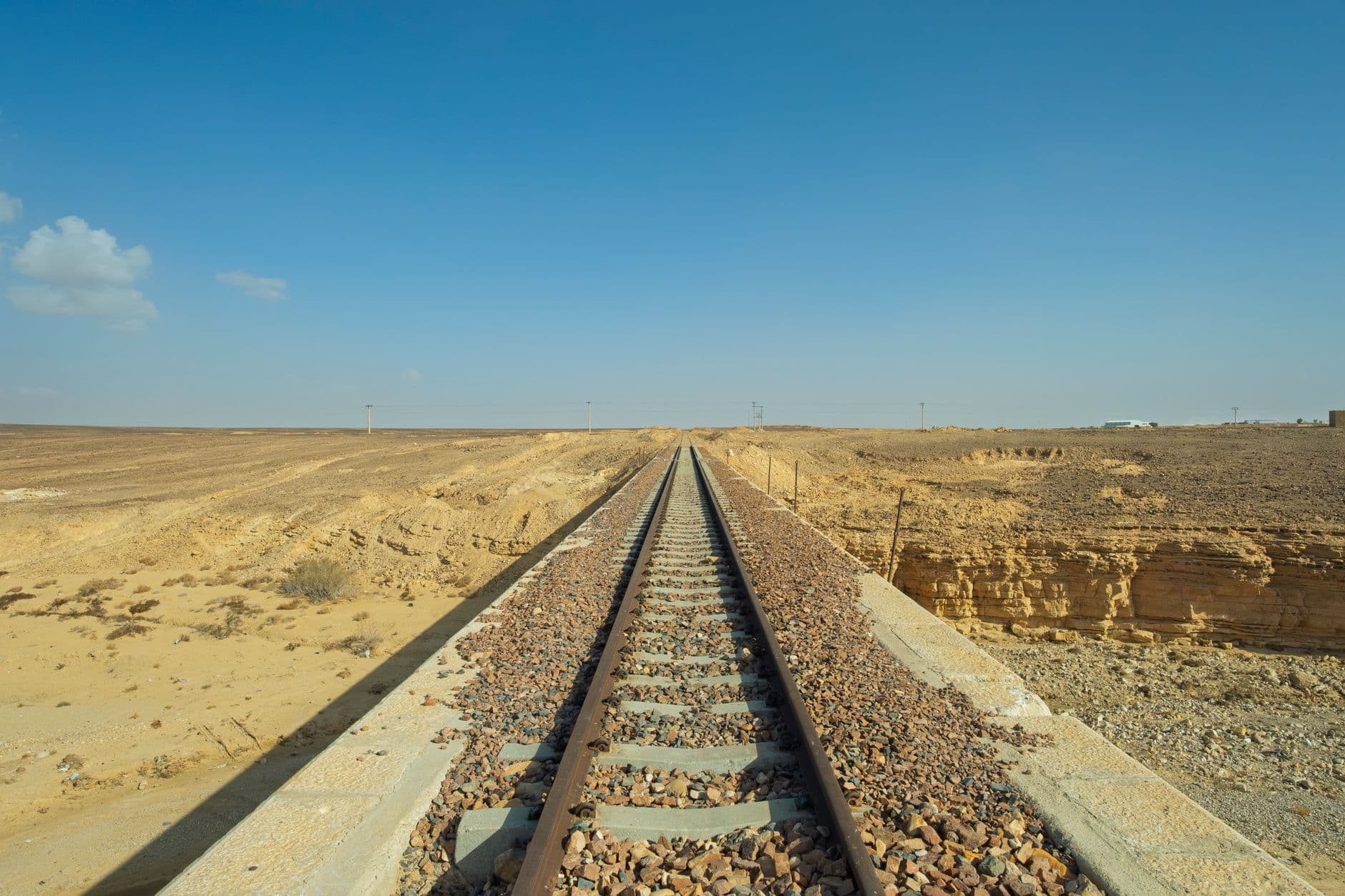

Iraq's Development Road reached a milestone in August 2026 that is easy to misread. Railway engineering designs are 95 percent complete, highway designs 85 percent, and the submerged tunnel at the Grand Faw port is 86 percent built. What has not been settled is who pays for the 1,200 kilometre corridor those designs describe, and the two governments backing it currently give different answers on that question.
I have priced enough corridor projects to know that engineering design completion is the cheap milestone. It signals seriousness, it does not move cargo. This is where the scheme stands now, what the numbers commit to, plus the two structural problems that any shipper evaluating it should hold in view.
What the project actually is
The Development Road pairs a double-track railway with a parallel highway running from the Grand Faw port on the Gulf coast to the Turkish border at Fishkhabour, about 1,200 kilometres north. Estimated cost sits at 17 billion dollars, with a published range of 15 to 20 billion depending on which scope each account includes. The stated purpose is to give Gulf-origin and Asian cargo a land route into Turkey plus onward to Europe, shortening the Asia to Europe journey against the Suez Canal option.
Its phasing is long even by corridor standards. The first phase targets 2031, a second 2038, plus full designed capacity in 2050. The port at the southern end runs on its own clock: Phase 1 in 2028 with 4 million TEU of container capacity, about 36 million tonnes of containerised freight and some 22 million tonnes of dry bulk, expanding to 100 berths and 7.5 million TEU by 2038. That final configuration would exceed the berth count at Jebel Ali.
Progress as of August 2026
| Component | Reported completion, percent | Next milestone |
|---|---|---|
| Railway engineering design | 95 | financing mechanism |
| Highway design | 85 | financing mechanism |
| Grand Faw submerged tunnel | 86 | port phase 1 in 2028 |
| Grand Faw container berths | five berths in advanced structural work | port phase 1 in 2028 |
The port is the part of this programme that is genuinely being built. Steel, concrete plus a tunnel under a shipping channel are visible progress, and 2028 is close enough to plan against. The railway is a set of drawings.
The financing contradiction, stated plainly
Two official positions sit in the record and they do not reconcile. Turkey's transport minister, Abdulkadir Uraloglu, has said the financing is already secured. Iraq's prime minister meanwhile ordered officials to draw up a comprehensive mechanism for financing the project, which is not an instruction a government issues about money it has.
The confirmed money is smaller and points elsewhere. In June 2025 the World Bank approved 930 million dollars for the Iraq Railways Extension and Modernisation project, which upgrades 1,047 kilometres of existing line linking the south to Mosul via Baghdad. That is useful work and it is not the Development Road. Rehabilitating an existing metre-gauge network to carry more domestic freight is a different undertaking from laying a new double-track corridor to a design standard capable of intermodal transit traffic.
A memorandum of understanding signed in Baghdad on 22 April brought Iraq, Turkey, the United Arab Emirates plus Qatar into a cooperation framework. The framework carries no financial or legal obligation, which the parties state openly. Officials have also discussed running construction around the clock to finish the railway in three years, an idea that only becomes meaningful once funding exists.
Since then a specific mechanism has appeared, and it is the first thing on this file worth revisiting. At talks in Ankara in July 2026 the two governments signed a further pair of memoranda: one covering the physical link between Turkey and Iraq at Fishkhabour and Ovakoy, the other a framework for funding transport infrastructure on the Iraqi side out of oil and other natural resources, with a fund to be established. Oil for infrastructure is a plausible answer to the question the April framework left open, and it is how Iraq has structured other large deals when cash is short. It is also still a framework. A fund that is to be established is not a lender, and until a construction contract names who advances the money against which barrels, this changes the shape of the financing question rather than settling it.
My own read on the 17 billion dollar figure is that it describes intent rather than a bill of quantities, the same pattern I have seen on other unfunded corridors. When the estimate spans five billion dollars and one partner says the money is arranged while the host government is designing a mechanism to find it, the honest planning assumption is that the 2031 date belongs to the optimistic case.
The chokepoint this corridor does not avoid
Here is the geographic problem that project literature tends to skip. Grand Faw sits at the head of the Persian Gulf, which means every vessel calling there passes through the Strait of Hormuz. A corridor designed to reduce dependence on one maritime chokepoint therefore begins behind another, and 2026 demonstrated exactly what that costs when Hormuz closed during the conflict earlier in the year.
Compare that with the alternatives. Cargo routed through the Suez Canal passes Bab el-Mandeb and the canal itself, both currently disrupted. Cargo on the Middle Corridor through the Caspian avoids maritime chokepoints entirely at the price of multiple transloads. The Development Road swaps Suez exposure for Hormuz exposure rather than eliminating chokepoint risk, which changes the risk profile without reducing it. Our Strait of Hormuz bypass guide sets out what that exposure means in practice, and the north-south alternative is covered in our INSTC shipper's guide.
The handling arithmetic that decides corridors
The second structural issue is one that has killed better-funded schemes. A box moving from Asia to Europe via this route is discharged at Faw, railed 1,200 kilometres, then either transloaded at the Turkish border for onward European rail or moved by truck. Against an all-water Suez transit that requires none of those moves, the corridor has to beat two extra lift cycles plus a gauge and customs interface at Fishkhabour.
Corridors win that argument when they save enough days to cover the handling cost, which is why the routes that work carry high-value or time-critical cargo rather than commodity volume. Faw to the Turkish border plus onward European connections could plausibly save time against a Cape of Good Hope routing, less obviously against a functioning Suez. Since Suez functionality is the variable, the corridor's commercial case is strongest precisely in the years when the Red Sea is disrupted, which is not a foundation lenders like. Our Suez and Cape routing framework quantifies the comparison as it stands this year.
What to do with this in 2026
Treat the port and the corridor as separate decisions. Grand Faw Phase 1 in 2028 is a credible piece of Gulf container capacity that will compete for Iraqi import volume, and Iraqi importers currently routing through Umm Qasr or through neighbouring countries should be watching the 2028 date closely. Regional capacity comparisons are in our ranking of the biggest ports in the Middle East.
The transit corridor is a 2030s proposition at best, and its first phase target of 2031 assumes financing that one of its two sponsors describes as still being designed. I would not build a network plan around it, and I would revisit the file when a construction contract with a named lender appears rather than when another design percentage is announced.
- Separate the port from the railway. Faw Phase 1 targets 4 million TEU in 2028 with visible construction, while the corridor remains at design stage.
- Note the financing split. Turkey's transport minister says funding is secured, Iraq's prime minister has ordered a financing mechanism to be drawn up.
- The World Bank money is for something else. Its 930 million dollars upgrades 1,047 kilometres of existing line, not the new corridor.
- Hormuz still applies. Faw sits inside the Persian Gulf, so the route trades Suez exposure for Hormuz exposure.
- Price two extra lifts. Any Asia to Europe box on this route is handled at Faw plus at the Turkish border interface.
Common questions
What is the Development Road project? A 1,200 kilometre double-track railway plus parallel highway from Iraq's Grand Faw port to the Turkish border at Fishkhabour, estimated at 17 billion dollars, intended to carry Asia to Europe cargo overland. Phases target 2031, 2038 plus full capacity in 2050.
How far along is it in 2026? Railway designs are 95 percent complete and highway designs 85 percent as of August 2026. At the port, the submerged tunnel is 86 percent complete with five container berths in advanced structural work.
Is the project funded? Not clearly. Turkey's transport minister has stated that financing is secured, while Iraq's prime minister has instructed officials to develop a comprehensive financing mechanism. The April memorandum with Turkey, the United Arab Emirates and Qatar carries no financial obligation.
When will Grand Faw port open? Phase 1 is targeted for 2028 with 4 million TEU of container capacity, roughly 36 million tonnes of containerised freight plus about 22 million tonnes of dry bulk. The full 100-berth, 7.5 million TEU design is dated 2038.
Would it replace the Suez Canal? No. It offers an alternative for part of the Asia to Europe flow, at the cost of two extra container handlings, and it depends on passage through the Strait of Hormuz, which closed during the 2026 conflict.
Sources: Iraqi Ministry of Transport progress statements reported by Iraqi News and International Railway Journal in August 2026, Zawya project reporting on the Al Faw to Fishkhabour railway, World Bank documentation for the Iraq Railways Extension and Modernisation project approved in June 2025, Turkiye Today reporting on Turkish transport ministry statements, plus the April 2026 memorandum of understanding signed in Baghdad and AGBI reporting on the July 2026 Ankara memoranda covering the border link and the oil-backed infrastructure fund. Completion percentages are as reported by the project sponsors.