


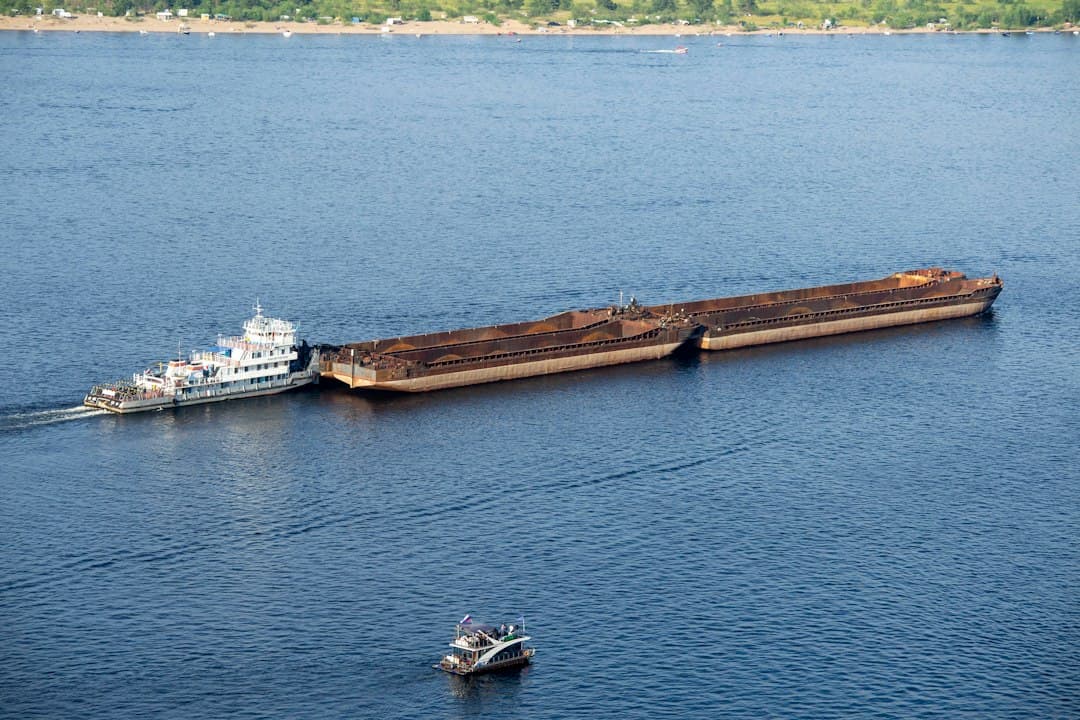

On 10 September 2026 Argentina handed operating control of its main export river to a private concessionaire for the first time since 2021. The toll ships pay to transit the Via Navegable Troncal (VNT), the Paraguay-Parana waterway, dropped from US$4.30 to US$3.80 per net registered tonne, and a 25-year contract now sits with a consortium of Belgian dredger Jan De Nul and Argentine firm Servimagnus, trading as Via Navegable Argentina. The practical question for anyone booking cargo through Rosario, Santa Fe or the river ports beyond is not who won the tender. It is what changes, on what schedule, and what could still go wrong.
What the concession covers
The VNT is the dredged, buoyed channel running from the Rio de la Plata estuary near Buenos Aires up through Rosario to the Confluencia, where the Parana and Paraguay rivers meet, and on toward the Paraguayan and Bolivian borders. Sources disagree on its length: Jan De Nul's own release cites 1,400 km, Buenos Aires Times gives more than 1,500 km, Infobae's account of the June award states 1,635 km, and Argentina's own port authority, the Administracion General de Puertos, lists 1,477 km on its official site. We could not reconcile these from the sources opened for this piece, so treat any single figure with caution.
The contract obliges Via Navegable Argentina to dredge and maintain the channel, replace and maintain roughly 1,150 navigation buoys, and install camera, radar and digital monitoring of water level, flow and tide, per the company's 19 June 2026 release and Argentina's government statements. The plan also folds in opening and upkeep of the Parana Guazu, Parana Bravo and Pasaje Talavera channels, extending the system into Entre Rios province.
Term, tender history and the legal fights
The term is 25 years, confirmed independently by Jan De Nul and Argentina's Economy Ministry. It replaces a gap that opened in 2021, when then-president Alberto Fernandez's government declined to renew Jan De Nul's original 1995 to 2021 concession; the state then ran dredging, buoying and tolling directly for five years.
The tender moved through three sealed envelopes: legal and financial background, then technical plans, then price. In the technical stage Jan De Nul scored 66.20 points against 42.14 for fellow Belgian bidder DEME NV, per comexonline and Buenos Aires Times; a third bidder, Brazil's DTA Engenharia, was ruled inadmissible for lacking a bid guarantee. Jan De Nul and DEME then submitted identical price offers, so the technical score decided the contract.
Behind the technical contest sat a geopolitical one. Reuters reported on 23 May 2026 on a letter dated 23 April from US Representative Brian Mast, chairman of the House Foreign Affairs Committee, to Secretary of State Marco Rubio, warning of "Chinese malign influence" in the bid. DEME's consortium includes the investment firm KKR and the US dredger Great Lakes Dredge and Dock. DEME has argued, per Bloomberg, that Jan De Nul's local partner Servimagnus maintains longstanding ties with the state-owned CCCC Shanghai Dredging. Jan De Nul and Servimagnus deny any Chinese ties and, as Reuters reported, called the allegations "a malicious fallacy." The government proceeded with the award. Separately, the disqualified third bidder, DTA Engenharia, filed a complaint with Argentina's Public Prosecutor's Office in May 2026 alleging the tender's qualification criteria were designed to favour Jan De Nul, according to Datamar News; the company had submitted a protest letter instead of the required bid guarantee, so this was never treated as a formal objection inside the tender itself. Environmental groups also challenged the tender in court on hydrology grounds. The government states no bidder objected formally at any stage; we could not independently verify the litigation's status beyond that statement.
Draft targets and where they apply
The figure that matters most for vessel planning is draft in the Rosario, or "Up-River," reach, the hub that handled the world's largest single-origin oilseed and grain export volume in 2025 per Bloomberg. Reporting from Letra P, sourced to the bid documents, lays out a staged plan:
| Stage | Depth target, feet | Toll, US$ per net registered tonne |
|---|---|---|
| Stage 0, initial maintenance | no deepening yet | 3.80 to 4.20 |
| Stage 1 | 36 | 4.65 to 5.05 |
| Stage 2 | 40 | 5.78 to 6.18 |
| Feasibility study, year 5 | 42 to 44 (study only) | not yet set |
Bloomberg's account frames the headline deepening as a move from 36 to 40 feet at Rosario, with a further study on reaching 44 feet. We read the two accounts as compatible if Bloomberg's "36 to 40 feet" describes the deepening due by Stage 2, with Letra P's bands as intermediate steps. The toll set at the September 2026 start, US$3.80, sits inside the Stage 0 band both sources describe.
Deepening at Santa Fe and the Confluencia, and the Entre Rios channels, are named in the government's communique as part of the same works programme, but neither source gives a separate draft figure for those reaches. Shippers moving cargo north of Rosario should ask the concessionaire for reach-specific draft guarantees rather than assume the Rosario figure applies uniformly. Canal 26, citing official projections, anticipates a 52.4 percent rise in vessel traffic toward northern Santa Fe over the contract's life, implying real investment is expected there too.
The toll regime and what it funds
Canal 26, citing official figures, states the concession should generate average annual billing of US$628.2 million, roughly US$15,707 million across 25 years. Buenos Aires Times, citing Bloomberg, put total capital spending on deepening at about US$10 billion; comexonline's May 2026 reporting cites the same order of magnitude.
A separate contest covers the Martin Garcia Channel, the Rio de la Plata stretch between km 39 and km 0 forming the basin's outlet to the Atlantic, run jointly with Uruguay through the Comision Administradora del Rio de la Plata. Infobae reported that of three bidders, Jan De Nul and Uruguay-based Boskalis International Uruguay advanced to the price stage, while China's CHEC Dredging was disqualified for equipment over 30 years old. That contract runs five years with a five-year option, far shorter than the VNT's 25. The CARP signed the contract with Jan De Nul's Uruguayan branch on 30 July 2026, worth about US$66 million, so the same company now holds both the VNT concession and the Martin Garcia maintenance and improvement work, according to Uruguay's foreign ministry and CARP's own site.
Why this matters for grain and regional barge flows
Roughly 80 percent of Argentina's exports, and 75 to 80 percent of agricultural exports specifically, move through the VNT, per Jan De Nul and Buenos Aires Times. The waterway also carries cabotage and transit cargo from Paraguay, Bolivia, Brazil and Uruguay under the 1992 agreement governing navigation on the system.
The commercial case for deepening rests on reducing "top-off" loading, where vessels partially load upriver at Rosario and finish at deeper Atlantic anchorages because the channel cannot support full draft. Bloomberg states the expansion aims to let more soy meal, Argentina's largest export by value, load fully upriver. We found no source that quantifies current top-off cost per tonne with enough rigor to repeat as fact; treat any such figure in the market as an estimate.
Readers benchmarking this corridor against alternatives should see our 2026 ranking of the largest grain export ports and the busiest inland waterways and river ports guide, which cover volumes rather than concession mechanics. Traders weighing routing between the River Plate system and Brazil should also read our coverage of Santos congestion and Brazilian agri-export flows, since a slower-than-planned Hidrovia deepening would push more marginal tonnage toward Brazilian ports.
Risks that could slow or derail the schedule
- Drought and low water. Paraguayan trade press reported a renewed extreme low-water alert in the upper basin and Pantanal in early 2026, after only a temporary mid-2025 recovery; the Paraguayan river shipowners association still projected about 28 million tonnes of traffic for the year. A dry cycle can offset dredged draft gains, so contracted depth targets do not guarantee available depth in a bad year.
- Court and regulatory challenges. Environmental groups have gone to court over hydrology concerns; the government says this has not stopped the process, but we could not access the litigation record directly.
- Political and tariff volatility. The toll bands above come from pre-award bid documents; a change of government or a renegotiation could revisit the schedule, as prior Argentine infrastructure concessions have seen.
- Geopolitical and access-channel risk. The China-linked allegations raised during the tender, and a September 2026 US State Department fact sheet on an "Andes-Atlantic Corridor" that refers to inland ports on the Hidrovia Waterway, point to continued outside attention. Separately, the Rio de la Plata access channel is contracted on a much shorter term, so a mismatch with VNT progress could bottleneck the river's mouth even if Up-River work stays on schedule.
What to monitor over the next 12 months
- Whether Stage 1 deepening to 36 feet holds to Jan De Nul's timetable: maintenance from August 2026, deepening targeted for completion by 2031.
- Whether Jan De Nul's Martin Garcia Channel works, contracted 30 July 2026, stay on their five-year schedule, since delay could still cap benefits from upstream deepening.
- Minutes from the Consejo de Control de la Via Navegable, formalised 7 August 2026, the forum where toll disputes and delays should surface first.
- Whether the toll moves into the Stage 1 band, US$4.65 to US$5.05 per net registered tonne, once 36-foot draft is certified, since the eventual 40-foot rate could run up to 44 percent above the pre-concession US$4.30 level.
For a wider view of how this corridor fits into regional trade infrastructure, including land routes that reduce dependence on any single river system, see our Bioceanic Corridor shipper guide and the ranking of the busiest ports in Latin America, which places Rosario and the River Plate system against Santos, Cartagena and Pacific coast terminals.
Common questions
Who won the Hidrovia concession and when? A consortium of Belgian dredger Jan De Nul and Argentine firm Servimagnus, trading as Via Navegable Argentina, was pre-awarded on 4 June 2026 and formally confirmed on 19 June 2026, with private management starting 10 September 2026.
How long does the concession run? 25 years, confirmed by Jan De Nul and Argentina's Economy Ministry.
Did the toll go up or down? It fell, from US$4.30 to US$3.80 per net registered tonne, at the September 2026 start. Bid documents show the toll is contracted to rise in stages as draft increases, potentially reaching 44 percent above the pre-concession rate once 40-foot depth is certified.
What is the target draft at Rosario? The contracted path is 36 feet, then 40 feet, with a year-five feasibility study on whether the channel can reach 42 to 44 feet.
Is the Rio de la Plata access channel included? No. The Martin Garcia Channel, the binational access route run jointly with Uruguay, was tendered separately on a shorter five-plus-five-year term; the Comision Administradora del Rio de la Plata signed that contract with Jan De Nul's Uruguayan branch on 30 July 2026.
Has the tender faced legal challenges? Yes, from environmental organisations over concerns about altering the Parana's natural dynamics. The government states no bidder formally objected at any stage.
How much investment is involved? Roughly US$10 billion over the 25-year term, with projected concession revenue of about US$628 million a year.
Sources: Jan De Nul press release, 19 June 2026; Buenos Aires Times, 5 June and 19 June 2026 (Bloomberg-sourced reporting on the award and technical scores); Reuters via Baird Maritime, 23 May 2026; Bloomberg via Vision Times, 16 June 2026; Argentina's Agencia Nacional de Puertos y Navegacion communiques via argentina.gob.ar, 18 June and 10 September 2026; comexonline.com.ar, 15 May 2026; Infobae, 22 June 2026; Canal 26, 10 September 2026; Letra P, 7 May 2026; U.S. Department of State fact sheet on the Andes-Atlantic Corridor, September 2026; Paraguayan trade press (abc.com.py, kontenidospy.com.py) on 2026 low-water conditions; Uruguay's Ministry of Foreign Affairs (gub.uy) and CARP, 30 July 2026; Datamar News, 13 May 2026. Figures reflect reporting available as of 30 September 2026.