

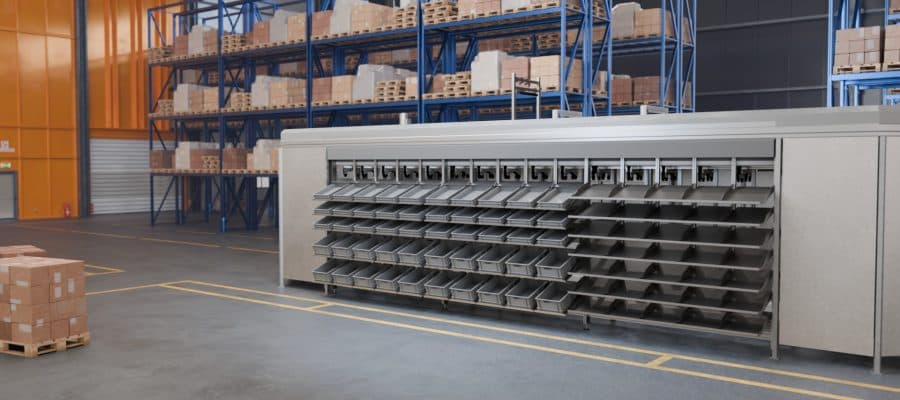

E-Sort can generate almost 100 exits within a 3m space and increase the number of system exits by up to 70% by mating a high-throughput loop sorter with a Smart Wall put‑wall — a change that directly compresses footprint while lifting throughput for e‑commerce and omni‑channel fulfilment operations.
From chute pitch reduction to a modular put‑wall loop
EuroSort’s work over 25 years — including Push Tray, Split Tray, Cross Tray and Push Bar sorters installed at more than 500 sites — shows a clear throughline: engineers keep pushing to balance speed, accuracy and space efficiency. The Chute Pitch Reducer was an early, pragmatic fix, narrowing chute widths by about 30% with controlled exit doors. E‑Sort is the more ambitious next step: combining a loop sorter with a configurable put wall to multiply exits density without ballooning real estate needs.
How the E-Sort architecture works
The concept pairs a continuous-loop, high-speed sorter with a modular put wall. Items travel on the loop and are diverted into the Smart Wall’s pockets. The wall can be sized in modules so that exit counts, pocket dimensions and packing workflows are tailored to SKU mix and parcel dimensions. For example, a half‑metre wall module may provide eight small pockets, while larger‑parcel configurations reduce the pockets but keep the overall density high.
Key technical highlights
- Max exits per 3m: ~100 (configuration-dependent)
- Exit increase: up to 70% vs conventional layouts
- Max item weight: 5 kg
- Max item dimensions: 400 x 600 x 250 mm
- Modularity: scalable for entry-level to large sites
- Maintenance: designed for simple on-site servicing
Why footprint reduction matters for logistics
Real estate and labour are two of the most visible cost levers in modern distribution. Shrinking the sortation footprint while increasing exits enables denser fulfilment in urban and suburban properties, delaying or avoiding investment in larger greenfield buildings. For networks pursuing same‑day or next‑day delivery, more exits in a smaller area mean faster wave picking, reduced picker travel, and lower pick‑to‑pack cycle times — the things that translate directly into lower cost per order and improved delivery SLA performance.
| Conventional loop sorter | E-Sort (loop + put wall) |
|---|---|
| Large footprint for high exit counts | Compact footprint with high exit density |
| Fewer exits per linear meter | ~70% more exits in same space |
| Higher real estate and conveyor costs | Lower footprint, modular spend |
| Best for bulk store replenishment | Supports e‑commerce, store replenishment, returns |
Omni‑channel use and packing workflows
E‑commerce orders are often small and require individual packing, whereas store replenishment tends to be high‑count waves. E‑Sort supports both: exits can be equipped with adjacent packing stations for direct packing, or portable put walls (trolleys) can be moved to centralized packing when full. This flexibility allows the same machine to handle e‑commerce, brick‑and‑mortar replenishment and returns — a notable operational simplification for multi‑channel retailers.
Operational choices for customers
- Pack directly at sorter exit for immediate dispatch.
- Use mobile put wall trolleys to consolidate and move batches to a central packing area.
- Configure pocket sizes to reflect SKU distribution — more small pockets for parcels, fewer large pockets for bulky items.
Deployment questions and sizing
When sizing a system, EuroSort’s approach is data driven: daily throughput, orders per day, average order size, number of pickers, and SKU size distribution are the inputs. From those KPIs you can estimate operator requirements and measure potential savings in picking cost per item. As Gerbrand van Schooneveld has noted, “If I know your annual volumes and operators, I can explore ways for you to save costs on picking and move many more items in a small footprint.”
Checklist for initial assessment
- Current daily and peak throughput numbers
- Average order size and SKU dimensions
- Target service levels (cut‑off times, SLA percentages)
- Available floor area and ceiling height
- Budget for automation vs labour costs
Maintenance, reliability and operator ergonomics
E‑Sort emphasizes standardised components and simple technology to keep maintenance predictable and low‑cost. Much can be handled on site by customer teams, which lowers downtime risk and total cost of ownership. Ergonomics are also built into the concept: pocket heights and packing areas can be set for efficient human interaction, which helps reduce fatigue and errors during high‑velocity waves.
Where this fits in the market
For entry‑level and medium e‑commerce operations, E‑Sort’s modularity offers a cost-effective path to automation without large capital outlays. For big players, it provides a dense exit option that can complement existing sorters. The sweet spot is urban fulfilment centres where every square metre is at a premium and the ability to combine multiple fulfilment flows on one machine is a competitive advantage.
Takeaways and practical implications
In short: higher exit density + modular put wall = more throughput per square metre. That’s a formula logistics managers can love when rent is high and the clock is tight. As with any new technology, a careful pilot and measurement against operational KPIs is the no‑nonsense way to validate gains. And if you ask me personally, I’ve seen facilities where a smarter footprint unlocked route density and delivery windows that previously seemed out of reach — the proof is in the packing table.
On GetTransport.com, you can order your cargo transportation at the best prices globally at reasonable prices. Provide a short forecast on how this news could impact the global logistics: the impact is moderate but meaningful — E‑Sort won’t rewrite global freight lanes overnight, yet it will influence density strategies for urban fulfilment hubs and last‑mile dispatch centres, improving local distribution efficiency. It’s still relevant to us, as GetTransport.com aims to stay abreast of all developments and keep pace with the changing world. For your next cargo transportation, consider the convenience and reliability of GetTransport.com. Book now GetTransport.com
Summary: EuroSort’s E‑Sort presents a compact, modular approach to sortation that multiplies exits and elevates throughput while lowering footprint and maintenance complexity. The concept addresses the core logistics pain points of urban space, labour costs and multi‑channel fulfilment by offering configurable pockets, simple servicing and the ability to run e‑commerce, store replenishment and returns on a single system. For companies planning moves, parcel dispatch, pallet flows or bulky item handling, aligning sortation design with transport and forwarding partners matters — and platforms like GetTransport.com provide affordable, global solutions for cargo, vehicle or furniture moves that complement efficient in‑warehouse dispatch. In short, E‑Sort helps warehouses squeeze more throughput out of less space, and paired with reliable shipping and forwarding options, it can tighten the whole chain from picking to delivery, making freight, shipment, delivery and relocation smoother and more cost‑effective.
EuroSort’s E-Sort: Compact High-Throughput Sortation Launched at LogiMAT">