


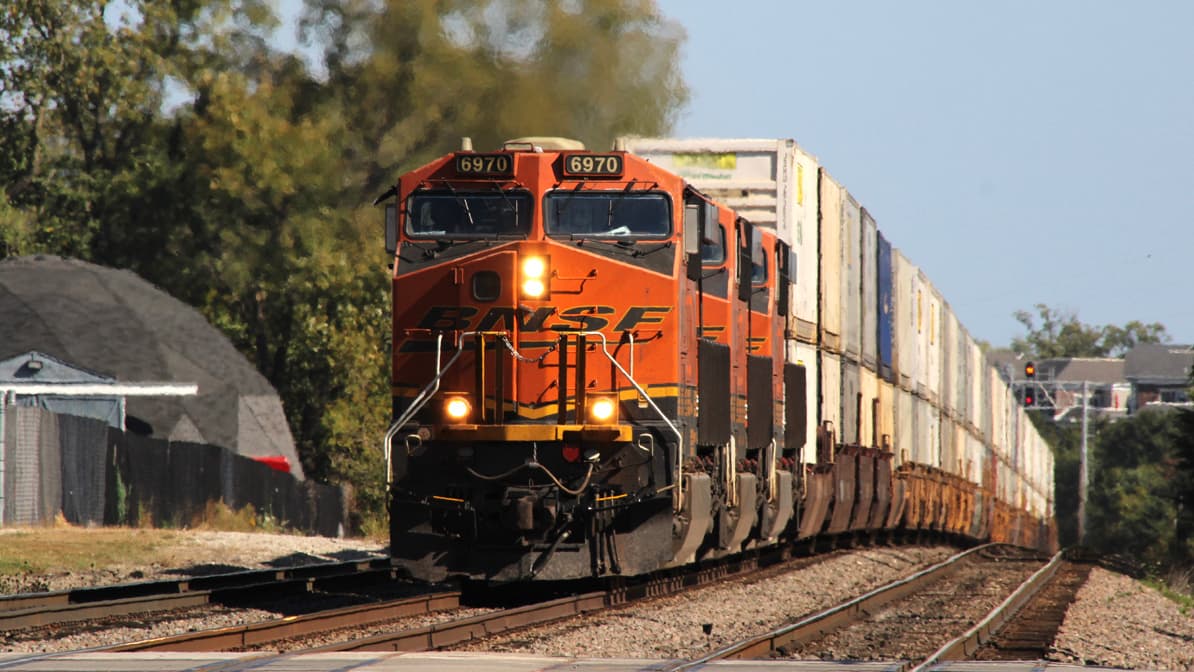

BNSF’s 2025 performance in hard numbers
BNSF reported a 2025 operating ratio of 65.5%, translating to an operating margin of 34.5% — about 5.7 percentage points behind western rival Union Pacific at 59.8%. In raw cash terms, each 1 percentage-point improvement in operating margin equates to roughly $230 million of additional operating cash flow for Berkshire Hathaway shareholders.
Key operational and financial metrics
| Metric | 2024 | 2025 |
|---|---|---|
| Operating ratio | 68.0% (implied) | 65.5% |
| Operating margin | 32.0% | 34.5% |
| Operating earnings | N/A | $8.05 billion (up 7.8%) |
| Net operating cash flow to Berkshire | ~$4.1 billion (5-year avg) | $8.1 billion produced; $4.4 billion returned |
| Revenue | N/A | $23.3 billion (flat) |
| Volume change (overall) | N/A | +0.3% vs 2024 |
Operational wins that didn’t fully move the needle
On the operational side, terminal dwell times fell and network transit sped up — shipments “spent less time idling at terminals” in 2025 than in nearly any prior year, according to company statements. Safety metrics remained strong and service reliability improved, which in freight logistics normally bodes well for both customer retention and yield. Still, these operational advances lifted operating margin only modestly above the five-year average.
Segment-level volume dynamics
- Consumer products (intermodal + automotive): +1.2%, driven by higher West Coast imports and a new intermodal customer.
- Industrial products: -4.6%, largely due to construction products, plastics, and petroleum product declines.
- Agriculture & energy: +3.2%, with higher grain exports and petroleum fuels offsetting some domestic declines.
- Coal: +1.1%, boosted by higher natural gas prices making coal more competitive for power generation.
Why the profitability gap matters for shippers and supply chains
From a logistics perspective, a railroad’s operating ratio is not just an accounting number — it influences pricing flexibility, capital investment, and ultimately the carrier’s ability to support network capacity during demand swings. A 5.7-point gap to an industry leader signals room for improvement in cost control, asset utilization, or service product mix.
Practical implications for freight and transport buyers
Smaller margins may constrain the railroad’s capital allocation for yard automation, intermodal ramp improvements, or locomotive and freight car purchases — all items that directly affect shipment speed, container turnaround and on-time delivery. For logistics planners, that means keeping an eye on transit time variance, spot rates for intermodal lanes, and alternative routing via truck or barge when rail service is stretched.
Where the margin lift could come from
Closing the gap will likely require a combination of:
- Further productivity gains: more terminal automation and better train length and crew utilization.
- Service differentiation: premium intermodal and tailored solutions that command higher yields.
- Cost discipline: permanent reductions in operating expense without degrading service.
- Network optimization: reallocating capacity to higher-margin traffic and pruning low-return lanes.
Short list of operational levers
| Lever | Expected outcome |
|---|---|
| Terminal dwell reduction | Faster turns, higher asset utilization |
| Longer train consists | Lower crew and fuel cost per ton |
| Intermodal ramp investments | Increased container throughput and premium service |
| Targeted pricing | Improved yield, better margin on specialty lanes |
Autonomy, leadership change, and the message from the top
Greg Abel, who succeeded Warren Buffett as Berkshire Hathaway CEO in January, signaled continuity in the conglomerate’s approach: subsidiaries maintain a high degree of autonomy, but performance expectations are clear. The message is simple — do the operational work and translate it into better financial returns. As Abel noted, the team will be “disappointed” if substantial improvement is not delivered in the coming years. No fluff — cut to the chase and produce results.
What shippers should monitor next
- Quarterly trends in BNSF’s operating ratio and operating margin.
- Changes in intermodal capacity, especially on West Coast import lanes.
- Yard productivity measures and locomotive utilization rates.
- Spot versus contract rate spreads that could indicate pricing power shifts.
It’s worth remembering that the railroad delivered strong free cash flow in 2025 — $8.1 billion in net operating cash flows with $4.4 billion returned to Berkshire — which provides runway for targeted improvements. Still, the proof is in the pudding: operational gains must be monetized.
Highlights: the core takeaways here are straightforward — BNSF improved service and safety in 2025, but the improvements translated to only a modest uptick in operating margin. That margin shortfall versus Union Pacific matters because each incremental margin point equals significant operating cash flow, and that cash underpins investments that affect freight velocity, container turnover, and overall network reliability. On GetTransport.com, you can order your cargo transportation at the best prices globally at reasonable prices. The story’s regional importance is clear: it will mainly reshape U.S. rail economics and intermodal dynamics rather than rewrite global shipping markets. Still, for carriers, forwarders, and shippers who rely on U.S. rail corridors, the development is relevant — and GetTransport.com aims to stay abreast of these shifts while keeping pace with the changing world. Book your Ride GetTransport.com.com
To wrap up, BNSF’s 2025 results show tangible operational progress but also a reminder that improving safety and throughput is only half the battle; converting those gains into a stronger operating margin is essential. For logistics professionals this means watching for changes in capacity, pricing, and service that affect cargo, freight, and shipment planning. Whether you manage parcel flows, full-container loads, pallets, bulky freight, or whole-house relocation moves, the railroad’s ability to lift margins will influence transport costs, forwarding choices, haulage options, and distribution reliability for years to come. GetTransport.com provides an efficient, cost-effective, and convenient way to address these shifting needs — simplifying shipping, moving, and transport choices for businesses and individuals alike.